 THEBUSINESSBYTES.COM Fast. Focused. Future-ready


Jayajit Dash
When Elon Musk promised to slash up to $2 trillion from the federal budget as head of the newly minted Department of Government Efficiency (DOGE), the breathless media coverage treated it as another chapter in the Tesla CEO’s disruptive genius narrative. What we witnessed instead was a spectacular case study in why running government like a Silicon Valley startup is not just naïve, it’s dangerous.
The math alone should have been a warning. Musk’s initial $2 trillion target represented roughly half the entire federal budget, a figure so divorced from fiscal reality that even his own team quietly walked it back to $150 billion before settling on a still-dubious $160 billion. This wasn’t ambitious leadership; it was the kind of magical thinking that would get a corporate CFO fired. But when you are the world’s richest man with direct access to the Oval Office, apparently basic math becomes optional.
The real scandal wasn’t Musk’s innumeracy – it was the breathtaking conflict of interest that everyone pretended not to see. Here was a man whose companies hold $22 billion in government contracts, wielding unprecedented influence over the very agencies that regulate his business empire. While Musk played government efficiency czar, his companies mysteriously saw a $2.37 billion reduction in regulatory scrutiny. This wasn’t reform; it was regulatory capture with a libertarian bow tie.
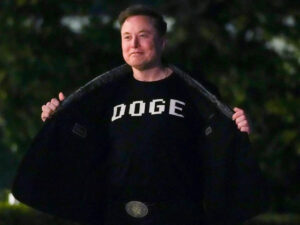 DOGE’s modus operandi revealed the fundamental hollowness of the efficiency rhetoric. Mass firings, chaotic buyout schemes, and ham-fisted attempts to access sensitive Treasury data weren’t signs of streamlined government – they were the thrashing of an organization that confused disruption with competence. When courts had to step in to block DOGE from accessing taxpayer records and reverse its more egregious personnel decisions, it became clear that Musk’s team had about as much understanding of constitutional governance as a first-year law student.
The human cost of this governmental LARP (Live Action Role Playing) was borne not just by confused federal employees, but by Musk’s own shareholders. Tesla’s profits plummeted 71per cent as Musk’s political theatre alienated the very customers who had made his electric vehicle empire possible. The bitter irony is hard to miss: while Musk lectured about government efficiency, his own company was hemorrhaging money because its CEO was too busy playing Washington insider to mind the store.
Perhaps most revealing was DOGE’s staffing strategy flooding federal agencies with young tech workers who possessed abundant confidence and zero understanding of how government actually functions. These digital natives, raised on the myth that government is just another platform to be optimized, crashed headfirst into the reality that democratic institutions weren’t designed to be “hacked” by coding bootcamp graduates. Their frustration at being “unfairly criticized” revealed a stunning tone-deafness about public accountability.
The Trump administration’s eventual distancing from Musk publicly emphasizing that agency heads, not the DOGE chief, had final authority, was the ultimate repudiation of the efficiency experiment. Even within a White House not known for institutional restraint, Musk’s approach was deemed too reckless, too self-serving, too divorced from political reality.
But the real damage extends beyond budget numbers or bureaucratic reshuffling. Musk’s DOGE tenure normalized the idea that democratic governance is just another failing startup awaiting Silicon Valley salvation. This techno-solutionist fantasy doesn’t just misunderstand government, it actively undermines the painstaking work of building accountable public institutions.
The promise of radical efficiency under Elon Musk’s leadership at DOGE ultimately fell short of its ambition. While the initiative sought to streamline government operations, many inside the system such as Treasury officials raised concerns over the access granted to external consultants without adequate public-sector experience. Meanwhile, Tesla customers witnessed the brand’s public image shift dramatically, becoming entangled in divisive political narratives that strained its appeal.
For federal employees, the reforms often felt more like political theatre than sustainable policy change. The experience highlights the risks of equating private-sector success with public-sector governance. Musk’s tenure at DOGE serves as a cautionary tale: when ambition outpaces accountability, both institutions and reputations can suffer. Far from draining inefficiencies, the effort left behind more questions than clarity about priorities, transparency, and the boundaries between business and statecraft.
DOGE didn’t just fail. It showcased what happens when ego overrides expertise, when ambition outruns accountability, and when one man’s empire-building fantasy collides with the architecture of democracy. The lesson is clear: revolution is no substitute for reform, especially when it serves the self more than the state.
(Jayajit Dash is an engaging content writer who excels in crafting articles at the intersection of technology and policy ecosystems. With a talent for presenting emerging technologies in a clear and understandable manner, he brings valuable insights to lay readers. Currently, he serves as a Senior Manager in Corporate Communications at Bhubaneswar-headquartered IT consulting company CSM Technologies.)


Leave a Reply