 THEBUSINESSBYTES.COM Fast. Focused. Future-ready

THEBUSINESSBYTES BUREAU
BHUBANESWAR, AUGUST 27, 2025
History often highlights well-known public figures, but the tireless efforts of behind-the-scenes visionaries often go unnoticed. A notable example is Sir Dorabji Tata, a man whose passion and dedication helped bring his father’s dream of a vibrant, self-sufficient India to life.
Sir Dorabji was not only a pioneering businessman but also a devoted patriot. He played a critical role in establishing India’s first steel plant in the challenging terrain of Chhota Nagpur, setting in motion the country’s industrial growth. The foundation of this now iconic plant was laid with a letter from P.N. Bose, a geologist working for the Maharaja of Mayurbhanj, Odisha. Bose’s discovery of iron ore deposits in the Gorumahisani hills led him to write to J.N. Tata, the founder of the Tata Group and father of Dorabji, on February 24, 1904.
True to his father’s vision, Sir Dorabji Tata embarked on a months-long exploration of Odisha and the Central Provinces, braving dense forests and rugged terrain. His efforts led to the discovery of the perfect location — a confluence of the Swarnarekha and Kharkai rivers — where he would ultimately establish the foundation for India’s steel industry.
Following this, the King of Mayurbhanj, Sriram Chandra Bhanjdeo, granted the Tata Iron and Steel Company Limited (now Tata Steel) a lease for the Gorumahisani iron ore mines. This agreement, signed in the early 1900s, paved the way for the steel plant’s creation, marking a new chapter in India’s industrial journey.
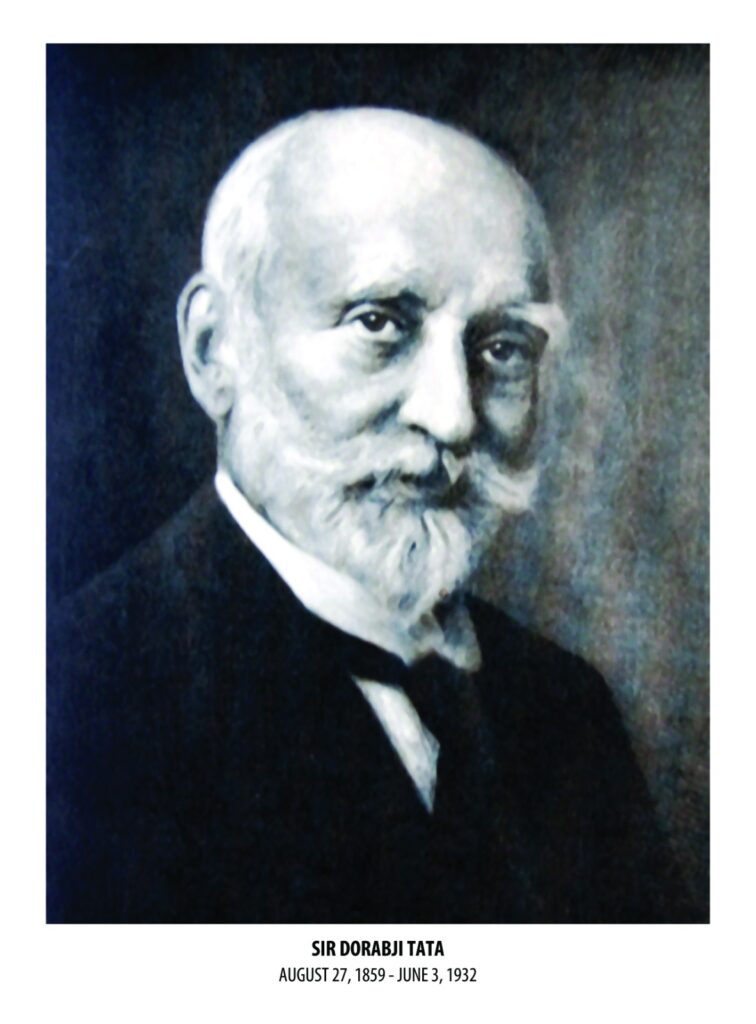 Sir Dorabji Tata’s leadership was pivotal in the success of Tata Steel. His vision, determination, and guidance steered the company through its formative years, ensuring its growth into a major industrial powerhouse. But his contributions went far beyond steel. As a compassionate leader, he championed the welfare of his workers, upholding his father’s ideals of fair treatment and respect. When a labor strike broke out in 1920, Sir Dorabji personally visited Jamshedpur, listened to the workers’ grievances, and played a key role in peacefully resolving the conflict. His dedication to the company was so profound that he and his wife, Lady Meherbai, even pledged their personal wealth — including her Jubilee Diamond — to help sustain the company during tough times.
Sir Dorabji’s vision extended beyond the steel industry. He spearheaded the development of hydroelectric power stations in the rugged Western Ghats, transforming India’s energy sector and fostering greater industrialization. He also played a crucial role in establishing Tata Power in 1911, a landmark move that laid the foundation for India’s clean energy future.
His influence within the Tata Group was transformative, helping to shape the organization into the largest business house in India. For his immense contributions to the nation’s industrial development, Sir Dorabji was knighted in 1910.
A true visionary, Sir Dorabji was deeply committed to harnessing India’s natural resources. He embraced his father’s ambition to tap into the Western Ghats’ water resources for hydroelectric power, helping to make Tata Power a reality. Sir Dorabji’s philanthropic spirit was equally profound. He played an instrumental role in the founding of the Indian Institute of Science in 1909, a pioneering institution that has since contributed significantly to India’s progress in science and technology.
He also established the Sir Dorabji Tata Trust, driven by his belief in using wealth for the betterment of society. Inspired by his father’s philanthropic legacy, the Trust has been instrumental in founding key institutions such as the Tata Institute of Social Sciences, the Tata Memorial Centre, and the Tata Institute of Fundamental Research. These institutions continue to serve the nation, impacting countless lives and contributing to a brighter future.
Sports played an important role in Sir Dorabji Tata’s nation-building philosophy. Building on his father’s guidance, who had once instructed Dorab to reserve land for football, hockey, and parks in the newly developed Sakchi (now Jamshedpur), Sir Dorabji nurtured a tradition of integrating sports into the Tata ethos. Motivated by a desire to see an Indian team compete at the Olympics, Sir Dorabji financed India’s first Olympic team for the 1920 Antwerp Games, despite the absence of an official Indian Olympic body. In 1924, he secured India’s place at the Paris Olympics and was appointed to the prestigious International Olympic Committee.
Today, Tata Steel remains a key player in promoting sports across India, continuing the legacy of Sir Dorabji Tata’s commitment to athletic excellence.
As we commemorate his 166th birth anniversary, we remember Sir Dorabji Tata not just as a successful businessman but as a true nation-builder — a pioneer who laid the foundation for a brighter, more prosperous India. His story is a reminder that the true heroes of history often work quietly behind the scenes, building a better future for all.


Leave a Reply