 THEBUSINESSBYTES.COM Fast. Focused. Future-ready

THEBUSINESSBYTES BUREAU
MUMBAI, OCTOBER 27, 2025
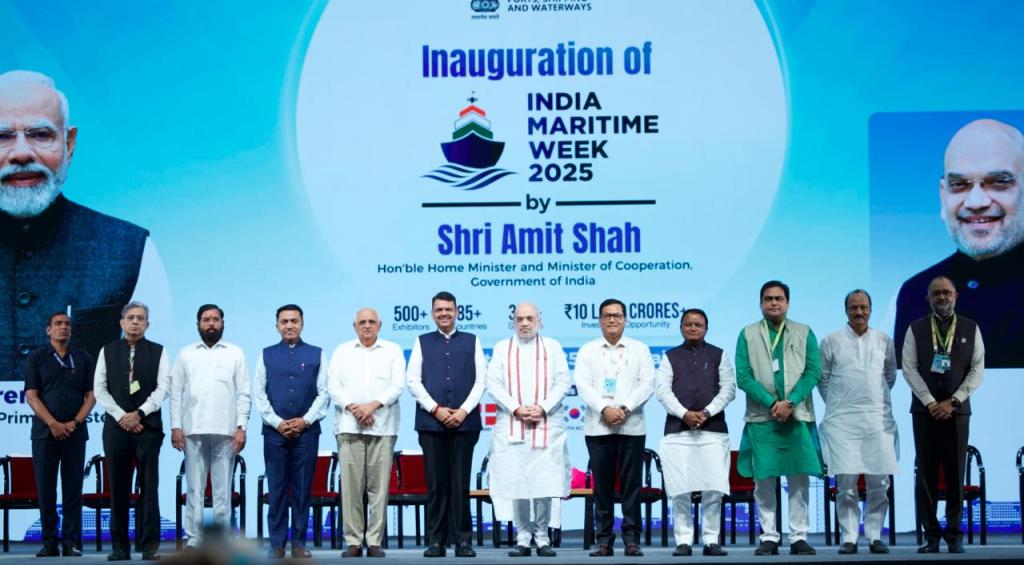
Union Minister for Home Affairs and Cooperation Amit Shah on Monday inaugurated India Maritime Week (IMW) 2025 at the NESCO Exhibition Centre in Mumbai, marking the grand opening of what is being hailed as the world’s largest maritime gathering. The five-day event, held under the theme “Uniting Oceans, One Maritime Vision,” has drawn over one lakh participants from 85 countries, featuring 500 exhibitors, 350 speakers, and 12 concurrent conferences and exhibitions — a resounding testament to India’s rising prominence in the global maritime arena.
In his inaugural address, Amit Shah declared that the maritime sector represents the nation’s “strength, stability, and sustainability,” underscoring that India’s rich maritime legacy is now evolving into a dynamic force of global cooperation. “This is India’s maritime moment — one that is transforming the Gateway of India into the Gateway of the World,” he said. “Due to the deep structural reforms initiated by Prime Minister Narendra Modi ji, India today stands as an emerging force on the global maritime map.”
Shah highlighted India’s strategic coastal and oceanic advantages, noting that the country’s 11,000-kilometre coastline, 13 coastal states, and 23.7 lakh sq. km Exclusive Economic Zone make it a natural maritime power. “Around 60 percent of our GDP is contributed by coastal states, and nearly 800 million people depend on the sea for their livelihood,” he said. Positioning India as a bridge between the Indo-Pacific and the Global South, Shah emphasised that maritime cooperation — not competition — will define the future. “Our maritime policy, guided by the Prime Minister’s vision of MAHASAGAR (Mutual and Holistic Advancement for Security and Growth Across Regions), seeks to build a green maritime future rooted in harmony with nature,” he added.
 Union Minister for Ports, Shipping and Waterways Sarbananda Sonowal described IMW 2025 as “a turning point in India’s maritime journey,” reaffirming the government’s resolve to position India among the world’s leading maritime powers through bold reforms, digitalisation, and record investment. “India currently handles about 10 percent of seaborne trade, and our goal is to triple it by 2047,” he said. “This will be supported by a fourfold increase in port capacity and the development of deep-draft mega ports.”
Sonowal highlighted that India’s port capacity has nearly doubled to 2,700 MTPA, cargo handling has increased to 1,640 MMT, and inland waterways cargo has expanded from 6.9 MMT to over 145 MMT in the last decade. The number of Indian seafarers, he noted, has grown by 200 percent, reaching 3.2 lakh. “Under the visionary leadership of Prime Minister Modi ji, India is not just keeping pace — India is setting benchmarks,” he said. “With ₹10 lakh crore worth of investment commitments and participation from 85 countries, IMW 2025 stands as a global vote of confidence in India’s maritime leadership.”
Minister of State for Ports, Shipping and Waterways Shantanu Thakur underlined India’s focus on sustainability, innovation, and human resource development. “India is building a smart, sustainable, and globally competitive maritime ecosystem that empowers industry, protects the environment, and connects Bharat to the world,” he said.
The inaugural day saw a series of high-level ministerial and bilateral sessions, with significant discussions on shipbuilding, green ports, and logistics cooperation held with Sri Lanka, the Netherlands, and Saudi Arabia. The Plenary Session featured a distinguished lineup of global maritime leaders, including Anthony Smith Jr. (Antigua and Barbuda), Magdalene Dagoseh (Liberia), Dr. Arvin Boolell (Mauritius), Robert Tieman (Netherlands), Marianne Sivertsen Næss (Norway), Anura Karunathilaka (Sri Lanka), Aung Kyaw Tun (Myanmar), Dr. Rumaih Al-Rumaih (Saudi Arabia), and Lee Hyun (South Korea). The leaders called for shared responsibility, sustainable innovation, and inclusive growth in advancing a resilient blue economy.
Adding intellectual depth to the event, the Centre for Maritime Economy & Connectivity (CMEC) hosted the Amrit Kaal Sessions on ship registration and financing, engaging policymakers, financiers, and shipowners from around the world. Maritime-rich states such as Maharashtra, Gujarat, Odisha, Goa, and the Andaman & Nicobar Islands showcased port-led development projects and blue economy initiatives aligned with the Maritime Amrit Kaal Vision 2047.
A key highlight of the day was “Sagarmanthan: The Great Oceans Dialogue” at the Jio World Convention Centre, a thought-leadership forum featuring diplomats, strategists, and maritime experts who explored global connectivity, sustainability, and ocean governance.
The inaugural ceremony was attended by Maharashtra Chief Minister Devendra Fadnavis, Gujarat Chief Minister Bhupendrabhai Patel, Goa Chief Minister Dr. Pramod Sawant, Odisha Chief Minister Mohan Saran Majhi, and Maharashtra Deputy Chief Ministers Eknath Shinde and Ajit Pawar, alongside global delegates, industry leaders, and maritime students.
Running through October 31, India Maritime Week 2025 will feature over 100 thematic sessions, CEO roundtables, and ministerial dialogues. The event reaffirms India’s civilisational ethos of Vasudhaiva Kutumbakam — “the world is one family” — as it connects nations through shared maritime aspirations and global partnerships.


Leave a Reply