 THEBUSINESSBYTES.COM Fast. Focused. Future-ready

THEBUSINESSBYTES BUREAU
BENGALURU, NOVEMBER 18, 2025
In a breakthrough that is being hailed as one of the most significant advancements in neurosurgical safety research in recent years, Dr. Mohana Rao Patibandla — Chief Neurosurgeon and CMD of Dr Rao’s Hospital, Guntur — presented India’s largest intraoperative neuro-monitoring (IONM) study at SIONCON 2025, held at the NIMHANS Convention Centre in Bengaluru. The landmark analysis, covering 1008 neurosurgical cases, has positioned Dr Rao’s Hospital among the country’s elite centres with extensive, rigorously documented IONM data.
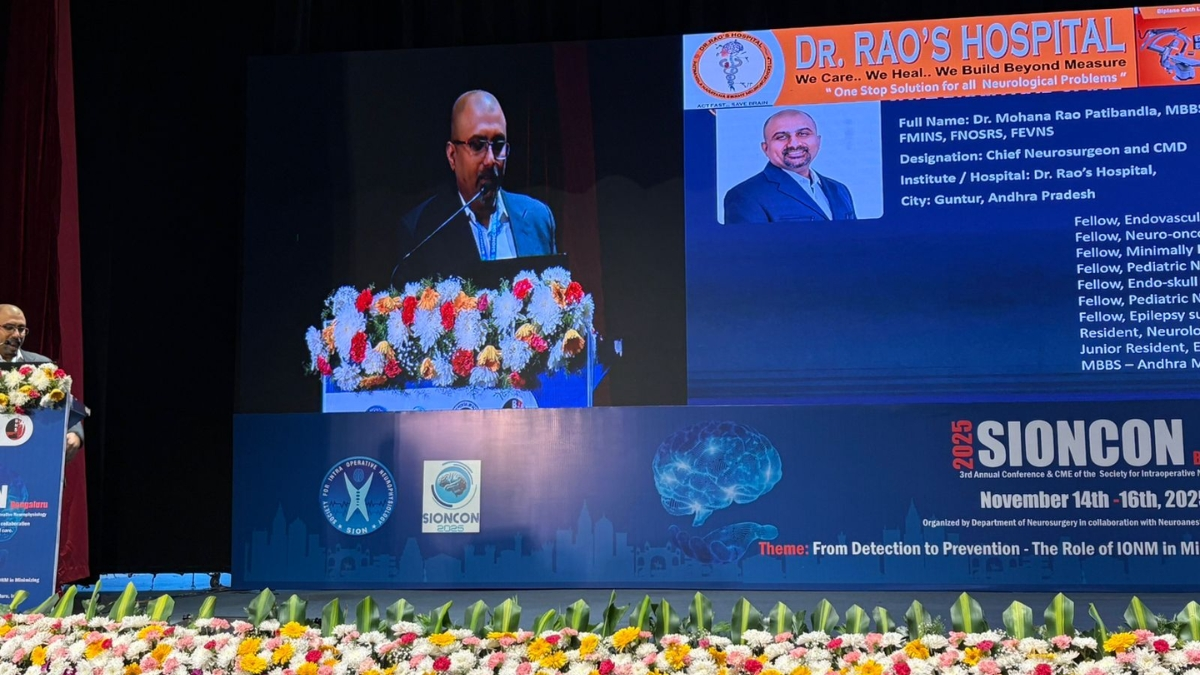 Spanning five years of brain, spine, pediatric and epilepsy surgeries, the study reinforces the transformative role of structured, multimodal IONM in reducing neurological complications during high-risk procedures. Highlighting the shift in modern neurosurgical practice, Dr. Rao noted that neuromonitoring has “moved beyond being a supportive tool” and now anchors real-time decision-making in the operating room. “IONM allows surgeons to operate with precision instead of uncertainty. Our 1008-case experience shows that neurological safety is measurable, predictable, and protectable,” he said.
The study’s metrics underline this impact with remarkable clarity, reporting an 85.7% sensitivity and 98.8% specificity in detecting neurophysiological changes. It further documented a 78.5% neurological deficit prevention rate, a 94% recovery rate among patients with transient postoperative deficits, and only 0.7% permanent signal loss—cases in which staged closure was employed to avert further injury. At the three-month mark, 91.6% of patients achieved functional independence with a Karnofsky Performance Status (KPS) of 80 or above. Experts at the conference emphasized the rarity of such numbers, especially for centres handling high volumes of complex skull base, spine, pediatric and eloquent-area brain tumor surgeries.
A notable highlight of the study was the superior outcomes reported in pediatric neurosurgery and awake craniotomy. Children undergoing epilepsy and tumor surgeries recorded faster recovery due to higher neuroplasticity, while awake brain surgeries—performed in 227 patients — showed no long-term complications and minimal transient disruptions. The research also validated staged closure as a safe and effective strategy; of the 26 cases where surgeries were paused to prevent neurological injury, 73% of patients regained significant neurological function after corrective steps.
SIONCON 2025, organised by the Society for Intraoperative Neurophysiology, brought together leading neurosurgeons and neurophysiologists from across India. Dr. Rao’s session quickly emerged as one of the most discussed for its unprecedented scale and practical insights into real-time surgical safeguarding. Stressing the urgency of national adoption, Dr. Rao said, “If India wants global outcomes, we need global protocols. IONM is not a luxury — it is essential for preventing avoidable disability.”
Dr Rao’s Hospital in Guntur, long recognized for its expertise in advanced neurosurgery, neuro-oncology, spine surgery and minimally invasive skull base interventions, continues to strengthen its position as a regional leader in IONM-driven surgical safety. With this landmark study, the institution adds a significant chapter to India’s neurosurgical research landscape while setting new benchmarks for patient protection and evidence-based surgical practice.


Leave a Reply