 THEBUSINESSBYTES.COM Fast. Focused. Future-ready

THEBUSINESSBYTES BUREAU
BHUBANESWAR, SEPTEMBER 21, 2025
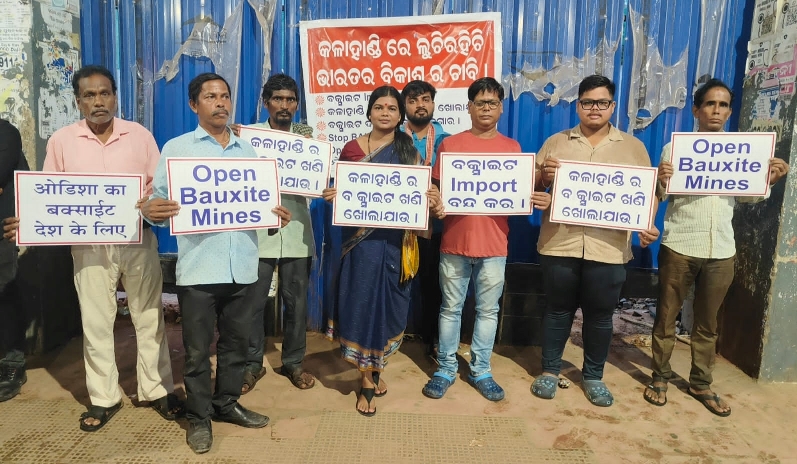
The voices of Kalahandi echoed through the streets of Bhubaneswar as villagers staged traditional street plays demanding inclusive growth and responsible use of Odisha’s resources. Their plays told the poignant story of a land rich in bauxite yet deprived of opportunity. Performed by the Rusi drama company, the villagers pressed for the long-delayed Gram Sabha to be convened, enabling sustainable opening of bauxite mines that could generate jobs, improve infrastructure, and reduce India’s dependence on costly imports for aluminium production.
At Master Canteen Square and Bomikhal Durga Mandap, passersby were drawn to the drumbeats, songs, and stirring dialogues of Kalahandi. The performances underscored the irony that while the district sits atop one of India’s largest bauxite reserves, its people still struggle with poor healthcare, limited education, and scarce employment. In sharp contrast, India continues to import nearly 4.5 million tonnes of bauxite annually, at an expense exceeding ₹4,000–5,000 crore.
??????????????
The street plays put forward a strong argument for harnessing Odisha’s vast bauxite reserves — estimated at more than 5 billion tonnes — to power both regional transformation and national progress. With a unified voice, the villagers demanded the Gram Sabha’s immediate convening to initiate responsible mining under ecological and social safeguards. Citing the 2008 Supreme Court judgment that empowers community participation and directs 5% of mining profits to the three lakh people of Kalahandi, the performers highlighted how sustainable mining could pave the way for schools, hospitals, roads, and dignified livelihoods.
First staged in Ullisirka, Narla, and Samarkata villages, the plays carried the same cry for justice to Odisha’s capital. Thousands of onlookers stopped to watch, applaud, and join the chorus, amplifying the demand that the state’s own resources fuel its development and future. Through folk music and biting humour, the plays raised a pressing question: *“When our soil holds such wealth, why do our villages remain poor? Why must our youth migrate to cities while our mati’s dhan (wealth of the soil) is sold away?”*
The performances reminded audiences that if conducted with responsibility, mining could reverse this reality — keeping children in schools, doctors in hospitals, and youth employed within their homeland. The artists invoked Justice S.H. Kapadia’s 2008 ruling, which promised both environmental safeguards and a 5% local profit share, crystallising their call with the slogan: “Kholo khadaan, karo vikas!” (Open the mines, bring development).
Performer Arundhati Misra captured the sentiment: “For us, mining is more than just jobs. It is dignity, the power to keep our children in our villages, and the right to decide our own future. With safeguards in place, mining can become our strength, not our loss.”
Many spectators expressed shock at the contrast between Odisha’s mineral wealth and Kalahandi’s deprivation. Bhubaneswar resident Srikant Gaud said, “The play moved me deeply. It is surprising that when our state has such rich reserves, they remain untapped. Mining here can finally deliver the development people have long awaited.”
The performances concluded with a powerful pledge, echoed by artists and spectators alike: “Apni mati ka dhan, sabka kalyan! Odisha ka bauxite, Bharat ka bhavishya!” (Our soil’s wealth for everyone’s welfare! Odisha’s bauxite for India’s future!).
Earlier, more than 5,000 Kalahandi residents had organised a large-scale protest in their villages, eliciting assurances from MLAs of Lanjigarh, Rayagada, and Dharmagarh constituencies. The issue has since gained momentum, with public figures, opinion leaders, and influencers extending their support.
By bringing their message from rural bus stops to Bhubaneswar’s busy streets, the people of Kalahandi signalled that this is no longer a local issue — it is a national priority. They urged policymakers to act decisively by convening the Gram Sabha, commencing responsible mining, and allowing Kalahandi’s wealth to create prosperity for its people and for India.


Leave a Reply