 THEBUSINESSBYTES.COM Fast. Focused. Future-ready

THEBUSINESSBYTES BUREAU
BHUBANESWAR, MAY 5, 2025
Odisha’s immense mineral wealth, particularly in bauxite, iron ore, and coal, holds the key to transforming the state into an economic engine for India’s self-reliant future, according to a new Whitepaper released by AIDENT (An Initiative for Development & Empowerment). Titled “Mining Odisha’s Potential: Powering India’s Journey to Atmanirbharta and Prosperity,” the report calls for urgent and bold reforms to unlock the state’s underutilised mining potential and pivot towards inclusive, sustainable, and industrial-led development.
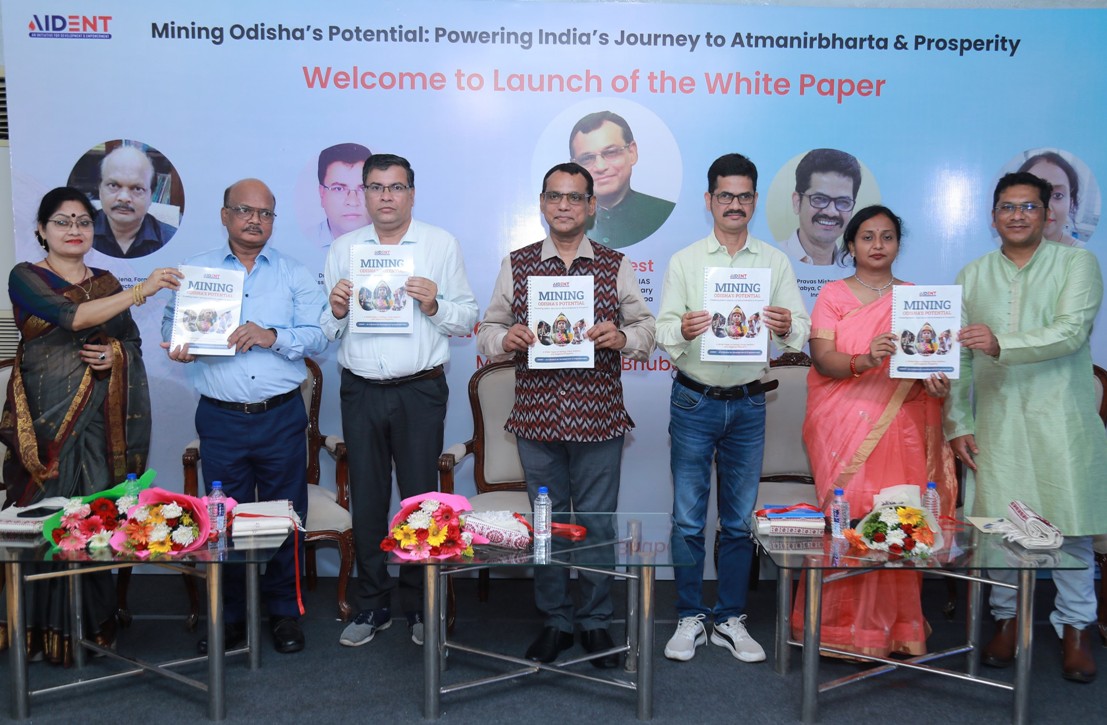
At the unveiling event, held in Bhubaneswar on Monday, thought leaders and policy experts agreed that Odisha’s mineral sector represents the most powerful lever for catalysing investments, generating large-scale employment, strengthening infrastructure, and enhancing India’s global competitiveness. However, despite its vast resource base, Odisha has only scratched the surface. Key challenges — such as procedural bottlenecks, underutilisation of resources like bauxite, lack of local value addition, inter-state wealth drainage, and execution delays — continue to constrain the sector’s transformative power. Experts argue that with timely intervention, the state can avoid repeating the mistakes of the past and ensure future generations inherit not only a rich soil but a legacy of shared progress, world-class institutions, and enduring prosperity.
“Odisha is at a now-or-never moment. It is about transformation and converting God-given resources into people-centred growth. We should ensure that the next generation of Odiyas inherit not just the legacy of rich soil, but the legacy of inclusive progress, world-class institutions, and enduring prosperity. At this pivotal moment, the leadership of Chief Minister Mohan Charan Majhi offers a strong foundation to translate Odisha’s mineral strengths into inclusive industrialisation and regional upliftment,” said Jayadev Sarangi, former Secretary to the Governments of Delhi and Goa, while formally launching the Whitepaper. Sarangi emphasised that the report is not merely a commentary on Odisha’s potential — it is a roadmap to elevate Odisha from being a mere resource supplier to a globally competitive value creator, especially under a development-focused state government that is actively aligning with Prime Minister Narendra Modi’s vision of 100 per cent value addition.
The Whitepaper outlines a comprehensive, phased roadmap for Odisha’s industrial and economic transformation. In the short term, it recommends simplifying regulatory frameworks and resolving mining clearances expeditiously. In the medium term, it proposes targeted investments in the creation of integrated mineral corridors and manufacturing clusters. Over the long term, it envisions Odisha’s positioning as a global hub for green aluminium, advanced steel production, and critical minerals essential for energy transition, defence, and transportation. This forward-looking strategy builds on Odisha’s natural advantages while addressing structural issues that have hindered inclusive development.
 Odisha’s mineral reserves are among the richest in the world. The state holds 35 per cent of India’s iron ore and 59% of its bauxite, along with significant deposits of coal, chromite, and manganese. These reserves are vital not only for Odisha’s economic future but also for India’s mineral security and industrial competitiveness. The Whitepaper highlights that Odisha has already emerged as one of India’s fastest-growing regional economies, largely due to a pivot towards mining and manufacturing. However, the benefits have not been equally shared. Local communities in mineral-rich districts such as Kalahandi remain underserved despite housing some of the state’s most valuable resources. The report calls for the immediate opening up of bauxite mining in such regions, not only to spur local employment and infrastructure but also to ensure that mining-led development directly improves livelihoods and quality of life for affected populations.
According to Sarangi, “Odisha’s mineral wealth is a national asset. However, unless we create strong forward linkages and inclusive development frameworks, we risk missing another generation of opportunity. This Whitepaper provides a practical and timely blueprint for Odisha’s transition from a resource supplier to a value creator.”
The report argues that Odisha’s current development model, though revenue-generating, remains flawed. A significant portion of extracted ore continues to be exported in raw or semi-processed form, leading to the loss of value creation, job opportunities, taxation potential, and reinvestment for local economies.
A glaring example is the ongoing import of bauxite from Guinea, China, and other countries to meet India’s domestic demand — despite Odisha having the largest deposits. The report asserts that industries which have already made significant investments in Odisha should be given first access to the state’s mineral resources. This would not only eliminate unnecessary import costs but also boost India’s economic sovereignty. Estimates from the Whitepaper reveal that fully unlocking Odisha’s bauxite potential alone could empower over 10,000 small and medium enterprises (SMEs), create approximately 2.4 million direct and indirect jobs, and attract multi-billion-dollar investments in downstream industries.
Speaking at the event, Sanjeev K Singh, State Program Manager at AIDENT, said, “This is not just a policy document — it’s a blueprint for generational change. If implemented, the recommendations in this paper can make Odisha the epicenter of India’s next industrial revolution while ensuring tribal communities, women, and youth are central to the prosperity it creates.” He emphasised that the mineral sector’s future success lies not in extraction alone, but in building inclusive models of growth that empower communities and respect local ecosystems.
The Whitepaper also presents a compelling case for coupling mining with structured community participation. In districts such as Rayagada and Kalahandi, responsible mining has already generated indirect employment for more than 7,000 people. Development funds from the Rs 12,000 crore-plus District Mineral Foundation (DMF) corpus have been channelled into essential public services. These include the construction of residential schools, primary health centres, mobile health units, and women’s self-help group enterprises. Scholarships for tribal youth, better maternal health services, and enhanced school enrolment are among the tangible social gains cited in the report. The Whitepaper recommends institutionalising such development models across all mining districts to ensure that mining drives long-term upliftment, not just GDP growth.
In his address, Pravas Ranjan Mishra, Founder of Kartabya – Centre for Social Innovation, underscored the importance of blending mineral policy with social innovation.
Dukhabandhu Sahoo, Associate Professor in Economics at IIT Bhubaneswar, highlighted the need to correct structural imbalances where mineral-rich states like Odisha lag behind industrially compared to resource-poor but policy-rich states such as Gujarat and Maharashtra.
Sipra Sagarika, Assistant Professor in Sociology at Fakir Mohan University, spoke about the role of inclusive mining policies in advancing gender equality, education, and health outcomes.
The Whitepaper comes at a critical time when Odisha is outperforming the national average in terms of economic growth and industrial output. With a state government now prioritising industrialisation, infrastructure expansion, and ease of doing business, Odisha has the rare opportunity to redefine its development trajectory.
The report closes with a strong call to action: Odisha doesn’t need more minerals — it needs smarter, people-first policies that convert those minerals into lasting prosperity.
As India marches towards its goal of economic self-reliance, the Whitepaper by AIDENT positions Odisha as not just a resource-rich state, but as a potential epicentre of a new era of industrial transformation — one that balances progress with inclusion, prosperity with sustainability, and growth with generational equity.


Leave a Reply