 THEBUSINESSBYTES.COM Fast. Focused. Future-ready

THEBUSINESSBYTES BUREAU
MUMBAI/PUNE, OCTOBER 7, 2025
With India’s solar photovoltaic (PV) waste projected to surge to nearly 200,000 tons by 2030 and 1.8 million tons by 2050, researchers at MIT World Peace University (MIT-WPU) have achieved a breakthrough in sustainability by developing and validating, through lab trials and industry collaboration, a scalable recycling process to tackle the nation’s mounting PV waste. The team has secured a Research Grant of INR 25 lakh from the Rajiv Gandhi Science & Technology Commission (RGSTC), Government of Maharashtra, to advance this pioneering initiative.
This innovative solution not only addresses India’s growing PV waste challenge but also supports the UN Sustainable Development Goals (SDGs) — Goal 9 (Industry, Innovation, and Infrastructure) and Goal 11 (Sustainable Cities and Communities) — by promoting circular industrial practices and greener urban development.
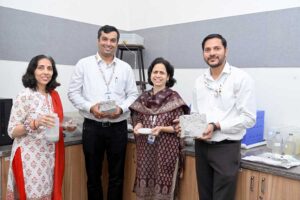 Currently, most discarded solar panels are either stored or partially dismantled for aluminum and cables, while valuable metals such as silver (Ag), copper (Cu), tin (Sn), and lead (Pb) are lost due to the complexity of separating their laminated, multi-layered structures. Recognizing this issue, a multidisciplinary team comprising Dr. Sarita R. Zele, Professor, Research and Development; Dr. Nivedita Gogate, Associate Professor, Civil Engineering; along with Dr. Deepti Marathe and Dr. Amrut Joshi, are leading this initiative at MIT-WPU. The project team also includes researchers Amar Shitole, Omkar Gajare, Neha Jadhav, Veda Shewalkar, Atharv Jagdale, Pranali Dhiware, Sameer Thamke, Anjali Gabhane, Sumit Dafe, Avanti Gulhane, Dhanashree Langhi, Ruturaj Jadhav, Ameya Bakal, and Chirag Sonawane.
The developed process enables recovery of valuable materials from end-of-life solar panels while upcycling non-recoverable fractions into eco-friendly construction products such as bricks, blocks, and aggregates. This dual-benefit approach not only prevents hazardous waste from entering landfills but also reduces dependence on virgin raw materials — fostering a closed-loop synergy between the renewable energy and construction sectors.
Dr. Sarita R. Zele, Professor, Research and Development, MIT-WPU, said, “Solar energy is one of the pillars of India’s clean energy transition, but its by-product — solar panel waste — is a growing concern. Our research provides a sustainable pathway that recovers valuable resources and transforms waste into useful construction products, ensuring that renewable energy remains genuinely green and environmentally responsible.”
Dr. Nivedita Gogate, Associate Professor, Civil Engineering, MIT-WPU, added, “Our innovation bridges renewable energy and construction, turning a waste challenge into an opportunity. By fostering industrial symbiosis, we reduce landfill burden, conserve natural resources, and promote a circular economy. We envision this model being scaled nationwide to make solar adoption truly sustainable.”
As India accelerates its solar power capacity under national clean energy commitments, MIT-WPU’s pathbreaking research ensures that today’s renewable infrastructure does not become tomorrow’s environmental challenge — reaffirming the university’s commitment to sustainable innovation and responsible technology.


Leave a Reply