 THEBUSINESSBYTES.COM Fast. Focused. Future-ready

THEBUSINESSBYTES BUREAU
BHUBANESWAR, SEPTEMBER 25, 2025
For years, the people of Odisha’s mineral-rich districts have done everything in their power to make their voices heard. They have marched in protest, submitted petitions to MLAs, and raised their demands in every forum available — amplified by social media until they trended nationally. From the red hills of Rayagada to the dusty squares of Kalahandi and the bustling streets of Bhubaneswar, Odisha’s people have transformed their struggle into performance, staging nukkad nataks (street plays) that blend song, satire, and dialogue. Each performance carries the same piercing refrain: why does India continue to import bauxite worth thousands of crores when Odisha’s hills already hold some of the world’s richest deposits?
The paradox is painful. “Odisha alone holds nearly 59 percent of India’s bauxite reserves, yet the country imports more than 4.5 million tonnes each year at a staggering cost of ₹4,000–5,000 crore. This undermines India’s march towards Atmanirbhar Bharat and weakens the vision of Viksit Bharat@2047,” noted Dr. Dukhabandhu Sahoo, Associate Professor of Economics at IIT Bhubaneswar. Aluminium, he pointed out, is indispensable for clean energy, defence, aerospace, and sustainable mobility. Yet, while Kalahandi and Rayagada sit atop billions of tonnes of bauxite — the very foundation of aluminium production — their communities wait, year after year, for the promise of development to materialize.
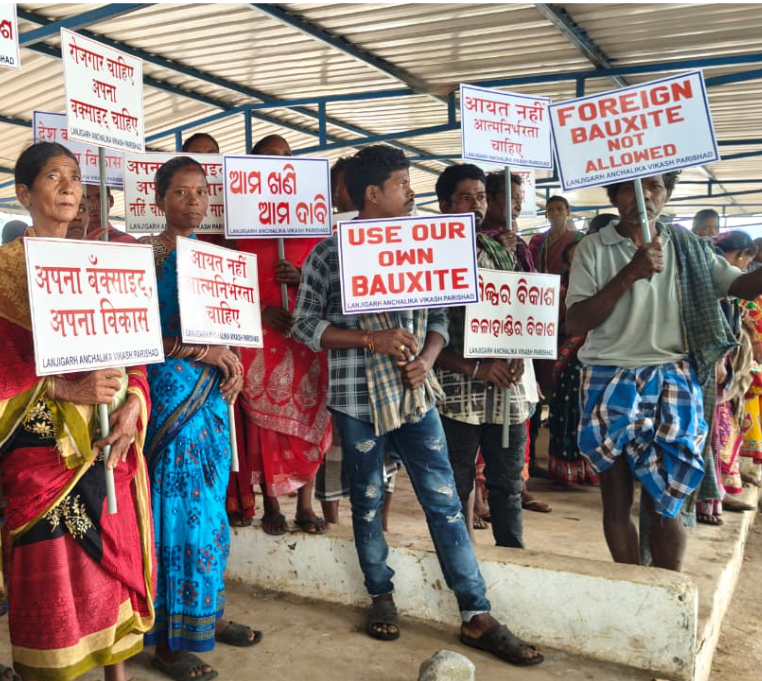 What makes this movement unique is its deeply cultural form of resistance. Through street theatre, folk performances, and song, villagers have asserted that mining is not merely about extracting minerals — it is about dignity, livelihoods, and shaping their collective future. As one performer declared, “This is not just about rocks and hills. It is about our children’s schools, our hospitals, and the chance to stand with pride.”
Their message aligns with the findings of the AIDENT Whitepaper, “Mining Odisha’s Potential: Powering India’s Journey to Atmanirbharta and Prosperity”. The report warned that Odisha stands at a “now-or-never” crossroads. Unlocking bauxite reserves, it argued, could empower more than 10,000 SMEs, create 2.4 million jobs, and attract multi-billion-dollar investments. Its appeal was unequivocal: convert “God-given resources into people-centred growth” so that the next generation inherits not just mineral wealth but a legacy of prosperity.
Legal and institutional voices have long echoed this urgency. Justice S.H. Kapadia’s landmark 2008 judgment required that at least five percent of mining profits be channelled directly into community development, while mandating strong ecological safeguards. Implemented faithfully, this model ensures that mining does not remain an extractive industry but evolves into an empowering force — funding schools, clinics, women-led enterprises, and local infrastructure, while also protecting fragile ecosystems.
“Protests, petitions, performances — the people of Odisha have already shown the way,” Dr. Sahoo emphasized. “The Whitepaper has laid out the roadmap. What remains is decisive action. The opening of bauxite mines is no longer only an economic imperative; it has become a cultural, social, and national necessity.”
The question, therefore, is no longer whether the message has been delivered — it has been, countless times, in chants, petitions, and street plays. The real question is how long the government can afford to ignore it. Can show-and-tell alone drive policy? Or will Odisha’s red hills continue to wait in silence, even as India dreams of becoming a self-reliant global power?
What remains now is not debate but action. Mining Odisha’s bauxite is no longer a matter of “if,” it is a matter of “when.” And every delay comes at a heavy price — measured not only in crores of rupees but in lost opportunities, stalled development, and weakened sovereignty. The people of Odisha have already given their answer. The ball now lies firmly in the nation’s court.


Leave a Reply