 THEBUSINESSBYTES.COM Fast. Focused. Future-ready

PRIYABRAT BISWAL
BHUBANESWAR, SEPTEMBER 23, 2025
For centuries, Ayurveda was regarded as a path people chose only when modern medicine reached its limits. It was the “last hope,” turned to with hesitation rather than confidence. But today, a quiet revolution is underway. The Indian government has set its sights on repositioning Ayurveda as the first line of treatment — a system rooted in ancient wisdom yet strengthened by modern science.
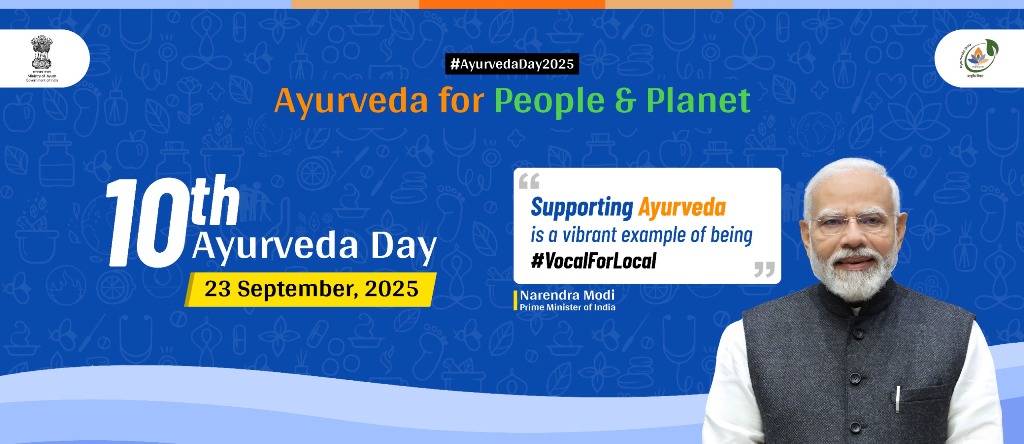 With September 23 now officially recognized as Ayurveda Day, the effort is gaining momentum worldwide. The occasion not only honours tradition but also seeks to carve a global identity for Ayurveda in modern healthcare systems. Earlier, Ayurveda-related events were linked to Dhanvantari Jayanti, celebrated on varying lunar dates each year. This inconsistency made it difficult for the practice to gain universal visibility. By fixing September 23 as Ayurveda Day, that barrier was removed. The date is not just practical but deeply symbolic: it falls on the equinox, when day and night are equal everywhere on Earth. Balance, after all, lies at the very heart of Ayurveda — balance of body, mind, spirit, and environment.
This year marks the 10th Ayurveda Day, celebrated under the theme “Ayurveda for People & Planet.” The message is clear: Ayurveda is not about preserving the past in isolation; it is about reimagining it with evidence, research, and global application. The Ministry of AYUSH emphasizes a strong integration of traditional knowledge with scientific validation to make therapies more reliable, accessible, and impactful.
 The past decade has already borne fruit. One shining example is BGR-34, an innovative formulation developed by the Council of Scientific and Industrial Research (CSIR). Using six medicinal herbs — Daruharidra, Giloy, Vijaysar, Gudmar, Manjistha, and Methi — the drug has shown remarkable efficacy in controlling diabetes and even reversing its progression. For a disease long deemed irreversible, this represents a breakthrough moment not only for Ayurveda but also for healthcare at large.
“Ayurveda Day is not just a celebration of tradition; it is the confluence of science and innovation,” said Dr. Sanchit Sharma, Executive Director of AIMIL Pharmaceuticals. “Medicines like BGR-34 demonstrate how traditional wisdom can be integrated with scientific research to create effective solutions tailored for the needs of modern patients,” he added.
This integration is part of a wider global shift. With chronic illnesses such as hypertension, obesity, and kidney disorders increasing at alarming rates, there is a renewed global appetite for plant-based, holistic solutions that minimize side effects and address the root causes of disease. Ayurveda’s time-tested remedies are finding fresh validation in this modern context.
Research is also extending Ayurveda into fields once thought beyond its scope. In Goa, the All India Institute of Ayurveda, in collaboration with the Tata Cancer Institute, is exploring Ayurvedic support in oncology. Early findings indicate that Ayurvedic formulations can significantly reduce the side effects of chemotherapy and radiation, opening new avenues in integrative cancer care.
The government’s vision is bold and transformative: Ayurveda should not be viewed as an “alternative,” but as a mainstream pillar of healthcare. With premier institutions such as CSIR and DRDO subjecting herbal formulations to rigorous testing, credibility is being reinforced step by step. Each new study, innovation, and patient success strengthens the case for Ayurveda’s rightful place in the modern healthcare ecosystem.
The shift is clear — Ayurveda is no longer content with being the medicine of last resort. It is stepping confidently into the role of first choice, blending its timeless wisdom with the rigor of modern science.


Leave a Reply