 THEBUSINESSBYTES.COM Fast. Focused. Future-ready

India Mobile Congress 2025 kicks off with vision of ‘Innovate to Transform’, showcasing India’s global digital leadership
THEBUSINESSBYTES BUREAU
NEW DELHI, OCTOBER 8, 2025
“Digital connectivity in India is no longer a privilege or a luxury — it has become an integral part of every Indian’s life,” said Prime Minister Narendra Modi while inaugurating the 9th edition of the India Mobile Congress (IMC) 2025, Asia’s largest telecom, media, and technology event, at Yashobhoomi, New Delhi on Wednesday.
Inaugurating the special edition of IMC, the Prime Minister lauded India’s growing technological prowess and the role of startups in shaping the nation’s digital future. “When I see startups presenting on themes such as financial fraud prevention, quantum communication, 6G, optical communication, and semiconductors, I am filled with confidence that India’s technological tomorrow is in capable hands,” he said, extending best wishes to innovators and industry participants.
Modi highlighted that the India Mobile Congress has rapidly evolved beyond mobile and telecom to become Asia’s largest digital technology platform, driven by India’s young innovators, researchers, and entrepreneurs. “This success story is powered by India’s tech-savvy mindset and the energy of its youth,” he asserted.
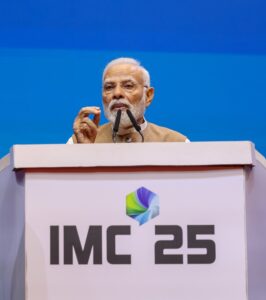
PM addressing at the inauguration ceremony of India Mobile Congress 2025 at Yashobhoomi, in Delhi on October 08, 2025.
Underscoring the government’s strong backing for indigenous innovation, the Prime Minister said initiatives like the Telecom Technology Development Fund and Digital Communications Innovation Square are funding startups working on next-generation technologies, while government-supported test beds for 5G, 6G, and advanced optical communication are enabling product development and research-industry partnerships. “Today, Indian industry, startups, and academia are collaborating seamlessly, creating intellectual property and contributing to global standards,” he noted.
Reaffirming India’s Atmanirbhar Bharat vision, Modi said, “India Mobile Congress and the nation’s telecom success reflect the strength of self-reliance.” He recalled that earlier regimes struggled for decades to adopt new technologies, but India has now transformed into a global manufacturing hub. Since 2014, electronics production has increased sixfold, mobile phone manufacturing has grown 28 times, and exports have surged 127 times, generating millions of jobs. Citing an example, he said a single global smartphone company now sources components from 45 Indian firms, creating over 3.5 lakh jobs.
Announcing a major milestone, the Prime Minister said, “India has joined the elite group of five countries with an indigenous 4G stack.” On the day of its launch, one lakh 4G towers were activated simultaneously, connecting over two crore citizens, many in remote regions. The Prime Minister also revealed that the Made-in-India 4G stack is export-ready, supporting India’s 6G Vision 2030 and boosting global digital partnerships.
He stressed the importance of a modern regulatory framework for India’s digital revolution, noting that the Telecommunications Act has replaced century-old laws with a facilitative regime that accelerates approvals, eases right-of-way permissions, and promotes investment. “The new law empowers, not restricts. It makes business easier and faster,” he said.
On cybersecurity, the Prime Minister assured that the government has strengthened anti-fraud laws, enhanced accountability, and improved grievance redressal systems. “Industry and consumers are both reaping the benefits of this safer digital ecosystem,” he added.
Highlighting India’s emergence as the world’s second-largest telecom and 5G market, Modi said the country’s unique combination of manpower, mobility, and mindset makes it a global leader. “India offers both scale and skill. Our youth are the fastest-growing developer population in the world,” he observed. With data costs cheaper than a cup of tea, he said, “India ranks among the top nations in per-user data consumption, proving that digital access is now a necessity, not a luxury.”
Calling India an investor-friendly destination, he declared, “This is the best time to invest, innovate, and make in India.” He highlighted opportunities spanning semiconductors, mobile manufacturing, electronics, and AI-driven startups, all reflecting India’s digital-first approach and global competitiveness.
Modi also pointed to semiconductor manufacturing, where India is building ten fabrication units to diversify the global supply chain. He urged Indian firms to seize the opportunity to become trusted global suppliers of telecom equipment and component design. “Why can’t Indian companies become reliable global design and manufacturing partners?” he asked, encouraging industry collaboration in critical areas like chipsets, sensors, and data infrastructure.
He further emphasized India’s potential to become a global data hub, citing growing investments in cloud and data center infrastructure amid rising concerns over data security and sovereignty. “Wherever the world faces bottlenecks, India can offer solutions,” he asserted.
Reiterating the synergy between startups and established players, the Prime Minister said, “India will be empowered by the speed of startups and the scale of established companies working together.” He expressed optimism that platforms like IMC would foster dialogue among innovators, academia, policymakers, and global industry leaders.
The event was attended by Union Minister Jyotiraditya Scindia, Minister of State Dr. Chandra Sekhar Pemmasani, and several industry leaders.
Jointly organised by the Department of Telecommunications (DoT) and the Cellular Operators Association of India (COAI), IMC 2025 will run from October 8–11 under the theme “Innovate to Transform”, showcasing India’s innovation-driven digital transformation. The event brings together over 7,000 global delegates, 400+ companies, and 1.5 lakh visitors from 150 countries, featuring 1,600 new use-cases, 100+ sessions, and 800+ speakers on cutting-edge topics such as 6G, quantum communications, AI, smart mobility, and green tech.
International delegations from Japan, Canada, the UK, Russia, Ireland, and Austria are participating, underscoring the event’s growing global relevance.
India Mobile Congress 2025 stands as a testament to India’s ambition to lead the next wave of digital innovation — transforming not just connectivity, but the future of communication itself.


Leave a Reply