 THEBUSINESSBYTES.COM Fast. Focused. Future-ready

THEBUSINESSBYTES BUREAU
NEW DELHI, OCTOBER 8, 2025
Union Minister for Communications Jyotiraditya M. Scindia on Wednesday said that “India will redefine satellite communications for humanity,” as he inaugurated the Satcom Summit on “Space Networks for Universal Connectivity” at the India Mobile Congress 2025. The summit brought together leading figures from India’s telecom and space sectors, including Dr. Jitendra Singh, Minister of State (Space), Dr. V. Narayanan, Chairman, ISRO/DoS, and Dr. Pawan Goenka, Chairman, IN-SPACe.
Describing the moment as “the threshold of a revolution — a revolution born in the sky, carried by satellites, but destined to transform lives on the ground,” Scindia said the Satcom Summit marks India’s entry into a new era of inclusive digital transformation. He noted that under the visionary leadership of Prime Minister Narendra Modi, India has connected 99.9 per cent of its population through 4.8 lakh 5G towers in just 20 months — the fastest deployment globally.
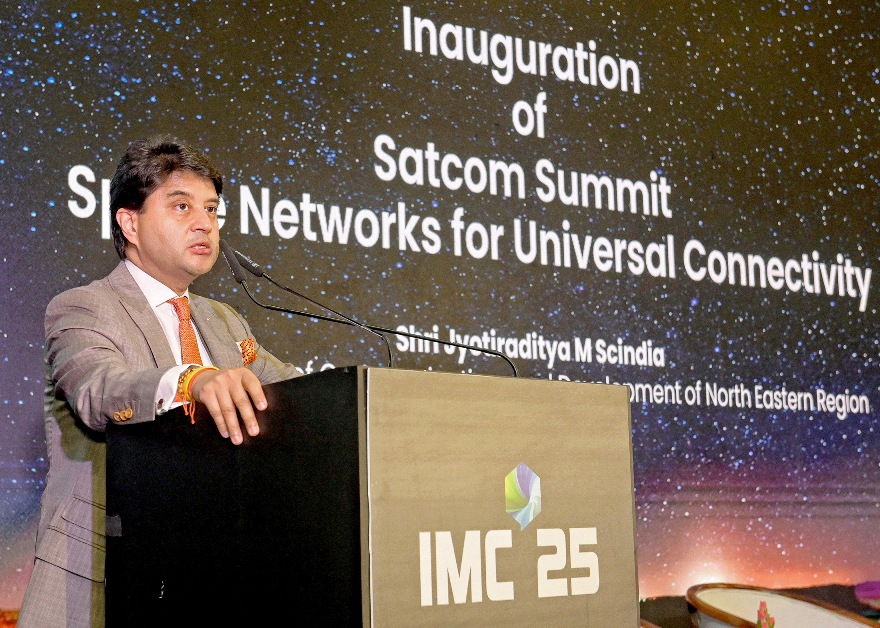
The Union Minister of Communications and Development of North Eastern Region (DoNER), Shri Jyotiraditya M. Scindia addressing the Satcom (Space Networks for Universal Connectivity) Summit, in New Delhi on October 08, 2025.
Scindia underscored that satellite communication (SATCOM) will extend digital inclusion to even the most remote corners of the nation. “SATCOM is no longer a luxury; it is a right — a form of justice in the digital era,” he said, emphasizing its potential to empower farmers, fishermen, doctors, and students in areas beyond the reach of terrestrial networks.
Highlighting the government’s connectivity mission, the Minister revealed that through the Digital Bharat Nidhi and the Universal Service Obligation Fund (USOF), India is working to connect 38,260 remote villages at an investment of ₹40,000 crore, of which **29,000 villages — about 75 per cent — have already been linked.
Scindia detailed a series of policy reforms that have catalysed growth in the sector, including administrative allocation of satellite spectrum aligned with global best practices, ensuring regulatory harmony and equitable access. He informed that GMPCS licences have been granted to OneWeb and Jio Satellite, while Starlink has received a Letter of Intent, setting the stage for a vibrant SATCOM ecosystem.
Projecting the industry’s bright prospects, Scindia said the Indian SATCOM market, valued at $4.3 billion in 2024, is expected to triple to $14.8 billion by 2033, reflecting both economic and strategic potential. He also announced the establishment of a ₹900 crore National SATCOM Monitoring Facility to safeguard spectrum assets and strengthen India’s satellite gateways.
Recalling India’s extraordinary journey from Aryabhata (1975) to Chandrayaan-3, Aditya-L1, NISAR, and the upcoming Gaganyaan, Scindia said the nation has evolved from being a follower to a global leader in space innovation. “India must not just be a beneficiary of satellite services — it must become a hub, an exporter, and a trusted global partner,” he asserted.
Calling for a unified national SATCOM effort, the Minister urged collaboration among government, industry, startups, academia, and international partners. “In the great symphony of progress, India will not be a silent listener. India will be the conductor, leading the orchestra of global innovation — composing the melody of opportunity,” Scindia concluded.


Leave a Reply