THEBUSINESSBYTES BUREAU
NEW DELHI, NOVEMBER 12, 2026
Calling for a stronger convergence of traditional farming wisdom and
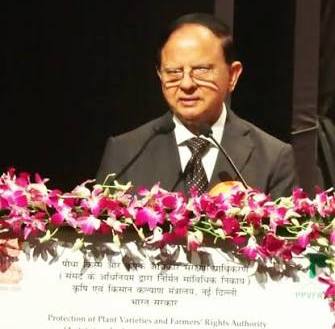
modern scientific research, Principal Secretary to the Prime Minister Dr P K
Mishra on Thursday said farmers must be recognised not merely as custodians of
India's agricultural biodiversity but also as innovators, entrepreneurs and key
beneficiaries of the country's agricultural transformation.
Addressing the 22nd Foundation Day of the Protection of Plant Varieties
and Farmers' Rights Authority (PPVFRA) and the Plant Genome Saviour Award
Ceremony here, Mishra stressed the need to connect farmers' traditional
knowledge with scientific research, quality seed systems and emerging market
opportunities. The occasion also marked 25 years of the Protection of Plant
Varieties and Farmers' Rights Act, 2001, which provides a distinctive framework
for balancing plant breeders' rights with the interests of farmers.
Underscoring the economic and strategic importance of agricultural
biodiversity, Mishra said India's rich genetic resources could play a crucial
role in developing climate-resilient crops capable of withstanding water
stress, pests and diseases. Their preservation, he said, was equally important
for safeguarding traditional knowledge, food cultures and community
livelihoods.
Highlighting India's 22 agro-biodiversity hotspots, he cited Koraput in
Odisha, recognised by the Food and Agriculture Organisation (FAO) in 2012 as a
Globally Important Agricultural Heritage System, as a compelling example of
community-led conservation and sustainable agricultural practices.
Mishra pointed out that nearly half of the plant varieties registered
under the PPVFRA were farmers' varieties, reflecting the significant
contribution of farming communities to India's agricultural innovation
ecosystem. He emphasised that benefit-sharing provisions and the National Gene
Fund were important instruments for ensuring that communities conserving
valuable genetic resources received fair economic returns.
Referring to India's growing scientific capabilities, he said the
National Genebank at the ICAR-National Bureau of Plant Genetic Resources was
the second largest in the world, while around 3,000 climate-resilient crop
varieties had been developed under the National Agricultural Research System.
He also underlined the potential of Geographical Indications (GIs) in enhancing
the commercial value of distinctive agricultural products and creating new
income opportunities for farming communities.
Highlighting India's growing international leadership on farmers' rights,
Mishra referred to the country's engagement with the International Treaty on
Plant Genetic Resources for Food and Agriculture, the 2022 Governing Body
session held in New Delhi and the 2023 Global Symposium on Farmers' Rights. He
also highlighted the Indore Declaration adopted by BRICS Agriculture Ministers
and the establishment of a Global Forum on Farmers' Rights in Seed Systems as
important milestones in advancing the global agenda.
Emphasising that the next phase of agricultural development must move
beyond recognition towards tangible economic empowerment, Mishra called for
strengthening community seed banks and field gene banks and integrating
farmers' traditional knowledge with contemporary scientific research. He
stressed the need to connect farmers' varieties with quality seed production
systems, Farmer Producer Organisations (FPOs) and wider commercial markets.
He also called for promoting farmer-led entrepreneurship and putting in
place fair, transparent and effective benefit-sharing mechanisms to ensure that
biodiversity conservation generated sustained economic opportunities for
farming communities.
Making a strong case for converting recognition into recurring economic
gains, Mishra observed, "An award honours a farmer once; a seed chain, a
market and a fair share of benefits sustain the farmer every season."
He said farmers should be viewed not simply as participants in India's agricultural transformation but as active contributors and beneficiaries of the process. Safeguarding agricultural diversity, he added, was a collective responsibility involving farmers, scientists, universities, industry, the government and society at large.
Mishra congratulated the PPVFRA and the award recipients, expressing confidence that stronger collaboration among farming communities, research institutions and market stakeholders would help transform India's agricultural heritage into a sustainable source of innovation, resilience and rural prosperity.