Discovery of persistent spin texture in silver
iodide could pave the way for next-generation spintronic devices
THEBUSINESSBYTES BUREAU
BHUBANESWAR, NOVEMBER 10, 2026
A researcher at the Indian Institute of Technology (IIT) Bhubaneswar has
identified a promising pathway towards developing next-generation electronic
devices by predicting the possibility of exceptionally long-lasting electron
spin in a nonmagnetic two-dimensional material.
The study, led by Dr Manish Kumar Mohanta, Ramanujan Faculty in the
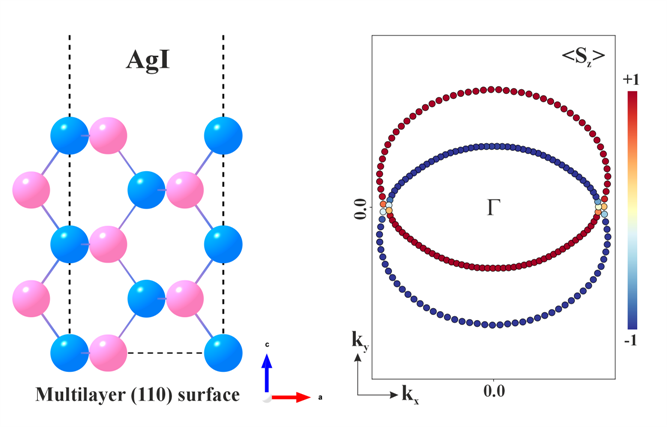
Department of Physics at IIT Bhubaneswar, identifies the (110) surface of cubic
zinc-blende silver iodide (AgI) as a potential host for a quantum phenomenon
known as persistent spin texture (PST). The findings, published in the prestigious
international journal Physical Review B of the American Physical Society, could
open new avenues for designing advanced spintronic devices that use electron
spin to process and store information.
Unlike conventional electronics, which primarily rely on the movement of
electric charge, spintronics seeks to harness the intrinsic spin of electrons
as an additional carrier of information. However, maintaining the stability of
electron spin over extended periods remains a major challenge. Persistent spin
texture offers a potential solution by enabling electrons to maintain a stable,
unidirectional spin alignment, thereby suppressing unwanted spin relaxation and
potentially allowing spin information to survive for exceptionally long
durations.
Using first-principles quantum mechanical simulations, supported by
mathematical modelling, Dr Mohanta demonstrated that the (110) surface of
silver iodide exhibits a unidirectional spin pattern, making it a promising
candidate for future spin-based electronic technologies.
The study further establishes that the predicted spin texture remains
robust under moderate mechanical strain, an encouraging finding for its
potential application in practical devices. Interestingly, the research also
shows that an electric field applied perpendicular to the material's surface
can disrupt the spin texture, indicating a possible route for electrically
controlling electron spin.
In another significant contribution, Dr Mohanta has introduced two new
mathematical models to explain the unusual spin patterns observed in the bulk
semiconductor OsSi. The work also raises a fundamental question in
condensed-matter physics: Can a nonmagnetic bulk semiconductor exhibit a
unidirectional spin pattern similar to that observed in two-dimensional
materials?
By developing new theoretical frameworks to describe and interpret these
unusual spin configurations, the research broadens the understanding of
electron spin behaviour in nonmagnetic semiconductors and offers fresh
directions for identifying quantum materials with desirable spintronic
properties.
The findings are particularly significant in the context of emerging
technologies that seek to make electronic devices faster, more energy-efficient
and capable of retaining information through electron spin. Although the study
is theoretical and further experimental validation will be necessary, it
provides an important foundation for exploring materials that could potentially
support exceptionally long spin lifetimes.
For Dr Mohanta, the publication also marks a significant professional milestone, as it is his first independent research work since joining IIT Bhubaneswar as a Ramanujan Faculty. The achievement adds to the institute's research contributions in the emerging field of quantum materials and next-generation electronic technologies.
The research paper is available at: https://link.aps.org/doi/10.1103/6dcb-r2xb.