THEBUSINESSBYTES BUREAU
NEW DELHI, NOVEMBER 21, 2026
India is aiming to build a USD 300-billion bioeconomy by 2030 and expand
it to USD 1 trillion by 2047, Union Minister Jitendra Singh has said, stressing
the need to accelerate research commercialisation, strengthen industry
partnerships and attract global scientific talent to achieve the ambitious
targets.
India's bioeconomy has grown from around USD 10 billion to more than USD
195 billion, reflecting the expanding contribution of biotechnology, innovation
and technology to the country's economic growth, Singh said while chairing the
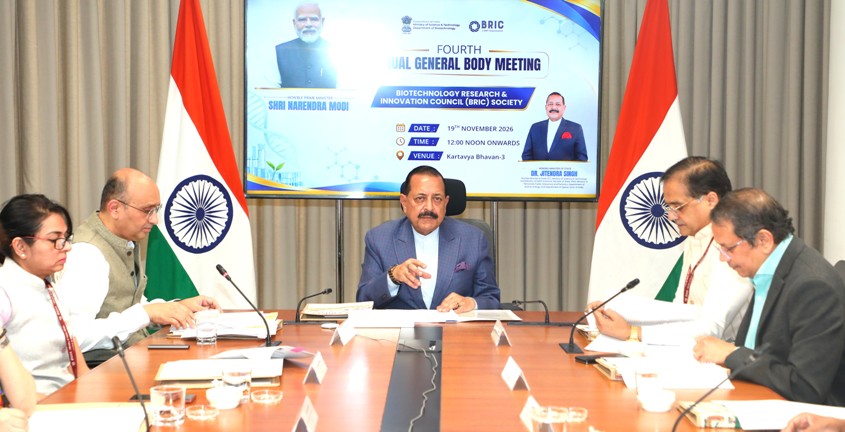
fourth Annual General Meeting of the Biotechnology Research and Innovation
Council (BRIC) Society here.
Describing BRIC as a pioneering model of institutional integration in the
government, the minister said bringing biotechnology research institutions
under a common umbrella was among the first initiatives of its kind and had
subsequently inspired similar approaches in other organisations.
The initiative was conceived to promote shared infrastructure,
collaborative research and integrated governance while allowing constituent
institutions to retain their individual scientific strengths, he said.
Singh emphasised that scientific achievements should not remain confined
to research publications and patents but must translate into technologies,
products and solutions that address societal needs and improve people's lives.
Highlighting BRIC's research credentials, he said the council had ranked
first among government institutions in health sciences and second in biological
sciences in India for the second consecutive year, according to the Nature
Index India.
BRIC institutions are undertaking research in healthcare, agriculture,
animal health, advanced materials and technology platforms, including novel
therapeutics, diagnostics, disease detection, climate-resilient agriculture and
sustainable biomaterials.
The minister called for closer alignment of research priorities with
national requirements, saying scientific innovation must deliver tangible
benefits to patients, farmers, industries and communities.
Underlining the importance of taking research from laboratories to the
marketplace, Singh said scientists, entrepreneurs, investors and industry must
engage with one another from the early stages of technology development.
Research commercialisation requires capital, mentorship, industry
partnerships and a better understanding of market and regulatory pathways, he
said, adding that technology translation should become an integral part of the
research ecosystem.
He welcomed initiatives such as the Entrepreneur-in-Residence programme
and collaborations to strengthen biomanufacturing, technology scale-up and
commercialisation, and urged BRIC institutions to build deeper links with
industry and innovation networks.
India's biotechnology startup ecosystem, which now comprises more than
11,000 startups, reflects growing confidence in the country's scientific and
entrepreneurial capabilities, Singh said.
He encouraged young scientists and innovators to move beyond publications
and patents towards product development, technology translation and enterprise
creation.
During the meeting, members also highlighted emerging opportunities at
the intersection of artificial intelligence and biology, technology development
and the need to attract Indian scientific talent working abroad to contribute
to the country's research ecosystem.
Suggestions included leveraging platforms such as Vaibhav Connect to
connect the scientific diaspora with research opportunities in BRIC
institutions, promoting interdisciplinary engagement with social sciences and
expanding partnerships with entrepreneurs and industry.
Referring to the D.E.S.I.G.N. for BioE3 Challenge, Singh said it had
received more than 6,000 proposals from school students and citizens across its
two categories, reflecting growing interest in biotechnology innovation.
He called for continued efforts to nurture young talent, attract
promising researchers and create opportunities for ambitious interdisciplinary
research, while making scientific achievements more accessible to the wider
public.
The AGM also reviewed BRIC's institutional progress, scientific
achievements, governance reforms, research collaborations and future
priorities. Department of Biotechnology Secretary and BRIC Director General
Rajesh S Gokhale presented a detailed account of the council's activities and
achievements.
Singh welcomed the operationalisation of BRIC's Secretariat and efforts
to strengthen research capacity through recruitment against revived scientific
positions.
The meeting also witnessed the launch of the BRIC Handbook of Memorandum
of Association, Rules, Regulations and Bye-laws, providing a consolidated
reference for the council's governance and functioning.
Members were also apprised of the proposal to dissolve existing societies
of constituent autonomous institutions and merge them with BRIC as part of the
ongoing institutional restructuring.
Singh said BRIC's collaborative research model, shared infrastructure and interdisciplinary programmes would play an important role in strengthening India's biotechnology ecosystem and positioning the country as a global hub for scientific innovation.
The AGM was held at Kartavya Bhawan under the chairmanship of Singh, who holds the portfolios of Science and Technology and Earth Sciences as Minister of State (Independent Charge), besides being Minister of State in the Prime Minister's Office and other departments, and President of the BRIC Society.