THEBUSINESSBYTES BUREAU
NEW DELHI, NOVEMBER 11, 2026
India and Norway are exploring joint research and technology initiatives
to convert industrial and construction waste into valuable resources, as the
two countries seek to accelerate the transition towards a circular economy and
promote sustainable construction practices.
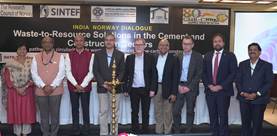
The initiative was discussed at the India–Norway Dialogue on 'Waste to
Resource Solutions in the Cement and Construction Sector', organised jointly by
the Council of Scientific and Industrial Research (CSIR), SINTEF and the
Research Council of Norway at the India Habitat Centre here on November 10.
The dialogue brought together scientists from CSIR laboratories,
Norwegian research experts, regulatory authorities and representatives of the
cement and construction industries to identify collaborative opportunities in
waste management, resource recovery and the development of environment-friendly
construction materials.
The discussions assume significance in the backdrop of India and Norway
elevating their bilateral relationship to a Green Strategic Partnership during
Prime Minister Narendra Modi's visit to Norway in May, with circular economy,
clean technologies and research identified as key pillars of cooperation.
The inaugural session was addressed by Dr Rama Swami Bansal, Head of
ISTAD at CSIR Headquarters, Dr Arvinn Gadgil of the Royal Norwegian Embassy, Dr
Kåre Helge Karstensen, Chief Scientist at SINTEF, Norway, and Prof R Pradeep
Kumar, Director of CSIR-CBRI, among other dignitaries.
Emphasising the need to move away from the conventional linear economic
model, Prof Kumar highlighted the potential of converting construction and
demolition (C&D) waste and industrial residues into valuable inputs for the
construction sector.
The discussions explored the utilisation of steel slag, fly ash, red mud
and other industrial by-products, while addressing key challenges such as
processing technologies, standardisation, economic feasibility and market
acceptance.
A major focus of the dialogue was the environmentally sound treatment of
hazardous waste, including Persistent Organic Pollutants (POPs), DDT and
PCB-contaminated materials, through cement kiln co-processing.
The technical session, led by Karstensen and Dr Ramesh Kumar, Chief Scientist
at CSIR-NEERI, examined how cement kilns could facilitate the destruction of
suitable hazardous organic contaminants under controlled high-temperature
conditions while replacing conventional fossil fuels with waste-derived
alternative fuels.
CSIR-NEERI presented India's National Implementation Plan under the
Stockholm Convention, the 2025 Construction and Demolition Waste Management
Rules and the inventory of legacy POPs. SINTEF shared international experiences
demonstrating the potential of cement kiln co-processing in hazardous waste
management.
Experts, however, underscored the importance of stringent technical
protocols, controlled industrial trials, continuous emission monitoring and
regulatory compliance to ensure safe and environmentally responsible
operations.
Research initiatives undertaken by CSIR-CRRI and CSIR-AMPRI also
showcased opportunities to use fly ash, copper slag, red mud, plastic waste and
steel grit in road construction, geopolymer concrete, specialised aggregates
and other value-added construction products.
Another key session, led by Dr Christian John Engelsen of SINTEF, focused
on C&D waste recycling, highlighting international best practices such as
recycled aggregate-based construction products, mobile recycling units and
advanced processing techniques to remove impurities.
Prof S K Singh of CSIR-CBRI presented the potential of slags and other
industrial by-products in construction, highlighting the importance of
developing sustainable alternatives to conventional construction materials.
The dialogue identified several priority areas for future India-Norway
cooperation, including the preparation of two to three joint research
proposals, pilot-scale demonstration projects for hazardous waste treatment,
development of technical guidelines for the disposal of DDT- and
PCB-contaminated waste, and advancement of waste-derived construction
materials.
Strengthening industry-academia partnerships and translating research outcomes into commercially viable and scalable technologies also emerged as key priorities.
The programme concluded with a commitment to deepen bilateral scientific and technological cooperation, promote circular construction practices and accelerate the transition towards resource-efficient and sustainable cement and construction industries.