
THEBUSINESSBYTES BUREAU
NEW DELHI, NOVEMBER 24, 2026
India's space economy is poised for an unprecedented expansion, with its
valuation expected to surge from the current USD 9 billion to USD 40-45 billion
in less than a decade, as private enterprises increasingly take centre stage in
transforming the country's space ecosystem, Union Minister Jitendra Singh said
on Tuesday.
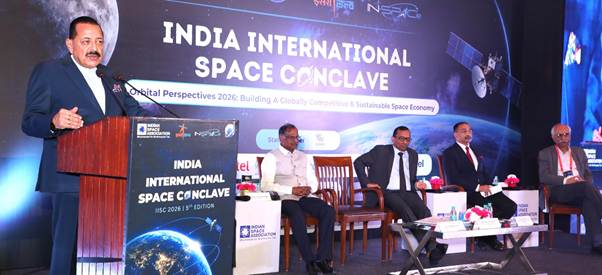
Addressing the fifth India International Space Conclave 2026 in New
Delhi, Singh said the remarkable expansion of India's space sector, from a
handful of startups to nearly 400-500 companies, reflected the transformative
impact of policy reforms initiated under Prime Minister Narendra Modi.
He described the opening up of the space sector to private participation
as a landmark shift that had dismantled longstanding barriers and unleashed
India's entrepreneurial, scientific and technological potential.
The Minister said the establishment of New Space India Limited (NSIL),
followed by the creation of IN-SPACe and the introduction of enabling policies
for private players, had fundamentally reshaped the country's space landscape, creating
new avenues for investment, innovation and commercial growth.
Highlighting the achievements of Indian space startups, Singh cited
Skyroot's maiden launch vehicle flight on July 18, 2026, its multi-mission
launch agreement and emergence as a unicorn as significant milestones in
India's private space journey. He also pointed to the progress made by Agnikul
and other emerging companies in developing advanced propulsion systems,
privately manufactured rocket engines, earth-observation technologies and
satellite imaging capabilities.
He said the growing participation of companies from diverse industrial
sectors was further expanding the commercial possibilities of India's space
economy.
Emphasising that the economic value of space technology extended well
beyond satellite launches and rocket manufacturing, Singh said its contribution
should also be assessed through the savings, efficiency gains and improved
public service delivery it enabled across sectors.
Citing the PM Gati Shakti National Master Plan, he said space-based
applications were playing an increasingly important role in infrastructure
planning, monitoring project timelines, reducing costs and minimising wastage
and leakages. From railways and defence to healthcare, education, communication
and construction, space technology had the potential to transform virtually
every sector of governance and economic activity, he added.
Responding to questions on generating greater demand for the space
industry, the Minister said the perceived shortage of demand was largely a
consequence of inadequate awareness about the practical applications of space
technology. He stressed that the sector's potential went far beyond rocket
launches and satellite missions, with enormous opportunities in infrastructure
development, communication and public service delivery.
He underlined that the Prime Minister's whole-of-government approach and
stronger coordination among ministries would be crucial in expanding the
adoption of space-based solutions.
On balancing strategic autonomy with international cooperation, Singh
said indigenous technological capabilities and global partnerships were
complementary rather than contradictory. India, he said, must continue
strengthening its domestic capabilities through indigenous sources,
technologies and projects while remaining open to mutually beneficial
international collaborations.
Drawing attention to India's achievements in emerging technologies, the
Minister said the National Quantum Mission, launched in 2023 with an eight-year
mandate, had already achieved 1,000 kilometres of secure quantum communication
within three years, against an original target of 2,000 kilometres over eight
years.
He said space, quantum technologies, semiconductors and nuclear science
were interconnected strategic domains that offered immense opportunities for
technological advancement, economic expansion and global competitiveness.
Calling for greater private investment, Singh urged domestic companies to
scale up their commitments to the space sector and encourage overseas investors
to explore India's rapidly expanding space ecosystem. He said initiatives such
as the Anusandhan National Research Foundation and the Research, Development
and Innovation (RDI) Fund were designed to strengthen research, promote
innovation and create a more conducive environment for private-sector
participation.
The Minister also made a strong pitch for greater Corporate Social
Responsibility (CSR) investments in scientific research and development, saying
corporate contributions should extend beyond machinery and infrastructure to
support research that benefits society at large.
Advocating a stronger culture of scientific philanthropy, he said
investment in research should be viewed as a meaningful contribution to
humanity and the country's long-term development.
Responding to suggestions for an international space innovation alliance,
a global accelerator programme for startups and international grand challenges,
Singh said India needed to embrace global strategies and benchmarks to
strengthen its position in the international space arena. He indicated that
possibilities for institutionalising broader international cooperation in the
space sector could be explored.
Welcoming proposals to expand the space ecosystem across more states and
encourage greater participation of students and young innovators, he said the
government remained receptive to constructive industry feedback and further
policy interventions to facilitate private enterprise.
The two-day India International Space Conclave 2026, organised by the
Indian Space Association (ISpA) on November 23 and 24, was held under the theme
'Shaping the Future of Space through Innovation, Governance, Human Potential
and Global Collaborations'. The event brought together industry leaders,
startups, researchers and international stakeholders to deliberate on India's
expanding role in the global space economy.
The occasion also witnessed the launch of the report 'Space Economy 2036:
The India Blueprint', outlining a roadmap for the country's future growth in
the sector.
The conclave was attended by ISRO Chairman and Department of Space Secretary Dr V. Narayanan, IN-SPACe Chairman Dr Pawan Kumar Goenka, Indian Space Association Director General Lt Gen Anil Kumar Bhatt (Retd), Arun T. Ramchandani and other prominent representatives of the space and technology industries.
Singh said the convergence of progressive policy reforms, indigenous technological capabilities, increased private investment and entrepreneurial innovation was laying a strong foundation for India's emergence as a globally competitive space power, with the private sector expected to play a defining role in the next phase of the country's space journey.