THEBUSINESSBYTES BUREAU
KHARAGPUR, NOVEMBER 21, 2026
There are no limits to what young minds can achieve if they dare to
challenge conventional thinking and turn possibilities into reality, Prime
Minister Narendra Modi said on Saturday, urging students of IIT Kharagpur to
place national interest at the centre of their ambitions and contribute towards
building a developed India by 2047.
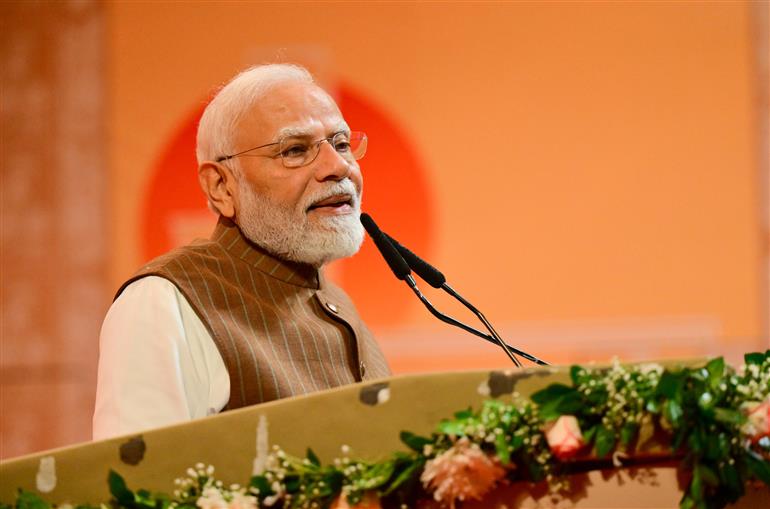
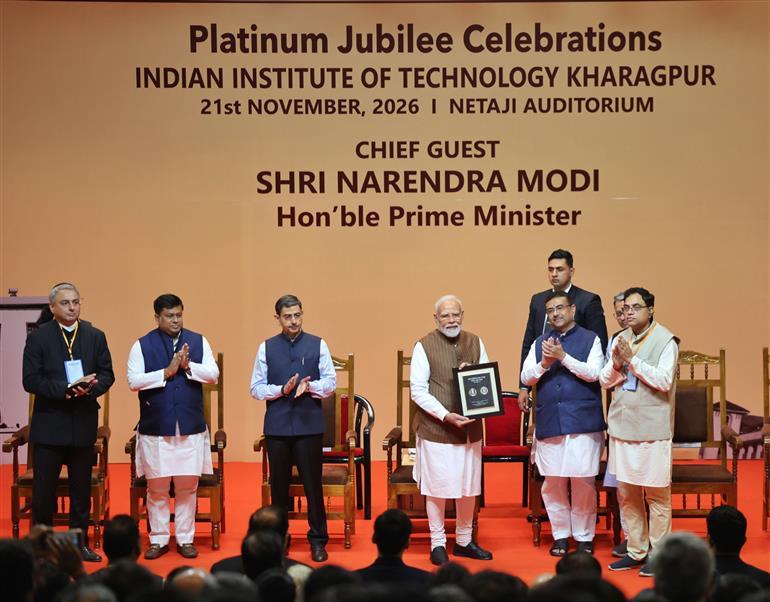
Addressing the Platinum Jubilee celebrations of IIT Kharagpur, the
country's first Indian Institute of Technology, Modi said the institution's
75-year journey reflected India's remarkable transformation and its
contribution to nation-building across generations.
Congratulating students, faculty members, staff and alumni, he said the
institute had played a significant role in India's journey from bullock carts
to bullet trains and from postal letters to social media, adapting to the
changing needs and aspirations of the country.
Recalling his memories of campus life, the Prime Minister said the
discussions over tea at Chedi's and the distinctive Hall culture remained
cherished experiences for generations of students. He also referred to the
institute's famous Diwali Illumination celebrations, observing that the
competition among different Halls added a special charm to the festivities.
Highlighting Bengal's historic contribution to India's freedom struggle,
Modi said IIT Kharagpur stood on the site of a former Detention Camp where
freedom fighters had demonstrated extraordinary courage and sacrificed for the
country's independence.
He said the same campus, which once witnessed the struggle for
'Self-Rule', was now nurturing young innovators whose ideas and technological
breakthroughs were strengthening India's resolve for 'Self-Reliance'.
"The journey from aspiration to self-reliance is the real energy of
building a Viksit Bharat," he said.
Tracing the institute's evolution since its establishment in the early
years of independent India, Modi said IIT Kharagpur was founded at a time when
the country urgently needed engineers to develop its industries and
infrastructure.
Its graduates subsequently contributed to India's space and atomic energy
programmes, strengthened the software industry and assumed leadership positions
in major global companies during the information technology revolution, he
said.
Expressing confidence in the institute's next generation, the Prime
Minister said its experience and achievements over seven decades would play a
crucial role in shaping India's future innovation ecosystem.
Emphasising the need to overcome self-imposed limitations, Modi said an
individual's potential was determined not by how quickly one became satisfied
but by the courage to challenge obstacles.
People often develop what are known as 'limiting beliefs', restricting
their own dreams, talents and capabilities by deciding in advance what is
possible and what is not, he said.
"We end up considering the limit of our thinking itself as the limit
of the world," he observed, adding that nations too could realise their
true potential only when they broke free from such constraints.
Referring to the government's initiatives over the past 12 years, Modi
said efforts to empower the poor and improve their ease of living had helped
bring about a significant transformation in society.
 Citing a recent World Bank report, he said around 50 crore people in
India had moved out of poverty over a period of 12 to 13 years, describing the
achievement as evidence of the country's changing mindset.
"This is not a small change; this is the result of that mindset
which says: Break the Limits," he said.
The Prime Minister cited India's Semiconductor Mission as another example
of challenging conventional thinking, recalling that several people had
questioned the initiative on the grounds that other countries had already been
manufacturing semiconductors for decades.
Rejecting the argument that India had entered the sector too late, he
said the government brought officials together to formulate a roadmap, and
within four years several semiconductor facilities had commenced work across
the country.
India had also started exporting chips, with former IIT Kharagpur
students playing leading roles in establishing and executing several
semiconductor projects, he said.
Similarly, opening up the space sector to private participation had
created unprecedented opportunities for young innovators, Modi said.
Recalling that India's space ecosystem was earlier largely confined to
ISRO, he said the government decided to provide opportunities to talented young
people outside the organisation.
He specifically mentioned IIT Kharagpur alumnus Pawan, who founded
Skyroot Aerospace and contributed to India's emergence as a country capable of
launching private rockets. Several other space startups were also accelerating
the country's space programme, he added.
Praising the contribution of the institute's alumni, Modi said they had
helped transform possibilities once considered impossible into reality.
Pointing out that the next two decades would be among the most productive
years of the students' lives and the most decisive period for India's
development, he said many of them would occupy leadership positions by 2047.
He urged students to identify the national challenges they wished to help
solve and make the country's interests their foremost priority.
"When you move forward with this mindset, then certainly, this will
bring new opportunities for you too and the country will also benefit
greatly," he said, reiterating his mantra of 'Nation First'.
Commending IIT Kharagpur for its achievements over the past 75 years, the
Prime Minister called upon the institution to continue its pursuit of
excellence and contribute to India's transformation into a developed nation.
Expressing confidence that the institute would celebrate its centenary in a Viksit Bharat, he urged students to work hard, remain ambitious and never lose sight of their responsibilities towards society and the nation.
Concluding his address, Modi invoked Swami Vivekananda's inspiring words: "Arise, awake, and stop not till the goal is reached."