THEBUSINESSBYTES BUREAU
GANDHINAGAR, NOVEMBER 21, 2026
Workers’ welfare and industrial growth must go hand in hand to drive
India’s economic development and realise the vision of Viksit Bharat, Union
Labour and Employment Minister Mansukh Mandaviya said on Saturday, stressing
that the implementation of the Labour Codes would help build a stronger, more
inclusive and industry-friendly labour ecosystem.
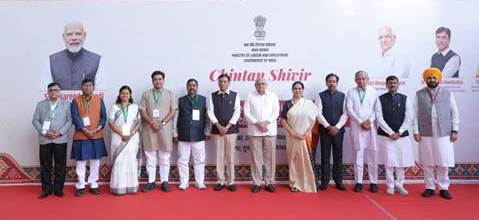
Addressing the inaugural session of the two-day Chintan Shivir of Labour
and Employment Ministers of States and Union Territories at Mahatma Mandir
here, Mandaviya described workers’ welfare and industrial growth as the twin
wheels of the vehicle of national progress.
The conclave, organised by the Ministry of Labour and Employment on
November 21 and 22, marks the first anniversary of the implementation of the
four Labour Codes, which came into effect on November 21, 2025.
The inaugural session was co-chaired by Gujarat Chief Minister Bhupendra
Patel and Mandaviya. Union Minister of State for Labour and Employment and MSME
Shobha Karandlaje, besides Labour, Employment and Industry Ministers and senior
officials from States and Union Territories, also participated.
Highlighting the Labour Codes as a significant milestone in India's
journey towards Viksit Bharat, Mandaviya said the reforms seek to ensure
minimum wages, expand social security coverage and provide for fixed-term
employment, while simultaneously reducing the compliance burden on industries
and creating an enabling environment for growth.
Underscoring the government's commitment to workers' welfare, he pointed
out that India's social security coverage had expanded substantially from 25
crore beneficiaries in 2014 to 101 crore in 2026.
The minister also highlighted India's demographic advantage and the
growing global demand for its skilled workforce, emphasising the need to
deliberate on international employment opportunities for the country's youth
and facilitate the mobility of Indian workers across borders.
Calling for a collective approach towards strengthening the labour
ecosystem, Mandaviya urged all stakeholders to work in the spirit of 'Team
India' for the welfare of the country's seven crore workers.
Referring to the fifth of Prime Minister Narendra Modi's 'Panch Pran',
which calls upon 140 crore citizens to work collectively towards achieving
national goals, he encouraged participants to actively contribute to the
deliberations and help shape the future course of labour reforms. He also
invited the delegates to explore Gujarat and experience its rich cultural and
historical heritage.
Delivering the keynote address, Gujarat Chief Minister Bhupendra Patel said
the dignity, welfare and empowerment of workers were integral to India's
progress and nation-building.
Reflecting on the changes brought about during the past year following
the implementation of the Labour Codes, Patel said the country was witnessing
the emergence of a stronger and more worker-centric labour ecosystem.
He described the Chintan Shivir as an important platform for States and
Union Territories to exchange best practices, strengthen cooperation and
develop a shared vision for labour welfare and industrial growth.
Reaffirming the foundational role of the workforce in India's
development, the chief minister said 'Shramik Kalyan' and industrial
development must progress together as the country moves towards becoming a
global economic powerhouse.
Earlier, in his welcome address and introductory remarks, Labour and
Employment Secretary Chandra Bhushan Kumar stressed the need for a change in
mindset and perspective to ensure the effective implementation of the Labour
Codes.
He said focused deliberations were essential to address the
responsibilities and expectations associated with the next phase of labour
reforms and translate the vision of Viksit Bharat into reality.
Kumar called upon representatives of States and Union Territories to
share their experiences, insights and best practices, while emphasising their
collective responsibility in making the Chintan Shivir productive and
outcome-oriented.
The first day of the conclave features four thematic plenary sessions
focusing on the implementation status and future roadmap of the Labour Codes,
employment initiatives and Employees' Provident Fund Organisation (EPFO)
reforms, Employees' State Insurance Corporation (ESIC) reforms, and social
security for unorganised workers and labour statistics.
The deliberations also include presentations through State and Union
Territory best-practice videos, followed by discussions on key policy and
implementation issues.
Simultaneously, parallel breakaway sessions for field-level officials from States and Union Territories are being organised to deliberate on strategies for implementing the Labour Codes, engagement with micro, small and medium enterprises (MSMEs), field-level initiatives and trust-based electronic compliance mechanisms.
The two-day exercise is expected to provide an opportunity for the Centre and States to strengthen coordination, share implementation experiences and evolve a collaborative roadmap for balancing workers' welfare with industrial competitiveness.