THEBUSINESSBYTES
BUREAU
NEW
DELHI, JANUARY 15, 2026
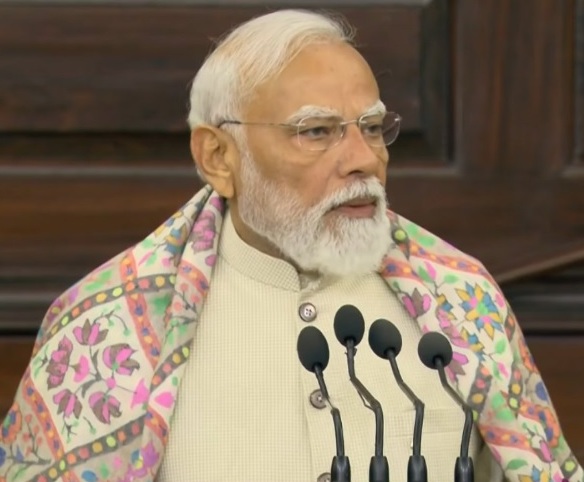
“Democracy delivers in India because, for us,
the people of the nation are supreme,” Prime Minister Narendra Modi said on Thursday
as he addressed the Conference of Commonwealth Speakers and Presiding Officers
in New Delhi, underscoring India’s commitment to effective, inclusive and
people-centric parliamentary democracy.
 Speaking at
the historic Central Hall, now rechristened as the Constitution House, the
Prime Minister reminded delegates that the venue holds a unique place in
India’s democratic journey. It was here, he said, that the Constituent Assembly
met in the final years of colonial rule to draft the Constitution, and for 75
years after Independence, the building served as India’s Parliament, witnessing
debates and decisions that shaped the nation’s destiny. Coming soon after the
celebration of 75 years of the Constitution’s implementation, he described the
gathering at the Constitution House as a moment of special significance for
Indian democracy.
Speaking at
the historic Central Hall, now rechristened as the Constitution House, the
Prime Minister reminded delegates that the venue holds a unique place in
India’s democratic journey. It was here, he said, that the Constituent Assembly
met in the final years of colonial rule to draft the Constitution, and for 75
years after Independence, the building served as India’s Parliament, witnessing
debates and decisions that shaped the nation’s destiny. Coming soon after the
celebration of 75 years of the Constitution’s implementation, he described the
gathering at the Constitution House as a moment of special significance for
Indian democracy.
This was the
fourth time India hosted the Conference of Commonwealth Speakers and Presiding
Officers, with the theme “Effective Delivery of Parliamentary Democracy.”
Reflecting on early doubts about whether democracy could survive and thrive in
a country as diverse as India, the Prime Minister said India transformed its
diversity into the greatest strength of its democratic system. He noted that
India has also disproved the notion that democracy and development cannot go
hand in hand, asserting that democratic institutions and processes have
provided the country with stability, speed and scale.
Highlighting
India’s economic and technological strides, the Prime Minister said the country
is today the world’s fastest-growing major economy and a global leader across
sectors, from digital payments and vaccine production to steel, startups,
aviation, railways, metro networks, milk and rice production. These
achievements, he said, reflect the strength of democratic governance.
The Prime
Minister emphasised that democracy in India is defined by last-mile delivery
and an unwavering focus on public welfare. He said this approach has enabled
nearly 250 million people to come out of poverty in recent years, reinforcing
the idea that in India, democracy truly delivers. He added that processes and
technology have been democratised to ensure that the aspirations and dreams of
citizens face no barriers.
Citing India’s
response during the COVID-19 pandemic, the Prime Minister recalled that even
while facing severe domestic challenges, the country supplied medicines and
vaccines to more than 150 nations, reflecting India’s long-standing tradition
of prioritising human welfare beyond its borders.
Referring to
the 2024 general elections, he described them as the largest democratic
exercise in human history, with nearly 980 million registered voters, more than
8,000 candidates and over 700 political parties, along with record
participation by women voters. He said Indian women are not only participating
in democracy but leading it, pointing to women occupying the offices of
President of India and Chief Minister of Delhi, and nearly 1.5 million elected
women representatives in local bodies, accounting for about half of grassroots
leadership.
The Prime
Minister highlighted the extraordinary diversity of Indian democracy, marked by
hundreds of languages, more than 900 television channels and thousands of
newspapers and periodicals. He said such diversity is sustained by deep
democratic roots, shaped by India’s ancient traditions of debate, dialogue and
collective decision-making. Recalling references from the Vedas, Buddhist
Sanghas and a 10th-century village assembly inscription from Tamil Nadu, he
described India as the “Mother of Democracy,” with values tested and
strengthened over millennia.
Noting that
nearly half of the Commonwealth’s population resides in India, the Prime
Minister said the country remains committed to contributing meaningfully to the
collective progress of Commonwealth nations, particularly in areas such as
health, climate action, economic growth and innovation. He added that India
continues to raise the concerns of the Global South on global platforms and,
during its G20 presidency, placed these issues at the centre of the
international agenda.
Looking ahead,
the Prime Minister said India is building open-source technology platforms so
that partner countries in the Global South and the Commonwealth can develop
systems similar to those in India. He underlined the importance of Speakers and
Presiding Officers in promoting awareness and understanding of parliamentary
democracy and shared that the Indian Parliament is leveraging study tours,
training programmes, internships and artificial intelligence tools, including
real-time translation of debates into regional languages, to make parliamentary
processes more accessible, especially for the youth.
Concluding his
address, the Prime Minister said his engagements with parliaments across more
than 20 member countries have been a source of continuous learning, with best
practices shared back home. He expressed confidence that the conference would
further strengthen cooperation, learning and the collective commitment to
making parliamentary democracy more effective and inclusive across the
Commonwealth.