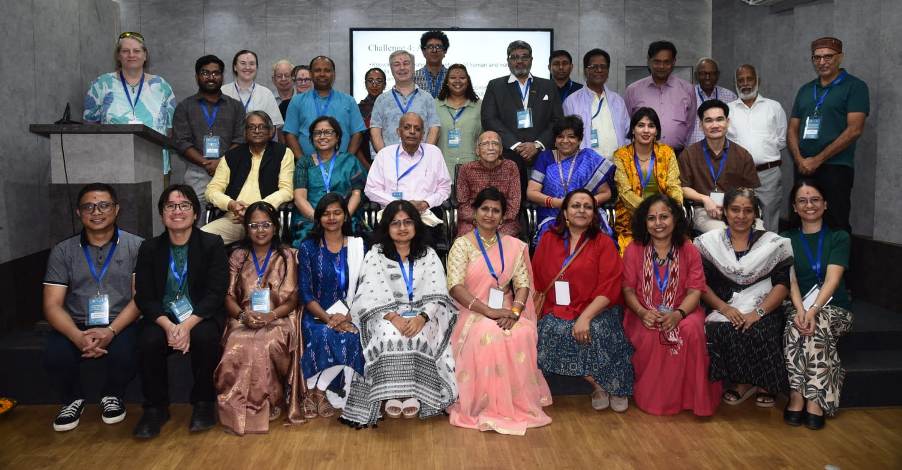
Around 52 delegates from nine countries
participate in 16th ARC International Roundtable and Second Asia–Africa
Dialogue
THEBUSINESSBYTES BUREAU
BHUBANESWAR, NOVEMBER 20, 2026
Bringing together leading scholars, researchers and delegates from nine
countries, Centurion University hosted a four-day international academic
conclave to deliberate on some of the most pressing contemporary challenges,
including artificial intelligence ethics, Indigenous knowledge systems,
ecological sustainability, interfaith dialogue and social justice.
The conclave featured the 16th ARC International Roundtable on Communication and Religious Humanism in the
Contemporary World: Nurturing Dialogue, Dignity, and Social Change, held
from November 13 to 15, followed by the Second Asia–Africa Dialogue on November
16.
Centurion University hosted and co-organized the international academic
gathering in collaboration with the Asian Research Centre for Religion and
Social Communication (ARC) at St John’s University, Thailand; the Desmond Tutu
Centre for Religion and Social Justice at the University of the Western Cape,
South Africa; and the Institute of Knowledge Societies, India.
The roundtable was inaugurated on the afternoon of November 13, with
around 52 participants representing various parts of India and countries
including South Africa, the Philippines, Thailand, Germany, France, Australia,
Sri Lanka and the United States.
Welcoming the delegates on behalf of the organizing committee, Centurion
University Vice-Chancellor Prof. Supriya Pattanayak highlighted the
significance of cross-cultural academic engagement in promoting human dignity,
mutual understanding and meaningful social transformation.
Delivering the inaugural keynote address, Prof. Dev Nathan explored how
Indigenous religious traditions offer valuable perspectives on human dignity
and alternative knowledge frameworks. This was followed by an opening panel
discussion that examined scholarly responsibility, Indigenous thought and
ecological stewardship in the contemporary world.
The academic deliberations were conducted across seven thematic sessions,
during which researchers presented 31 papers covering a wide spectrum of
issues, including artificial intelligence and digital ethics, ecological
sustainability, interfaith dialogue, gender equality, social justice, media
representation and the lived realities of marginalised communities.
Representing the host university, Prof. Smita Mishra Panda presented a
paper examining religious transformation and cultural identity among the Saora
communities of southern Odisha, bringing regional Indigenous experiences into
the broader international discourse.
Adding a cultural dimension to the academic proceedings, Kolkata-based
Attodeep Dance Theatre and the Lotus Communication Network, in association with
ARC and Centurion University, staged Buddhacarika
on the evening of November 14. The dance-theatre production portrayed the life
and journeys of Gautam Buddha through an evocative combination of chant, music
and dance.
The international conclave culminated on November 16 with the Second
Asia–Africa Dialogue, which brought together intellectual exchanges and
explorations of Odisha's rich cultural and historical heritage. Beginning at
the iconic Konark Sun Temple, the dialogue featured Dr Tammy Wilks, who
examined how biometric surveillance deepens exclusion among Kenyan Nubian
communities. Prof. Gnana Patrick reflected on shared colonial legacies and
Indigenous intellectual traditions, highlighting the importance of recognising
historical experiences and knowledge systems in shaping contemporary societies.
The programme concluded at the Dhauli Shanti Stupa, a landmark symbolising peace and non-violence, providing an appropriate setting for the dialogue's emphasis on human dignity, coexistence and cross-cultural understanding.
Dr. Sudhansu Sekhar Behera of the School of Management, Centurion University, coordinated the international event with the support of faculty members and students.