
THEBUSINESSBYTES BUREAU
NEW DELHI, NOVEMBER 25, 2026
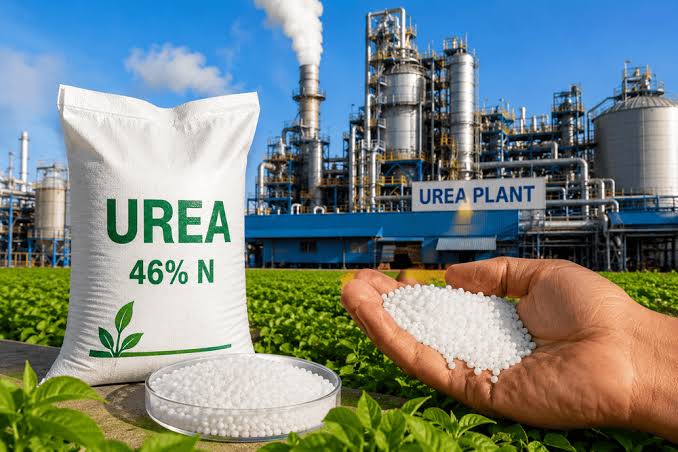
In a major push towards self-reliance in fertiliser production, the
government has approved six new brownfield urea manufacturing plants entailing
an investment of around Rs 54,000 crore under the National Investment Policy
for Urea (NIPU)-2026, aimed at reducing import dependence and strengthening
fertiliser security.
The initiative, aligned with Prime Minister Narendra Modi's vision of
Atmanirbhar Bharat, will expand domestic manufacturing capacity through
projects in the public, private and cooperative sectors, with more projects in
the pipeline.
The six proposed plants, each with an annual installed capacity of 12.7
lakh tonnes (LMT), will come up at Madras Fertilizers Ltd (MFL) in Chennai,
National Fertilizers Ltd (NFL) in Nangal, KRIBHCO's cooperative unit at
Shahjahanpur, Matix Fertilizers at Panagarh, Chambal Fertilizers and Chemicals
Ltd's Gadepan complex in Rajasthan, and IFFCO's Jagdishpur unit in Uttar
Pradesh.
The projects at Chennai and Nangal will primarily replace ageing
manufacturing facilities that have been operating for over six decades and
around five decades, respectively. These legacy plants face higher production
costs, excessive energy consumption and process-safety challenges.
At Nangal, the existing unit's energy consumption stands at 6.498 Gcal
per tonne, against the industry weighted average of 5.95 Gcal per tonne and the
new energy norm of 5 Gcal per tonne, highlighting the need for modernisation.
The brownfield expansion strategy is expected to accelerate project
execution and improve cost efficiency by leveraging existing land, utilities,
infrastructure, logistics networks and technical manpower.
With each project carrying an estimated capital cost of Rs 9,000 crore,
the six plants are expected to attract nearly Rs 54,000 crore in fresh
investment and generate employment opportunities.
To improve investor confidence and project viability, the policy provides
for a balanced return on equity (RoE) framework ranging between 12 and 16 per
cent, along with a foreign exchange rate mitigation mechanism. The latter
provides for exchange rate normalisation and conversion into rupees after four
years at prevailing rates.
The use of existing brownfield infrastructure is also estimated to
generate annual savings of around Rs 225 crore per project, translating into
nearly Rs 1,800 crore over eight years.
India consumes approximately 400 LMT of urea annually. Domestic
production, which stood at 225 LMT in 2014-15, increased to a record 314.07 LMT
in 2023-24 before settling at 293.30 LMT in 2025-26.
Meanwhile, the country's indigenous reassessed urea production capacity
has risen from 207.54 LMT per annum in 2014-15 to 269.42 LMT in 2026-27. The
additional capacity is expected to narrow the demand-supply gap, reduce
imports, conserve foreign exchange and improve domestic availability of the key
agricultural input.
The government said the earlier New Investment Policy-2012, announced in
January 2013 and amended in October 2014, had facilitated the establishment of
six urea plants, adding a combined capacity of 76.2 LMT annually.
These included four joint venture projects of nominated public sector
undertakings at Ramagundam, Gorakhpur, Sindri and Barauni, and two private
sector units at Panagarh and Gadepan.
Besides the six newly approved projects, two major urea projects with a capacity of 12.7 LMT each are under execution. The Talcher Fertilizer Project in Odisha, based on coal gasification, is expected to be completed by December 2027, while the Assam Valley Fertilizers and Chemicals Company Ltd project at Namrup was announced in March 2025.
The latest policy push is expected to build on the capacity expansion achieved under the earlier investment policy and take India closer to self-reliance in urea manufacturing.