THEBUSINESSBYTES BUREAU
NEW DELHI, NOVEMBER 16, 2026
India and Belarus on Monday agreed to step up bilateral trade, investment
and economic cooperation, with a focus on manufacturing, pharmaceuticals,
agricultural machinery, digital technologies and advanced engineering, as the
two countries explored fresh avenues to deepen their longstanding partnership.
The decision was taken at the 12th Session of the India–Belarus
Inter-Governmental Commission on Trade, Economic, Scientific, Technological and
Cultural Cooperation, co-chaired by Minister of State for Commerce and Industry
Jitin Prasada and Belarusian Foreign Minister Maxim Ryzhenkov in New Delhi.
The two sides reviewed the progress of bilateral cooperation and
discussed a range of measures to expand trade and investment flows, strengthen
institutional engagement and encourage greater participation of businesses in
each other's markets.
A key focus of the deliberations was the proposed Roadmap for Cooperation
for 2027–2031, which is expected to provide direction to bilateral economic
engagement and identify priority areas for collaboration in the coming years.
The discussions covered a wide range of sectors, including industry,
financial and banking services, agriculture and food processing,
pharmaceuticals, healthcare, tourism, education, culture, science and
technology, construction and customs cooperation.
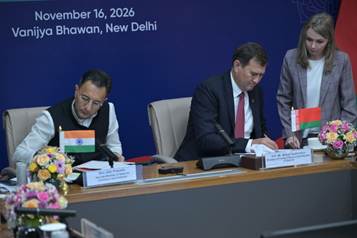
The two countries also signed the Protocol of the 12th Session,
reaffirming their commitment to expanding cooperation and translating the
existing friendly ties into stronger economic and commercial partnerships.
Addressing the business community, Prasada highlighted India's expanding
economic and manufacturing capabilities and said the longstanding friendship
between the two countries offered a strong foundation for mutually beneficial
business partnerships.
He urged companies from both countries to explore joint ventures,
technology partnerships, investment opportunities and greater
business-to-business engagement.
Highlighting the potential for collaboration in pharmaceuticals,
agricultural and industrial machinery, engineering, chemicals, digital
technologies and scientific research, Prasada also called for exploring
opportunities in market access, local partnerships, co-development and emerging
technologies, including unmanned aerial systems and advanced manufacturing.
Significantly, an India–Belarus Business and Investment Forum was
organised alongside the commission's session, bringing together business
representatives, industry associations and government institutions from both
countries to identify fresh opportunities for trade, investment and commercial
cooperation.
The forum witnessed participation from Belarusian companies operating in
diverse sectors, including automotive and agricultural machinery, mining
equipment, pharmaceuticals, chemicals, microelectronics, banking, agriculture
and engineering.
The participating companies discussed prospects for joint ventures,
technology transfer, localisation of manufacturing, research and development
and stronger supply-chain linkages.
Agricultural and civil unmanned aerial systems, pharmaceutical
cooperation, mining equipment, water treatment technologies and food processing
emerged as potential areas for deeper business collaboration.
Both sides emphasised the need for sustained engagement between their business communities and encouraged enterprises to take forward the opportunities identified during the forum.
India and Belarus agreed to continue working together to expand cooperation across the identified sectors and strengthen their economic partnership. The two countries also agreed to hold the 13th session of the Inter-Governmental Commission in 2027, with the dates and agenda to be finalised through diplomatic channels.