THEBUSINESSBYTES BUREAU
NEW DELHI, NOVEMBER 16, 2026
India and Thailand have stepped up efforts to deepen bilateral trade and
economic cooperation, with two-way commerce rising 12.6 per cent to USD 21.49
billion in the financial year 2025-26, as the two countries explored fresh
avenues of collaboration in digital payments, financial technology, investment
and market access.
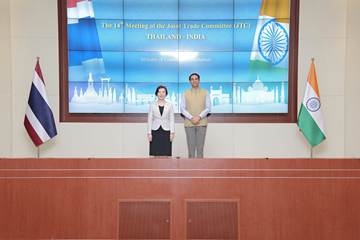
The issue figured prominently at the 14th meeting of the India-Thailand
Joint Trade Committee (JTC), held on November 16 at the Ministry of Commerce in
Nonthaburi, Thailand, where both sides reviewed the progress of bilateral
economic engagement and discussed measures to further expand trade and
investment flows.
The meeting was co-chaired by Additional Secretary in the Department of
Commerce, Ministry of Commerce and Industry, Nitin Kumar Yadav, and
Director-General of Thailand's Department of Trade Negotiations, Chotima
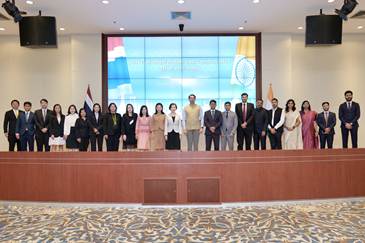
Iemsawasdikul. Representatives of various ministries, departments and
organisations from both countries also participated.
The two sides noted that Thailand accounted for 16.7 per cent of India's
total trade with the ASEAN region, underlining its growing significance as a
key economic partner. They acknowledged the role of the JTC in facilitating
trade and investment and reaffirmed their commitment to strengthening economic
ties and improving market access.
 India highlighted investment opportunities in key sectors, including
infrastructure and logistics, automobiles and electric vehicles, food
processing and agro-industries, electronics and semiconductors, as well as
tourism, hospitality and wellness.
Thailand, in turn, presented its economic outlook and investment
facilitation measures, including its "Co-Creation Co-Investment"
approach. India welcomed the initiative and agreed to examine it further in
consultation with the concerned ministries and departments.
In a significant push towards strengthening regional trade integration,
both countries discussed ways to improve the utilisation of the ASEAN-India
Trade in Goods Agreement (AITIGA) and the India-Thailand Early Harvest Scheme.
They also explored establishing a mechanism for the annual exchange of
bilateral trade data and information on the utilisation of preferential trade
benefits. The proposed mechanism is aimed at identifying untapped trade
opportunities, improving the use of tariff preferences and addressing
implementation-related bottlenecks.
Both sides stressed the need for an early and meaningful conclusion of
the ongoing review of AITIGA, which is expected to further strengthen trade
relations between India and ASEAN member countries.
Market access issues also featured prominently in the discussions, with
particular emphasis on agricultural, livestock and marine products. The two
countries deliberated on sanitary and phytosanitary measures, certification
procedures, quality and regulatory requirements, and the removal of non-tariff
barriers affecting traders.
The discussions also covered opportunities for cooperation in
pharmaceuticals and healthcare, AYUSH and traditional medicine, textiles,
plastics and petrochemicals, gems and jewellery, and the services sector.
Recognising the growing importance of digital connectivity in
facilitating cross-border commerce, India and Thailand also discussed
cooperation in fintech, linkage of India's Unified Payments Interface (UPI)
with Thailand's payment ecosystem and local currency settlement mechanisms to
facilitate smoother and more cost-effective trade transactions.
Collaboration between trade promotion organisations of the two countries was also discussed to strengthen business-to-business engagement and encourage greater participation of companies in bilateral trade and investment activities.
The meeting concluded with both sides reiterating their resolve to build on the positive momentum in economic relations, address trade-related challenges and unlock new opportunities for businesses, investors and exporters in both countries.