THEBUSINESSBYTES
BUREAU
NEW DELHI, JANUARY 28, 2026
India and
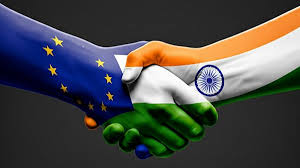
the European Union have broadly agreed on a comprehensive set of measures to
address the European bloc’s stringent carbon regulations on carbon-intensive
imports, marking a significant breakthrough in bilateral economic and climate
cooperation. The understanding includes financial support for decarbonisation,
technical assistance, and the creation of a joint working mechanism to iron out
operational challenges arising from the EU’s Carbon Border Adjustment Mechanism
(CBAM), official sources said on Wednesday.
From January
1, the EU began implementing CBAM, the world’s first carbon tariff framework,
which imposes levies on carbon-intensive products such as steel, cement and
aluminium. The regulation had emerged as one of the most contentious issues
during the India-EU free trade agreement negotiations, which were successfully
concluded earlier this week.
 As part of
the broad consensus, the two sides are working towards signing a memorandum of
understanding under which the EU will partner with India to help domestic
industries reduce their carbon footprint. The EU has committed nearly USD 500
million for the first two years to provide technical assistance, advanced
technology and funding to support India’s transition towards cleaner
production.
As part of
the broad consensus, the two sides are working towards signing a memorandum of
understanding under which the EU will partner with India to help domestic
industries reduce their carbon footprint. The EU has committed nearly USD 500
million for the first two years to provide technical assistance, advanced
technology and funding to support India’s transition towards cleaner
production.
While the EU
has maintained that it cannot offer country-specific concessions under CBAM,
citing the uniform applicability of the regulation to both foreign partners and
European domestic industry, it has agreed to greater transparency and
cooperation. A dedicated technical working group will be set up to ensure
complete visibility on how carbon footprints are measured and how tariffs are
calculated, helping resolve outstanding concerns.
In a key
assurance for Indian industry, the EU has agreed to accredit Indian verifiers
to audit firms’ carbon footprints, addressing cost and access issues that would
arise if verification were limited to Europe. It has also accepted India’s
proposal that any flexibility extended by the bloc to another country under
CBAM would automatically apply to India. Additionally, India’s domestic
policies that incentivise emission reductions and the levies collected under
them will be accounted for under CBAM to prevent double taxation on Indian
exporters.
Officials
described the engagement on CBAM as a “living dialogue”, allowing both sides to
address any future measures that may arise as the regulation evolves.
Beyond trade
and climate issues, the agreement delivers a major boost to mobility for Indian
students and professionals. Sources termed the mobility partnership as one of
the EU’s best-ever commitments, covering intra-corporate transferees,
contractual service suppliers, independent professionals and trainees.
Intra-corporate transfers will be allowed across all services sectors with an
initial stay of three years, extendable by two more years, and will also cover
spouses and dependents.
Provisions
for contractual service suppliers will apply to 37 sectors, while independent
professionals will be covered in 17 sectors, including high-interest areas for
India such as IT, business and professional services. Student mobility will be
allowed without restrictions, with post-study work opportunities, a move
expected to accelerate the growing flow of Indian students to Europe by providing
greater certainty and predictability.
Both India
and the EU have reiterated their political commitment to sign and ratify the
free trade agreement at the earliest, despite the legal scrubbing and
ratification process taking time. Recent engagements with key stakeholders
indicate strong intent on the EU side to complete the process on an accelerated
timeline.
Once
implemented, the India-EU free trade agreement, covering nearly a quarter of
global GDP, will eliminate tariffs on 99 per cent of Indian exports to the EU
and reduce duties on over 97 per cent of EU exports to India. The EU estimates
annual tariff savings of up to four billion euros for its exporters. Indian
sectors such as textiles, apparel, leather goods, handicrafts, footwear and
marine products are expected to gain significantly, while Europe stands to
benefit in wine, automobiles, chemicals and pharmaceuticals, with wine duties
set to fall sharply from the current 150 per cent to a range of 20–30 per cent
under the pact.