THEBUSINESSBYTES BUREAU
NEW DELHI, JANUARY 30, 2026
In a
breakthrough that could redefine the future of renewable energy storage, Indian
scientists have developed a self-charging energy storage device that is powered
directly by sunlight, eliminating the need for separate solar panels and
batteries. The innovation, known as a photo-capacitor, seamlessly integrates
solar energy harvesting and energy storage into a single compact system,
offering a promising pathway toward clean, efficient and self-sustaining power
solutions.
The
cutting-edge device has been developed by scientists at the Centre for Nano and
Soft Matter Sciences (CeNS), Bengaluru, an autonomous institute under the
Department of Science and Technology (DST), Government of India. By merging two
critical functions — converting sunlight into electricity and storing that
electricity for later use — the photo-capacitor addresses one of the most
persistent challenges in renewable energy systems: complexity and energy loss
arising from multi-component designs.
Conventionally,
solar energy systems rely on separate units for power generation and storage,
such as photovoltaic panels paired with batteries or supercapacitors. While
effective, these hybrid systems require additional power management electronics
to balance voltage and current mismatches, adding to cost, device size and
energy losses. Such limitations become particularly problematic for
miniaturised, portable, wearable and autonomous devices, where space and
efficiency are critical.
The newly
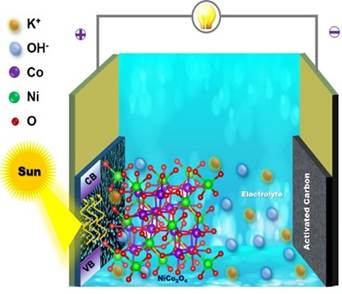
developed photo-rechargeable supercapacitor overcomes these challenges by
combining both functions within a single architecture. Under the guidance of
Dr. Kavita Pandey, the research team engineered a novel electrode using
binder-free nickel-cobalt oxide (NiCo₂O₄) nanowires
grown uniformly on nickel foam through a simple in situ hydrothermal process.
The result is a highly porous, conductive three-dimensional
network that can simultaneously absorb sunlight and store electrical charge.
These
nanowires, measuring just a few nanometres in diameter and several micrometres
in length, play a crucial role in the device’s performance. Their unique structure
enhances light absorption while enabling rapid charge transport and efficient
energy storage. When tested under illumination, the NiCo₂O₄ electrode
demonstrated a striking 54 per cent increase in capacitance, rising from 570 to
880 millifarads per square centimetre at a current density of 15
milliamperes per square centimetre. Even after 10,000 charge-discharge cycles,
the electrode retained 85 per cent of its original capacity, highlighting its
robustness and long-term stability.
To assess
real-world applicability, the researchers assembled an asymmetric
photo-supercapacitor using activated carbon as the negative electrode and NiCo₂O₄ nanowires
as the positive electrode. The device delivered a stable output voltage of 1.2
volts and maintained 88 per cent capacitance
retention even after 1,000 photo-charging cycles. Notably, it operated
efficiently across a wide range of lighting conditions, from low indoor
illumination to intense two-sun exposure, demonstrating its adaptability and
resilience.
Beyond
experimental validation, the team also conducted detailed theoretical studies
to understand the exceptional efficiency of the nanowire system. The analysis
revealed that nickel substitution within the cobalt oxide framework narrows the
material’s band gap to around 1.67 electron volts and induces half-metallic
behaviour. This rare property allows the material to act as a semiconductor for
one electron spin and metallic for the other, significantly enhancing charge
transport and electrical conductivity — an advantage particularly valuable for
photo-assisted energy storage.
By
integrating sunlight capture and energy storage into a single device, the
innovation enables the development of self-charging power systems capable of
functioning anywhere, including remote and off-grid regions. Such technology
has the potential to reduce dependence on fossil fuels and conventional
batteries while supporting the transition toward sustainable and
environmentally friendly energy solutions.
Published in
Sustainable Energy & Fuels, a
journal of the Royal Society of Chemistry, the study marks a significant
milestone in renewable energy research. It also underscores the power of
combining experimental work with theoretical insights to unlock new
possibilities in advanced materials science. With further development and
scaling, this new class of smart, photo-rechargeable energy storage devices
could play a vital role in advancing India’s clean energy ambitions and
inspiring similar innovations across the globe.