THEBUSINESSBYTES
BUREAU
NEW DELHI, JANUARY 29,
2026
India’s
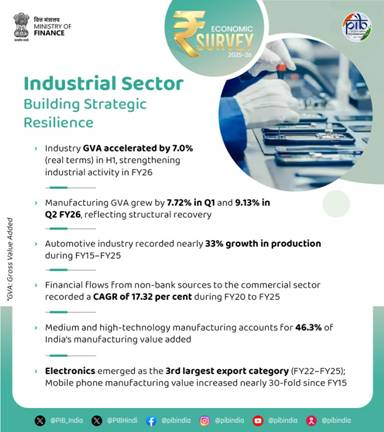
industrial engine is gathering fresh momentum, with the sector’s Gross Value
Added expanding by a robust 7.0 per cent year-on-year in real terms during the
first half of FY2025-26, underscoring a clear acceleration in industrial activity
and reaffirming the economy’s structural strength amid a challenging global
backdrop. The Economic Survey 2025-26, tabled in Parliament on Wednesday by
Union Minister of Finance and Corporate Affairs Smt. Nirmala Sitharaman,
highlights that the rebound marks a notable improvement over the 5.9 per cent
growth recorded in the previous fiscal year, reflecting the cumulative impact
of policy reforms, infrastructure expansion and technology-led transformation
across industries.
The Survey
points to manufacturing as a key growth driver, with Manufacturing GVA rising
by 7.72 per cent in the first quarter and further strengthening to 9.13 per
cent in the second quarter of FY26. This performance, it notes, is rooted in
deeper structural shifts underway within the sector, including a gradual move
towards higher-value manufacturing, improved availability of industrial
infrastructure through corridor-led development, and rising adoption of
technology, digitisation and formalisation across firms. These changes are
reshaping India’s industrial landscape, enabling greater productivity,
efficiency and global competitiveness.
 Significantly,
medium- and high-technology activities now account for 46.3 per cent of India’s
total manufacturing value added, a milestone that reflects the growing
sophistication of the country’s industrial base. The Survey attributes this
transformation to targeted government initiatives such as the Production Linked
Incentive schemes and the India Semiconductor Mission, along with the steady
strengthening of domestic capacities in electronics, pharmaceuticals, chemicals
and transportation. This shift has also translated into an improved global
standing, with India’s ranking in Competitive Industrial Performance moving up
to 37th in 2023 from 40th in 2022, signalling rising industrial capability on
the world stage.
Significantly,
medium- and high-technology activities now account for 46.3 per cent of India’s
total manufacturing value added, a milestone that reflects the growing
sophistication of the country’s industrial base. The Survey attributes this
transformation to targeted government initiatives such as the Production Linked
Incentive schemes and the India Semiconductor Mission, along with the steady
strengthening of domestic capacities in electronics, pharmaceuticals, chemicals
and transportation. This shift has also translated into an improved global
standing, with India’s ranking in Competitive Industrial Performance moving up
to 37th in 2023 from 40th in 2022, signalling rising industrial capability on
the world stage.
On the
financing front, while bank-based industrial credit growth from commercial
banks moderated to 8.24 per cent in FY25 from 9.39 per cent in FY24, the Survey
emphasises that this does not reflect a slowdown in overall funding to
industry. Instead, it highlights a diversification of financing sources, with
non-bank financial flows to the commercial sector recording a strong compound
annual growth rate of 17.32 per cent between FY20 and FY25. Quoting the Monthly
Economic Review of August 2025, the Survey notes that the decline in bank
credit coincided with an increase in the overall flow of financial resources to
the commercial sector, pointing to a maturing and broadening financial
ecosystem.
Core
industries have continued to maintain strong momentum, reinforcing the
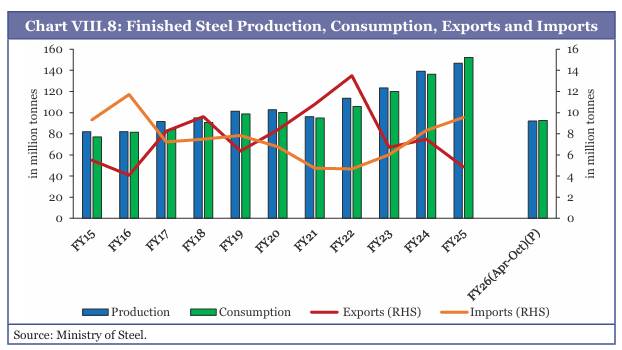
industrial recovery. India remains the world’s second-largest producer of steel
and cement, with the Survey underscoring the transformative changes witnessed
in the steel sector over the past five years, driven by robust domestic demand
from construction and manufacturing. In cement, India’s per capita consumption
stands at around 290 kg, significantly below the global average of 540 kg,
indicating substantial headroom for growth. The Survey notes that the
government’s sustained focus on mega infrastructure projects—spanning highways,
railways, housing, smart cities and rural development—is expected to
significantly boost cement demand in the coming years.
Energy and
raw material supply has also strengthened, with India’s coal industry reaching
historic levels of production in FY25. Coal output touched 1,047.52 million
tonnes, marking a 4.98 per cent increase over the previous year, providing
critical support to power generation and energy-intensive industries.
Meanwhile, the chemicals and petrochemicals sector continues to play a pivotal
role in industrial development, contributing 8.1 per cent to the overall
manufacturing GVA in FY24, reflecting its importance as a backbone for multiple
downstream industries.
The
automotive sector has emerged as another major growth pillar, recording nearly
33 per cent growth in production over the decade from FY15 to FY25. The Survey
highlights that government-led initiatives to promote electric mobility have
significantly reshaped the industry’s trajectory, leading to a sharp rise in
electric vehicle registrations in recent years. Strategic policy interventions
such as the PLI schemes for automobiles and advanced chemistry cell battery
storage, the PM E-DRIVE scheme, PM e-Bus Sewa Payment Security Mechanism, and
the scheme to promote manufacturing of electric passenger cars have
collectively strengthened domestic manufacturing capabilities and accelerated
the transition towards cleaner mobility.
India’s
electronics sector stands out as a standout success story, having undergone a
remarkable structural transformation in recent years. The Survey notes that
electronics has climbed from the seventh-largest export category in FY22 to the
third-largest and fastest-growing by FY25. This surge has been driven by a
sharp rise in domestic production and exports, with the mobile manufacturing
segment at the centre of this expansion. Mobile phone production value
witnessed an extraordinary nearly 30-fold increase, rising from ₹18,000 crore in FY15 to ₹5.45
lakh crore in FY25, underscoring India’s emergence as a global manufacturing
hub for electronics.
The
pharmaceutical industry, another cornerstone of India’s industrial ecosystem,
continues to consolidate its global leadership. Ranked as the world’s
third-largest by volume, the sector meets around 20 per cent of global generics
demand and exported to 191 countries in FY25. The Survey notes that the
industry’s annual turnover reached ₹4.72 lakh crore in FY25,
with exports growing at a compound annual rate of 7 per cent over the past
decade, highlighting its resilience and expanding global footprint.
Overall, the
Economic Survey 2025-26 paints an optimistic picture of India’s industrial
sector, noting that strong momentum has been sustained despite an evolving and
uncertain global environment. It credits reforms in infrastructure, logistics,
ease of doing business and innovation systems for strengthening the foundations
of industrial growth. Looking ahead, the Survey emphasises that the next phase
of industrialisation will require a calibrated shift from a model focused
largely on import substitution to one centred on scale, competitiveness,
innovation and deeper integration into global value chains. Rather than
striving for complete self-reliance across all segments, the Survey argues that
India must build strategic resilience through diversification, deeper
capabilities and greater private sector investment in research and development,
technology adoption, skills and quality systems — laying the groundwork for
sustained and inclusive industrial growth in the years ahead.