THEBUSINESSBYTES
BUREAU
NEW DELHI,
JANUARY 26, 2026
India marked its 77th Republic Day
with a majestic parade on Kartavya Path that blended military might, cultural
grandeur and diplomatic symbolism, projecting a confident nation rooted in
unity and prepared for the future. Against the evocative backdrop of 150 years
of *Vande Mataram*, the celebrations carried a distinct imprint of courage and
resolve, with the armed forces’ Operation Sindoor emerging as a powerful motif
of valour and preparedness.
The ceremonial proceedings began with
President Droupadi Murmu taking the salute after arriving at Kartavya Path in a
traditional buggy, accompanied by the President of the European Council Antonio
Costa and President of the European Commission Ursula von der Leyen, the chief
guests for the occasion. Their presence underscored India’s growing global
stature and deepening strategic engagement with Europe. Prime Minister Narendra
Modi, Defence Minister Rajnath Singh, senior Union ministers, top military
leadership, diplomats and officials witnessed the spectacle from the saluting
dais.
 The parade opened on a vibrant
cultural note as nearly a hundred artistes set the rhythm with a sweeping
musical presentation themed *Vividata Mein Ekta*, celebrating India’s
civilisational diversity and collective harmony. Precision and pageantry
followed as the marching columns moved in step, led by Parade Commander Lt
General Bhavnish Kumar, General Officer Commanding, Delhi Area.
The parade opened on a vibrant
cultural note as nearly a hundred artistes set the rhythm with a sweeping
musical presentation themed *Vividata Mein Ekta*, celebrating India’s
civilisational diversity and collective harmony. Precision and pageantry
followed as the marching columns moved in step, led by Parade Commander Lt
General Bhavnish Kumar, General Officer Commanding, Delhi Area.
Operation Sindoor took centrestage
through a striking tri-services tableau that showcased replicas of key weapon
systems employed during the operation earlier this year. A glass-encased
integrated operations centre rolled down the boulevard, visually narrating the
coordination and technological prowess behind modern Indian warfare, including
the deployment of BrahMos and S-400 missile systems.
For the first time, the Indian Army
presented a phased Battle Array Format, integrating ground and aerial combat
elements in a seamless display. The reconnaissance component featured the
storied 61 Cavalry in active combat gear, followed by high-mobility
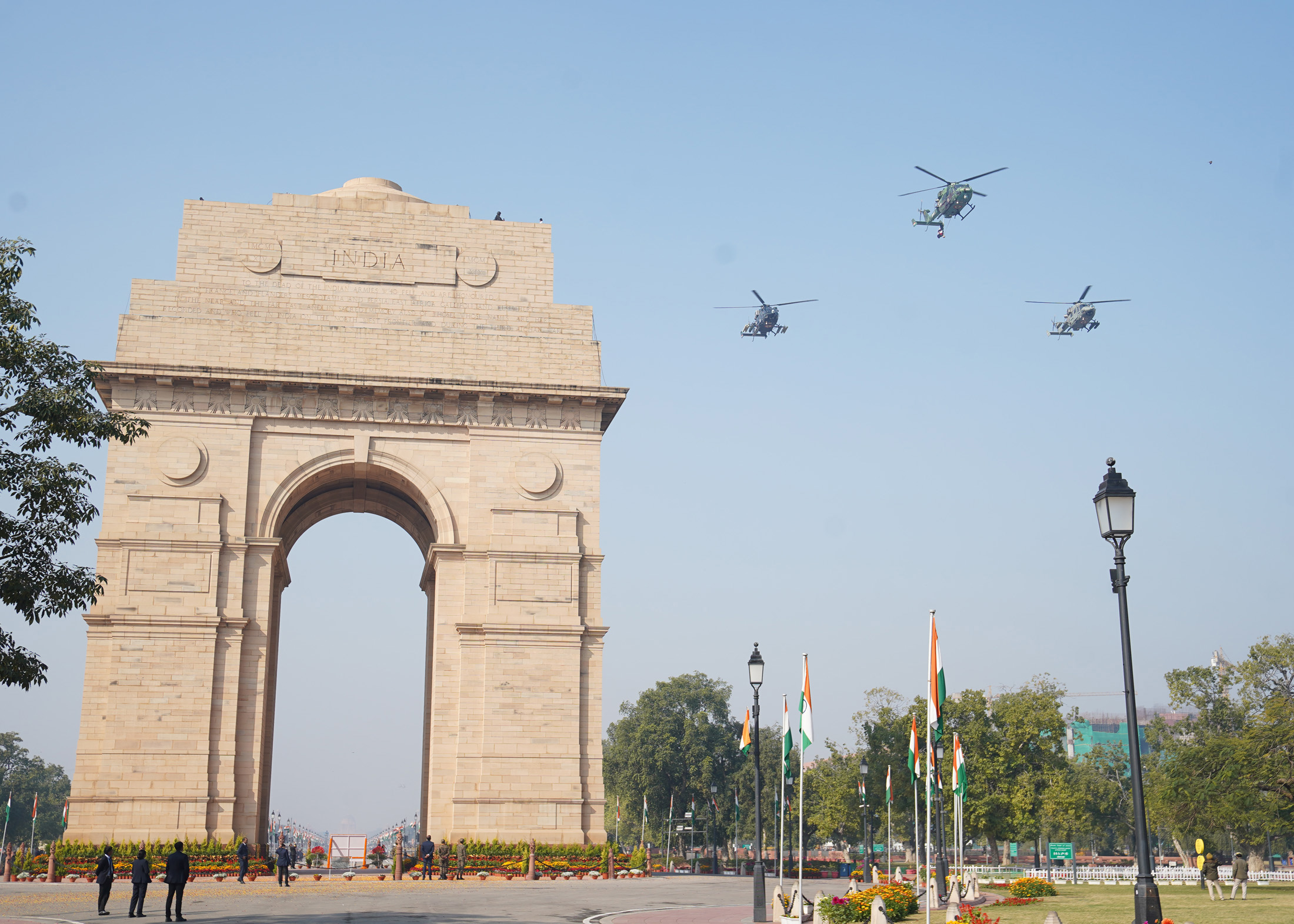
reconnaissance vehicles. Overhead, indigenous Dhruv Advanced Light Helicopters
and their armed Rudra variants flew in Prahar formation, illustrating
battlefield dominance and rapid response capability. Heavy armour soon
followed, with T-90 Bhishma tanks and the indigenous Arjun main battle tanks
advancing with air cover from Apache AH-64E and Prachand light combat
helicopters. Mechanised strength was further highlighted by BMP-II infantry
combat vehicles and the Nag missile system in its tracked Mk-2 configuration.
India’s cutting-edge missile
capabilities drew special attention with the display of the Suryastra Universal
Rocket Launcher System, Akash surface-to-air missiles and the supersonic
BrahMos cruise missile, reinforcing the country’s growing self-reliance in
defence manufacturing. The Defence Research and Development Organisation
showcased its hypersonic glide missile LR-AShM, designed to strike both static
and moving targets with high precision, featuring indigenously developed
avionics and advanced sensor systems.
Adding a significant international
dimension, a military contingent from the European Union marched with the flags
of Operations Atalanta and Aspides, marking the EU’s first-ever participation
in a military parade outside Europe. The gesture symbolised expanding security
cooperation and mutual trust.
The Indian Navy contingent, comprising
144 young sailors, marched smartly under the leadership of Lt Karan Nagyal,
followed by a visually rich naval tableau themed *Strong Navy for a Strong
Nation*. It traced India’s maritime legacy from a reconstructed fifth-century
stitched ship, INSV Kaundinya, through the Maratha Navy’s Gurab-class vessels,
to modern indigenous platforms such as aircraft carrier INS Vikrant and INS
Udayagiri. The tableau also depicted the historic circumnavigation route of
INSV Tarini during the Navika Sagar Parikrama-II expedition, with Sea Cadets
Corps members marching alongside, reflecting youth engagement in maritime
traditions.
The Indian Air Force contingent, led
by Squadron Leader Jagdesh Kumar, marched in crisp formation before the skies
erupted in thunder. Two Rafale fighters, flanked by MiG-29s, Su-30 MKIs and a
Jaguar aircraft, roared past in the dramatic Spearhead formation, symbolically
dubbed the “Sindoor Formation,” drawing loud applause from spectators.
Altogether, 30 tableaux representing
states, Union Territories and central ministries rolled past the saluting dais,
weaving together themes of cultural heritage, technological advancement and
national progress. The energy peaked with breathtaking stunts by the joint
DareDevils motorcycle team from the CRPF and Sashastra Seema Bal, showcasing
balance, courage and teamwork.
The celebrations concluded with a
grand aerial fly-past involving 29 aircraft, including fighter jets, transport
planes and helicopters. Iconic platforms such as Rafale, Su-30 MKI, MiG-29 and
Jaguar flew alongside strategic assets like the C-130, C-295 and the Navy’s
P-8I, forming formations named Arjan, Vajraang, Varuna and Vijay, leaving
trails of pride across the winter sky.
As the echoes faded over Kartavya
Path, the 77th Republic Day parade stood as a resounding statement of India’s
unity, resilience and rising power, with the spirit of Sindoor symbolising
sacrifice, strength and an unyielding commitment to the nation.