
THEBUSINESSBYTES
BUREAU
NEW DELHI,
JANUARY 20, 2026
The Ministry of Food Processing
Industries (MoFPI), Government of India, has charted an ambitious and
forward-looking roadmap to transform India’s food processing ecosystem into a
globally competitive, inclusive and innovation-driven sector following a
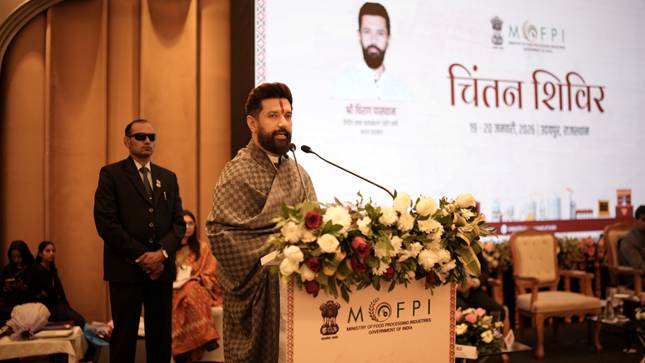
two-day Chintan Shivir held at Udaipur, Rajasthan. Organised under the
chairmanship of the Minister for Food Processing Industries, the Shivir
reflected a whole-of-government and whole-of-industry approach, bringing together
senior representatives from 22 Central Ministries, 27 States and Union
Territories, over 30 industry members, academic institutions, NIFTEMs and
Invest India.
The deliberations, attended by the
Secretary and Special Secretary of the Ministry along with other senior
officials, saw active participation from Additional Chief Secretaries,
Principal Secretaries and senior officials from key Central Ministries and
Departments, including the Department of Commerce and the Department of
Agriculture and Farmers Welfare. The wide-ranging engagement ensured rich,
outcome-oriented discussions focused on strengthening India’s food processing
sector through policy reforms, innovation, value-chain integration and
collaborative action.
Inaugurating the Chintan Shivir, the
Union Minister for Food Processing Industries, Chirag Paswan, underlined the
Government’s steadfast commitment to building a modern, competitive and
inclusive food processing ecosystem that enhances farmer incomes, reduces
post-harvest losses, promotes value addition, strengthens food safety and
nutrition, and generates large-scale employment, particularly for youth and
women. He described food processing as a critical pillar for strengthening
agri-value chains, expanding India’s export footprint and positioning the
country as a trusted global supplier of high-quality, value-added and
sustainable food products in alignment with national development priorities. On
the occasion, special publications highlighting technological advancements in
food processing and success stories of Start-up Grant Challenge winners were
released, reinforcing the Ministry’s focus on innovation and entrepreneurship.
The Chintan Shivir featured intensive
brainstorming across six thematic groups that examined key challenges and
opportunities across the food processing value chain. Discussions focused on
doubling the level of food processing in India over the next five years,
enhancing exports and global positioning, developing high-growth segments such
as nutraceuticals, food fortification, plant-based protein-rich products and
alcoholic beverages, strengthening food safety and quality frameworks,
reinforcing agri-food value chains from farm to fork, and addressing myths and
misconceptions around processed foods through evidence-based discourse on
nutrition, health and food security.
The groups presented a comprehensive
set of actionable recommendations, including strengthening farm-level
aggregation and MSME participation, expanding modern processing capacity,
cold-chain and logistics infrastructure, and improving quality and safety
standards. To boost exports, emphasis was placed on export-oriented
infrastructure, improved market access through trade agreements, promotion of
‘Brand India’, creation of a single integrated digital platform for market
intelligence and regulatory support, and leveraging gastro-diplomacy.
Institutional reforms such as establishing a National Food Processing Promotion
Council, introducing a Bharat Quality Food Mark, developing innovation
clusters, digital traceability platforms and targeted support for emerging
segments were also proposed. The recommendations further highlighted the need
for science- and risk-based food safety regulation, AI-enabled monitoring,
faster testing systems, cluster-based agri-food processing hubs, value-chain
financing, farmer capacity building, indigenous manufacturing of food
processing machinery and end-to-end traceability. Addressing nutrition and food
security, the groups stressed scientific communication, public awareness
initiatives, inclusion of food science education in schools, research support
and evidence-based nutritional guidelines aligned with Indian food habits.
States and Union Territories played a
pivotal role by sharing best practices and policy innovations. Uttar Pradesh
outlined a roadmap to double its food processing capacity through incentives,
food parks and a strong single-window system, while Maharashtra showcased
leadership under PMFME, promotion of fortified foods and women-led enterprises.
Andhra Pradesh highlighted successful cluster-based interventions in coffee,
cocoa and fisheries supported by central and state schemes. Other States such
as Chhattisgarh, Madhya Pradesh and Uttarakhand presented reform-led,
export-oriented and horticulture-driven models, while Bihar, Andaman and
Nicobar Islands and Telangana contributed region-specific insights, reinforcing
inter-state learning and collaboration.
On the sidelines, the Minister
inaugurated a Common Incubation Facility at Krishi Upaj Mandi Samiti, Udaipur,
developed under the PMFME scheme to process minor forestry products such as
custard apple, jamun, amla, aloe vera and spices. The facility is expected to
strengthen value addition, support local entrepreneurs and promote sustainable
utilisation of regional agri and forest produce, contributing to inclusive
growth and livelihood generation.
Concluding the Chintan Shivir, the
Minister appreciated the collective efforts of all participants in arriving at
practical and implementable recommendations and reiterated the Ministry’s
commitment to handholding stakeholders. He urged all stakeholders to work
collaboratively for time-bound implementation, emphasising that sustained
coordination between the Centre, States, industry and institutions will be key
to realising India’s ambition of becoming a global leader in food processing.