The real strength of a free press is not
reflected in how loudly it speaks about those in power, but in how fearlessly
it speaks when those in power need to be questioned, says Priyabrat Biswal
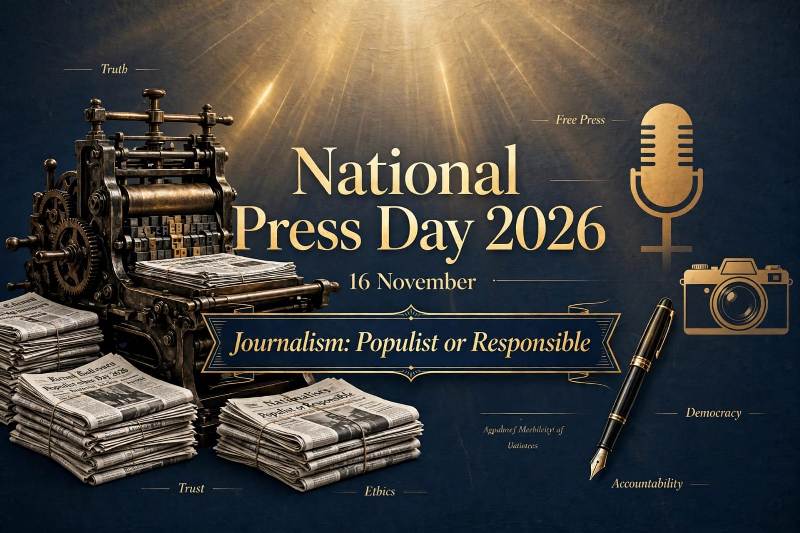
As India observes National Press Day, the theme for this year,
“Journalism: Populist or Responsible”, invites us to reflect on a fundamental
question: Is journalism fulfilling its responsibility towards society, or is it
gradually losing its voice amid the growing influence of political power,
commercial interests and competing narratives?
The true purpose of journalism is not merely to publish news, attract
audiences or shape public opinion. Its greatest responsibility is to speak the
truth, raise uncomfortable questions, expose wrongdoing and give a voice to
those who often remain unheard. Journalism must stand with facts, public
interest and democratic values, irrespective of whose interests are challenged.
True journalism is not about pleasing those in power; it is about serving
the people.
In a democratic society like India, the media plays an indispensable role
as a bridge between the government and citizens, a watchdog over institutions
and a platform for public concerns. Issues affecting ordinary people every day —
rising prices, unemployment, inadequate healthcare, deteriorating
infrastructure, corruption, environmental degradation, farmers' distress, educational
challenges and social injustice — deserve sustained attention.
These are not merely routine news items; they directly affect people's
lives, livelihoods and dignity. Journalism must bring such concerns to the
forefront, investigate their causes, question those responsible and pursue them
until meaningful answers and accountability emerge.
Unfortunately, the significance of journalism is sometimes overshadowed
by sensationalism, political narratives, selective reporting and excessive
emphasis on news that attracts immediate attention. Serious public issues are
often pushed aside by manufactured controversies and partisan debates.
Responsible journalism must rise above this tendency. It must independently
examine facts, verify claims, investigate allegations and present different
perspectives fairly.
Equally important is the independence of the media from government and
corporate pressure. No government, political establishment, business house or
powerful individual should dictate what journalists can report, which issues
they should highlight or which questions they must avoid. The freedom to
investigate, question and criticise is not merely a privilege of the media; it
is an essential pillar of democracy.
A government should be judged not by how favourably it is portrayed, but
by how transparently it responds to questions and criticism. Similarly,
corporate influence and advertising relationships must never be allowed to
determine editorial priorities or suppress uncomfortable truths.
The credibility of journalism rests on one essential principle: the
editorial voice must remain independent of every form of external influence.
There are still journalists across the country who pursue difficult
stories with courage, dedication and professional integrity. They investigate
beyond official statements, visit neglected communities, document people's
hardships, question powerful authorities and bring uncomfortable truths into
public view. Many work with limited resources and under challenging circumstances,
often without the recognition they deserve.
Their contribution must be acknowledged. A journalist who exposes
corruption, highlights the suffering of marginalised communities, questions
administrative failures or brings an ignored public grievance to the attention
of the authorities performs a service of immense democratic value.
The worth of a journalist should not be measured merely by the popularity
of a television programme, the circulation of a newspaper or the number of
digital followers. It should be measured by the quality of reporting, depth of
investigation, strength of evidence, fairness of presentation and courage to
uphold the truth.
A small regional publication or independent digital journalist
highlighting a serious local issue may serve the public far more meaningfully
than a large media organisation preoccupied with sensationalism. A
well-researched report about a village without drinking water, a government
hospital lacking essential facilities or a community deprived of basic rights
can make a genuine difference to thousands of lives.
India's evolving media landscape, encompassing print, television and
digital platforms, has created opportunities for diverse voices to reach wider
audiences. Independent journalists, regional publications and grassroots
reporters deserve encouragement. A fair and sustainable media environment,
supported by transparent and objective institutional and advertising policies,
is important. However, financial support must never become an instrument to
reward favourable coverage or discourage critical reporting.
Ultimately, the relationship between journalism and society must be
founded on public trust. That trust is earned through accuracy, impartiality,
courage, accountability and consistency. Journalists
must remain committed to facts rather than propaganda, professional ethics
rather than personal interests, and public welfare rather than institutional
convenience.
On this National Press Day, governments, corporate organisations, media
owners and citizens must recognise that an independent press is not an
adversary of democracy but one of its strongest safeguards. Questioning
authority is not hostility; it is an essential part of democratic
accountability.
Let us stand firmly behind journalists who write with conviction, report
with integrity and refuse to compromise the truth for personal, political or
commercial considerations. They may not always have the loudest platforms or
the largest audiences, but their work represents the conscience of journalism.
The real strength of a free press is not
reflected in how loudly it speaks about those in power, but in how fearlessly
it speaks when those in power need to be questioned.
This National Press Day, let us renew our commitment to journalism that
is fearless without being reckless, critical without being prejudiced,
independent without being irresponsible and sensitive to the everyday realities
of ordinary people.
Because when journalism loses its courage, society loses one of its most
important voices. And when the press remains free, fearless and truthful,
democracy remains stronger.
Contact: Cellphone: 7978664134
E-mail: [email protected]