THEBUSINESSBYTES BUREAU
BHUBANESWAR, NOVEMBER 6, 2026
With growing urbanisation and rising vehicular pressure posing fresh
challenges to cities, the Odisha Government is stepping up efforts to reshape
urban mobility and strengthen urban governance, with Housing and Urban
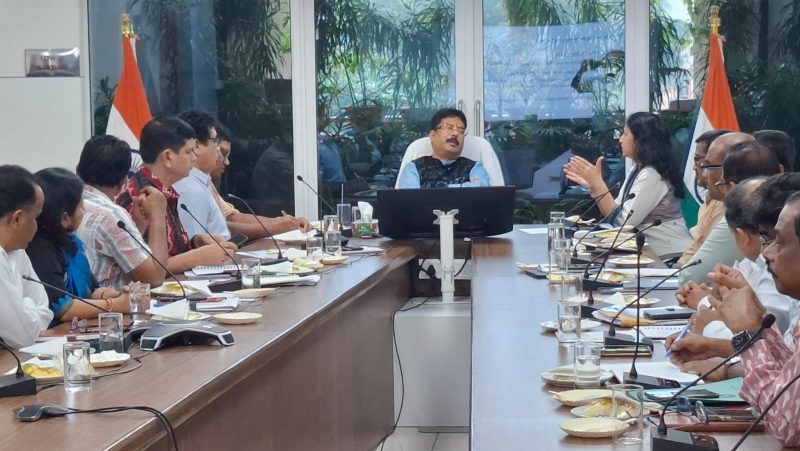
Development Minister Dr Krushna Chandra Mahapatra on Friday reviewing a series
of key developmental initiatives, including the Draft Odisha Parking Policy
2026, Urban Mobility Plan and Urban Challenge Fund.
At a high-level review meeting held at the conference hall on the third
floor of Kharavel Bhawan here, the Minister took stock of the progress of
priority programmes of the Housing and Urban Development Department and
emphasised the need for a coordinated, sustainable and forward-looking approach
to urban development across the State.
The meeting was attended by Additional Chief Secretary of the Department
Usha Padhee, Director of Municipal Administration Arindam Dakua, Special
Secretary Gangadhar Naik and Binaya Kumar Dash, along with Additional
Secretaries and other senior departmental officers.
A major focus of the deliberations was the Draft Odisha Parking Policy
2026, which seeks to overhaul parking management in urban areas through a
planned, regulated and technology-driven framework. The proposed policy aims to
address mounting pressure on limited urban road space caused by the increasing
number of vehicles while ensuring that parking arrangements complement broader
sustainable mobility objectives.
Significantly, the proposed framework seeks to shift the focus from
vehicle-centric urban planning to people-centric mobility, giving priority to
pedestrians, cyclists, persons with disabilities, emergency services and public
transport in the allocation of road space.
It envisages the preparation of city-level Parking Master Plans and
neighbourhood-specific Parking Area Management Plans to facilitate scientific,
location-sensitive and efficient parking arrangements. The proposed measures
include demand-based parking charges, differential pricing for on-street and
off-street parking, digital parking permits, real-time parking information,
electronic payment facilities and technology-enabled monitoring systems.
The policy also promotes optimum utilisation of existing parking
infrastructure through shared parking facilities, besides encouraging EV-ready
parking spaces and better integration of parking infrastructure with public
transport and non-motorised transport networks.
Recognising the varying mobility requirements of different urban areas,
the draft framework proposes special parking and traffic management
arrangements for commercial centres, hospitals, educational institutions,
residential neighbourhoods, industrial zones and transport hubs. Effective
implementation would be supported by institutional coordination among Urban
Local Bodies, Traffic Police and other concerned agencies.
The meeting also reviewed the Urban Mobility Plan and Urban Challenge
Fund, with discussions centred on strengthening the planning, financing and
implementation framework for future urban infrastructure and mobility projects.
The functioning of District Urban Development Agencies (DUDAs) also came under
scrutiny, with emphasis on enhancing institutional efficiency and ensuring
effective execution of urban development programmes.
The deliberations provided an opportunity to assess the progress of
ongoing initiatives, identify emerging priorities and reinforce coordination
among different wings of the Department to expedite development interventions
across Odisha.
The proposed policy initiatives assume significance as Odisha's cities grapple with the twin challenges of rapid urban expansion and increasing pressure on civic infrastructure. A structured parking management system, integrated mobility planning and stronger urban institutions are expected to play a crucial role in making cities more accessible, organised and environmentally sustainable.
The review underlines the State Government's commitment to building future-ready urban centres where efficient mobility, improved governance and quality civic infrastructure go hand in hand, paving the way for more liveable and sustainable cities across Odisha.