
THEBUSINESSBYTES BUREAU
BHUBANESWAR, NOVEMBER 27, 2026
In a major push towards easing traffic congestion and strengthening urban
public transport, the Odisha government is set to move ahead with a Bus
Priority Lane pilot project on two major traffic corridors in Bhubaneswar,
aiming to ensure faster, safer and more reliable bus services.
The proposed initiative, spearheaded by the Housing and Urban Development
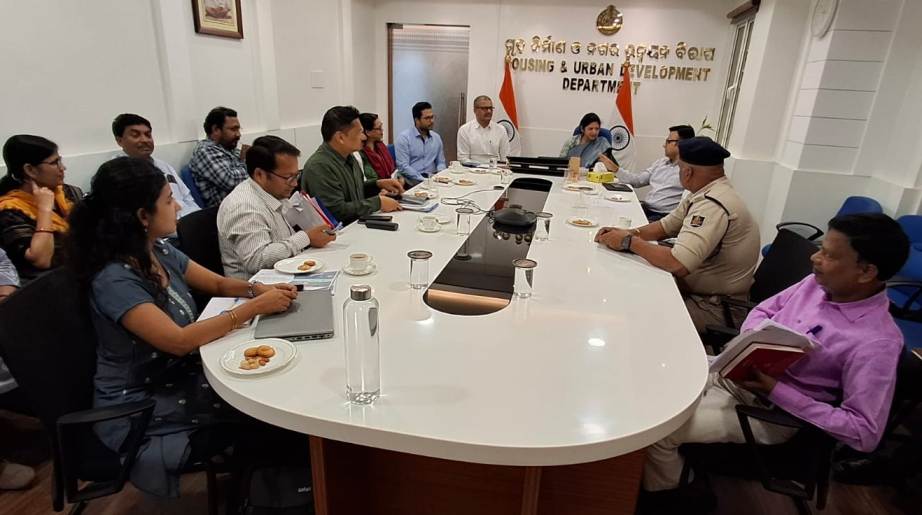
Department, was discussed at a high-level review meeting chaired by Additional
Chief Secretary, Housing and Urban Development Department, Usha Padhee. The
meeting deliberated on a comprehensive strategy for traffic decongestion,
pedestrianisation, improved lane discipline and dedicated priority lanes for
Ama Buses.
The meeting also explored the proposal to engage transgender persons as
Traffic Wardens, reflecting the State government's commitment to inclusive
participation, social empowerment and dignified livelihood opportunities.
Making a detailed presentation, Comprehensive Region Urban Transport
(CRUT) Managing Director Md. Siddique Alam outlined the proposed pilot
corridors, infrastructure requirements, traffic management arrangements and
implementation strategy. The project has been formulated through consultations
involving CRUT, Bhubaneswar Municipal Corporation (BMC), Bhubaneswar
Development Authority (BDA), Bhubaneswar Smart City Limited, Traffic Police,
Works Department and other concerned agencies.
Two high-demand corridors have been identified for the pilot project. The
first is the Airport-Nandankanan stretch, covering approximately 18 km, while
the second is the Vani Vihar-Sishu Bhawan corridor, spanning around five km.
The Airport-Nandankanan corridor currently caters to approximately
9,000-10,000 passengers daily through six routes operated by 63 buses.
Similarly, the Vani Vihar-Sishu Bhawan corridor serves around 5,000-6,500
passengers daily through six routes with a fleet of 64 buses. The dedicated
priority lanes are expected to minimise delays caused by mixed traffic and make
bus journeys more predictable and dependable.
As part of the infrastructure improvement plan, a field assessment has
identified the requirement for 18 additional Bus Queue Shelters, including 10
along the Airport-Nandankanan corridor and eight along the Vani Vihar-Sishu
Bhawan stretch. Existing shelters will also be relocated wherever necessary,
while bus bays at five identified traffic bottlenecks — KIIT Square, Patia
Square, Damana Square, Niladri Vihar Square and Jaydev Vihar Square — will be
improved to prevent obstruction to the smooth movement of vehicles.
The proposed priority lanes will primarily cater to Ama Bus services,
while also allowing ambulances, fire services and other authorised emergency
and critical-response vehicles. The review meeting also examined operational
issues, including the positioning of priority lanes, traffic signal
optimisation, rationalisation of parking spaces and effective regulation of
auto-rickshaws and other para-transit vehicles.
Emphasising the need for a coordinated approach, Smt. Padhee directed the
concerned agencies to take forward the initiative in a time-bound manner. She
underscored that traffic decongestion cannot be achieved through isolated
interventions and requires integrated planning, effective enforcement,
disciplined road usage and improved public transport services.
She also called for close coordination among CRUT, Traffic Police, BMC,
BDA, Works Department and other stakeholders to ensure that the proposed
interventions are practical, citizen-friendly and effective at the ground
level.
It was decided to undertake a detailed technical and feasibility
assessment covering lane configuration, traffic impact, cost-benefit analysis
and standard operating procedures. The assessment is scheduled to be completed
within one month from December 1, 2026.
The phased implementation strategy will include necessary civil
infrastructure improvements, relocation of bus shelters, parking management,
traffic signal optimisation and technology-enabled enforcement. A 15-day dry
run will be conducted before the full-scale launch to identify operational
challenges and incorporate necessary improvements.
To ensure strict compliance and effective traffic management, the
proposal envisages round-the-clock CCTV surveillance, automated detection of
traffic violations and e-challan mechanisms. Training of enforcement and
operational personnel, alongside public awareness campaigns focusing on lane
discipline, pedestrian safety and responsible road usage, will also form an
integral part of the initiative.
In another significant aspect of the proposed urban mobility reforms, the
meeting discussed the engagement of transgender persons as Traffic Wardens. The
initiative seeks to provide dignified livelihood opportunities to members of
the transgender community while facilitating their meaningful participation in
public service and urban traffic management. The modalities for their training,
engagement and deployment will be finalised in consultation with the concerned
authorities.
Among those present at the meeting held at the third-floor Conference Hall of Kharavela Bhawan were Transport Commissioner Amitav Thakur, BMC Commissioner Chanchal Rana, BDA Vice-Chairman Subham Saxena, Additional Commissioner of Police Dr. K. V. Singh, DCP (Traffic) Anup Kanungo, Manoj Kumar Mahananda of Central (R&B) Circle, Additional Secretary-cum-General Manager, CRUT, Sahadev Samadhia, along with other senior officials and representatives of the concerned departments.
With the proposed Bus Priority Lane pilot and accompanying traffic management measures, Odisha is seeking to usher in a more organised, inclusive and sustainable urban transport system in Bhubaneswar. The initiative is expected to give public transport greater priority, enhance pedestrian safety and ensure smoother and more disciplined movement for all road users.