
THEBUSINESSBYTES BUREAU
BHUBANESWAR, NOVEMBER 27, 2026
Bringing Odisha’s rich Dokra heritage into dialogue with contemporary
art and research, the Odisha Craft Odyssey (OCO) Residency Programme 2026 on
Friday unveiled MOLTEN MONOLITH, a research exhibition exploring the
histories, material knowledge and evolving practices of the traditional metal
craft at Lalit Kala Akademi, Bhubaneswar.
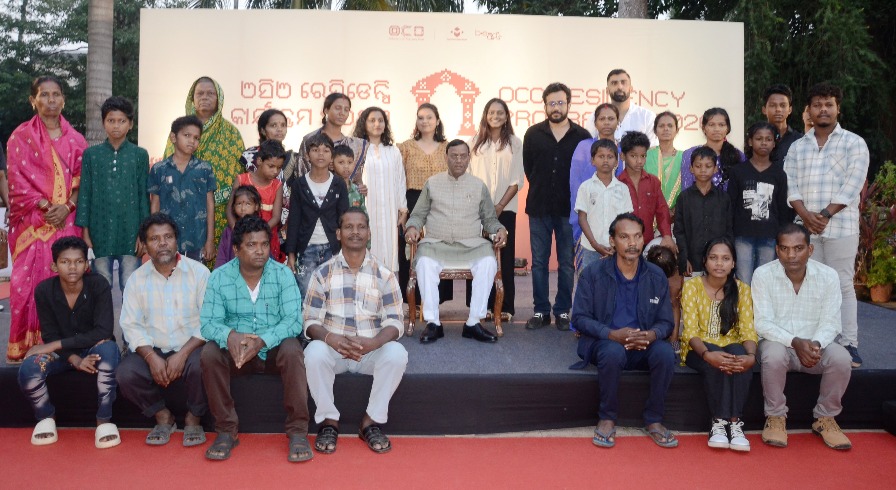
The exhibition was previewed in the presence of Odisha Governor Braj Mohan Ram, who attended as the Chief Guest, and Dr Susmita Mohanty, Indian
spaceship designer, as the Guest of Honour. The event brought together members
of the city’s art and cultural fraternity, researchers, craft practitioners and
art enthusiasts to explore the creative and research outcomes of this year’s
residency.
Curated by Sibdas Sengupta, the exhibition showcases the outcomes of a
six-week residency involving extensive field research and engagement with Dokra
artisan communities in Nuagaon and Nabajibanpur villages of Dhenkanal district.
The research was undertaken by Researchers-in-Residence Reema K., Muskaan Singh
and Tejal Kawachi through conversations, observations, documentation and
sustained interactions with artisans.
The inaugural programme featured the exhibition opening, a curatorial
walkthrough, addresses by the curator, researchers and artisans, a panel
discussion and the screening of the OCO Residency documentary. Sandeep Hota,
Co-founder and Managing Director of BEADS and Managing Trustee of Odisha Craft
Odyssey Trust, delivered the welcome address.
Moving beyond the finished metal artefact, MOLTEN MONOLITH
examines the intricate network of labour, material knowledge, cultural
narratives and human relationships that sustain Dokra craftsmanship. Through
motifs carrying cultural memories, landscapes that provide raw materials and
the labour-intensive processes involved in metal casting, the exhibition
presents a deeper understanding of the traditional practice and its adaptation
to contemporary realities.
Explaining the curatorial vision, curator Sibdas Sengupta said, “MOLTEN
MONOLITH is an attempt to shift the way we encounter and understand Dokra,
moving beyond the finished object to the knowledge, labour, histories and
relationships embedded in its making. The artisans are not simply subjects of
research or custodians of a tradition; they are active participants in shaping
the craft's language, meaning and future. Bringing their material knowledge and
lived experiences into the exhibition allows us to question conventional ways
of documenting and presenting craft, while opening up new conversations between
artistic practice, research and community knowledge.”
The exhibition brings together three distinct yet interconnected
research explorations. Muskaan Singh’s A Tale/Tail Left Untold navigates
folklore, memory and imagination through films, drawings, sculptural forms,
collected motifs and poetry. Drawing inspiration from oral histories and
interactions with artisan communities, the work explores how stories travel
across generations and continue to survive through play and performance.
Tejal Kawachi’s research investigates the relationship between craft,
labour, land and belonging. Through works such as Tracery, The
Monument to Constant Labour (Topography of Effort), Terrain of Belonging
and Hands in Hold, she examines objects preserved by artisans,
impressions left by casting processes, material landscapes and the embodied
knowledge of practitioners.
Reema K.’s research traces the historical and material journeys of
Dokra, bringing attention to women's labour and participation, metal as an
archive and fragmented histories preserved through broken objects, clay pits
and conversations with artisans.
Collectively, the three research projects present Dokra not merely as an
inherited technique but as a living cultural practice shaped by memory, human
relationships, skilled labour and changing social circumstances.
A significant aspect of the exhibition is the recognition of artisans as
active collaborators and knowledge holders rather than mere subjects of documentation.
Their expertise, lived experiences and creative decisions form an integral part
of the research and exhibition narrative. The artisans who collaborated with
the researchers include Bijuli Majhi, Chandan Majhi, Golap Gadtia, Hemanta
Majhi, Jaya Maharana, Jhunu Dehuri, Pabitra Dehuri, Ramesh Majhi, Sabita
Pradhan, Sanatan Pradhan and Trinath Behera.
Highlighting the broader vision of the initiative, Sandeep Hota,
Co-founder and Managing Director, BEADS, and Managing Trustee, Odisha Craft
Odyssey Trust, said, “Through Odisha Craft Odyssey, we aim to explore craft
traditions beyond their finished forms, bringing attention to the histories,
knowledge and people behind them. MOLTEN MONOLITH brings together artists,
researchers and master artisans to create new perspectives on Dokra while
recognising the knowledge and lived experiences of the communities that sustain
this tradition.”
Extending the exhibition beyond the gallery space, Odisha Craft Odyssey
has organised a series of public programmes, academic engagements and
collaborative activities during the exhibition period.
An Academic Colloquium titled Counter-Archives, Pedagogies, and
Artisanal Sovereignty will be held on November 29, featuring research
presentations followed by a panel discussion. On December 2, curator Sibdas
Sengupta and Researchers-in-Residence Reema K., Muskaan Singh and Tejal Kawachi
will lead In the Heat of the Archive: Curatorial and Researchers’
Walkthrough, offering visitors an opportunity to engage more closely with
the research and creative processes behind the exhibition.
On December 5, RECASTING THE FRAGMENT: An Artisan–Researcher Workshop
will bring researchers together with master Dokra artisan Pabitra Dehuri for a
specialised, limited-capacity session exploring material, process and
reinvention. The programme will conclude on December 6 with A Tale/Tail Left
Untold, a performance conceived by Muskaan Singh in collaboration with
children from the artisan community, followed by an exhibition walkthrough with
the curator and researchers.
The exhibition will remain open to the public from November 28 to December 7, between 11 am and 7 pm, at Lalit Kala Akademi, Bhubaneswar.