THEBUSINESSBYTES
BUREAU
BHUBANESWAR, JANUARY 29, 2026
In a strong
signal of Odisha’s growing global economic relevance, Chief Minister Mohan
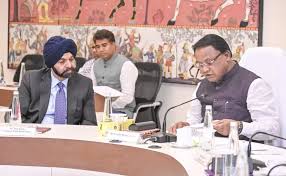
Charan Majhi on Thursday held high-level discussions with World Bank Group
President Ajay Banga at Lok Seva Bhawan here, focusing on deepening
international cooperation to accelerate the state’s sustainable and inclusive
development agenda.
The meeting,
attended by senior state officials including Chief Secretary Anu Garg,
Development Commissioner D K Singh and representatives from the World Bank,
centred on strengthening collaboration across priority sectors that are
critical to Odisha’s long-term growth and reform trajectory. Deliberations
covered a wide canvas, ranging from inclusive economic development and
infrastructure upgradation to social sector outcomes, technology-led resilience
and preparing the state’s youth for private sector employment.
 Chief
Minister Majhi outlined the state government’s reform-driven approach that has
positioned Odisha as one of India’s most attractive investment destinations. He
highlighted flagship initiatives and policy interventions aimed at boosting
infrastructure creation, promoting micro, small and medium enterprises,
strengthening agriculture and allied activities, and expanding tourism. These
measures, he noted, have not only improved ease of doing business but also
generated large-scale employment opportunities, particularly for youth and
women.
Chief
Minister Majhi outlined the state government’s reform-driven approach that has
positioned Odisha as one of India’s most attractive investment destinations. He
highlighted flagship initiatives and policy interventions aimed at boosting
infrastructure creation, promoting micro, small and medium enterprises,
strengthening agriculture and allied activities, and expanding tourism. These
measures, he noted, have not only improved ease of doing business but also
generated large-scale employment opportunities, particularly for youth and
women.
The impact
of these reforms is reflected in Odisha’s robust investment pipeline. According
to data from the Centre for Monitoring Indian Economy up to December 2025, the
state has secured investment proposals worth ₹2.5 lakh crore, ranking second nationally after
Andhra Pradesh. Streamlined acts and rules, coupled with proactive governance,
have played a key role in attracting investor confidence.
World Bank
Group President Ajay Banga lauded Odisha’s development momentum and its clear
reform orientation. He particularly appreciated the state’s focus on skill
development as a cornerstone for expanding private sector employment
opportunities for its young population. Drawing attention to successful models,
Banga said the upcoming World Bank Group–India strategic plan would take
inspiration from institutions such as the Central Tool Room and Training Centre
in Bhubaneswar, aligning closely with India’s ₹4 billion national programme to modernise
Industrial Training Institutes across the country.
Reaffirming
the World Bank’s long-term commitment to Odisha, Banga emphasised continued
support through technical assistance, policy advisory services and financial
partnerships. He underlined the importance of strengthening institutional
capacity and fostering effective public-private partnerships to sustain
high-growth outcomes.
The leaders
also exchanged views on broader global and regional economic challenges,
including infrastructure creation, urbanisation pressures and sustainable
resource utilisation, agreeing on the need for collaborative and
forward-looking strategies to address them.
During the
meeting, Chief Minister Majhi presented the Odisha Vision document to President
Banga, detailing the state’s development roadmap under “Odisha Vision 2036 and
2047: Viksit Odisha for Viksit Bharat.” The vision seeks to drive
transformative growth and position Odisha as a frontrunner in India’s journey
towards becoming a developed nation.
The
interaction concluded on an optimistic note, with both sides expressing strong
intent to deepen engagement and explore new areas of partnership aligned with
Odisha’s development priorities and the World Bank Group’s strategic framework.