
THEBUSINESSBYTES
BUREAU
NEW DELHI,
FEBRUARY 1, 2026
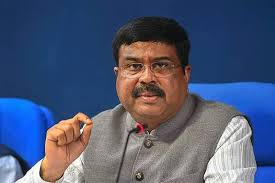
Union Minister for Education Dharmendra
Pradhan described the Union Budget 2026–27 as a Yuva Shakti–driven budget that
places human capital at the heart of India’s growth journey and provides a
clear roadmap for achieving the vision of Viksit Bharat.
Lauding the historic nature of the
Budget, Pradhan said it gives a decisive boost to education, skilling and
employment creation while unlocking Bharat’s full growth potential through
inclusive and people-centric development. He informed that the total budget
allocation for the Ministry of Education has reached an unprecedented ₹1,39,289.48 crore, marking an 8.27 per cent increase over
the Budget Estimates of 2025–26. Expressing gratitude to Prime Minister Narendra
Modi and Union Finance Minister Nirmala Sitharaman, he termed the Budget
futuristic, pro-people and employment-oriented, bringing cheer especially to
the poor, youth and middle-class households.
 The Minister said the Budget is
inspired by the three Kartavyas of accelerating and sustaining economic growth,
fulfilling aspirations and building capacities of all, and ensuring equitable
access to resources and opportunities. He noted that this Viksit Bharat Budget
will spur all-round growth, strengthen self-reliance in strategic and frontier
areas, invigorate education, innovation and skilling ecosystems, empower MSMEs,
boost tourism and healthcare, and transform Tier-II and Tier-III cities into
new growth engines, ensuring that economic progress translates into tangible
gains for over 140 crore citizens.
The Minister said the Budget is
inspired by the three Kartavyas of accelerating and sustaining economic growth,
fulfilling aspirations and building capacities of all, and ensuring equitable
access to resources and opportunities. He noted that this Viksit Bharat Budget
will spur all-round growth, strengthen self-reliance in strategic and frontier
areas, invigorate education, innovation and skilling ecosystems, empower MSMEs,
boost tourism and healthcare, and transform Tier-II and Tier-III cities into
new growth engines, ensuring that economic progress translates into tangible
gains for over 140 crore citizens.
Highlighting the focus on youth, Pradhan
said the three Kartavyas outlined by the Finance Minister place special
emphasis on strengthening the capacities of India’s yuva to realise the goal of
Atmanirbhar Bharat. He pointed out that India already has one of the highest
rates of female participation in STEM education globally, and to further
encourage girls’ enrolment, the Budget proposes establishing one girls’ hostel
in every district through viability gap funding and capital support.
The Minister also underscored the proposal
to set up five University Townships near major industrial and logistics
corridors, envisioned as integrated academic zones hosting universities,
colleges, research institutions, skill centres and residential facilities. He
said a high-powered ‘Education to Employment and Enterprise’ Standing Committee
will be constituted to recommend measures aligned with the services sector,
examine the impact of emerging technologies such as AI on jobs and skills,
embed AI in curricula from the school level, and upgrade SCERTs for advanced
teacher training.
Pradhan further lauded the
announcement of AVGC Content Creator Labs in 15,000 secondary schools and 500
colleges, a move expected to support two million professionals by 2030 in the
fast-growing animation, visual effects, gaming and comics sector.
On allocations, he said higher
education has received ₹55,727.22 crore in 2026–27,
reflecting an 11.28 per cent increase over the previous year, with significant
hikes for central universities, IITs, NITs, UGC, IIMs and deemed universities,
along with enhanced
support for new schemes in AI, research, global-class institutions and
apprenticeships. School Education and Literacy has received its highest-ever
allocation of ₹83,562 crore, with major increases
for Samagra Shiksha, PM-POSHAN, PM-SHRI, Kendriya Vidyalayas,
Navodaya Vidyalayas and the launch of Atal Tinkering Labs as a flagship
initiative.