THEBUSINESSBYTES
BUREAU
NEW
DELHI, JANUARY 16, 2026
“Startup India is not just a scheme, it is a
rainbow vision connecting diverse sectors with new opportunities,” Prime
Minister Narendra Modi said on Friday as he addressed the programme marking a
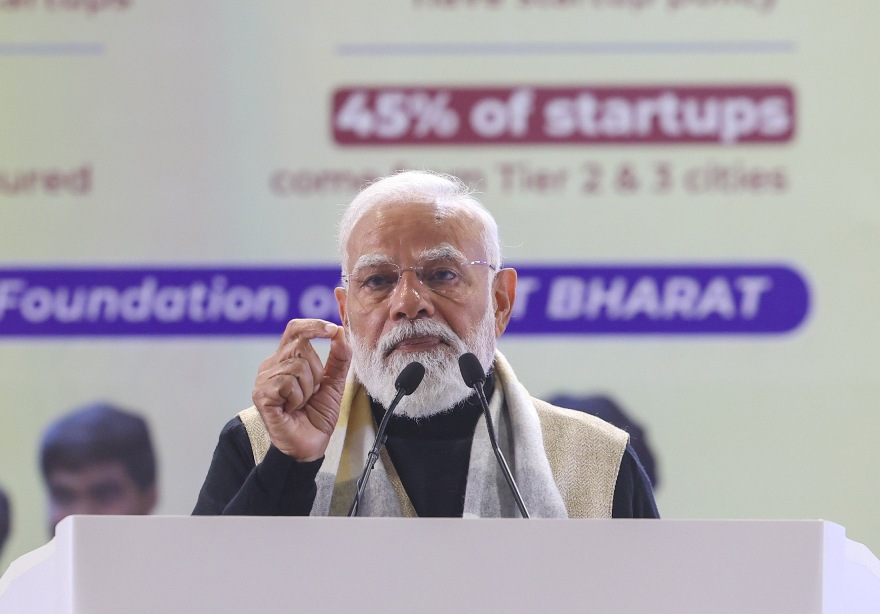
decade of the Startup India initiative on the occasion of National Startup Day
at Bharat Mandapam here. Speaking before a gathering of startup founders,
innovators and policymakers, the Prime Minister described the celebration as a
moment that symbolises the aspirations and confidence of a new and rising
India.
Interacting
with young entrepreneurs working across agriculture, fintech, mobility, health
and sustainability, the Prime Minister said their ideas were impressive, but
what stood out even more was their confidence and ambition. Recalling the
launch of Startup India ten years ago, he expressed satisfaction over how the
initiative had grown into a nationwide movement driven by youth focused on
solving real-life problems. He lauded the courage of young innovators who dared
to dream differently and transform challenges into opportunities.
 Marking the
completion of a decade, Modi said the journey of Startup India was not merely
the success of a government programme, but the story of millions of dreams
taking shape. He recalled that ten years ago innovation had limited space to
flourish, but the initiative challenged those constraints by giving young
Indians the freedom to experiment and build. “In just 10 years, the Startup
India Mission has become a revolution. Today, India is the world’s
third-largest startup ecosystem,” he said, noting that the number of startups
has grown from fewer than 500 in 2016 to over two lakh today. He highlighted
that India had just four unicorns in 2014, compared to nearly 125 active
unicorns now, a transformation that has drawn global attention.
Marking the
completion of a decade, Modi said the journey of Startup India was not merely
the success of a government programme, but the story of millions of dreams
taking shape. He recalled that ten years ago innovation had limited space to
flourish, but the initiative challenged those constraints by giving young
Indians the freedom to experiment and build. “In just 10 years, the Startup
India Mission has become a revolution. Today, India is the world’s
third-largest startup ecosystem,” he said, noting that the number of startups
has grown from fewer than 500 in 2016 to over two lakh today. He highlighted
that India had just four unicorns in 2014, compared to nearly 125 active
unicorns now, a transformation that has drawn global attention.
The Prime
Minister pointed out that the momentum continues to accelerate, with startups
scaling up, entering capital markets and creating jobs. In 2025 alone, nearly
44,000 new startups were registered, the highest in any single year since the
initiative began, reflecting the sector’s growing role in employment
generation, innovation and economic growth. He expressed confidence that many
of the young innovators present would themselves become case studies in India’s
startup success story.
Modi noted
that Startup India has fundamentally changed the country’s entrepreneurial
culture. Earlier, he said, starting a business was largely the domain of
established industrial families, while middle-class and poorer youth aspired
mainly to secure jobs. That mindset has shifted, with entrepreneurs now
emerging from Tier-2 and Tier-3 cities and even villages, building ventures
that address grassroots challenges. This spirit of contributing to society and
nation-building, he said, held immense value.
Highlighting
inclusivity, the Prime Minister said women have played a significant role in
this transformation, with more than 45 per cent of recognised startups having
at least one woman director or partner. He noted that India has become the
world’s second-largest ecosystem for women-led startup funding, strengthening
the country’s innovation potential.
Explaining why
startups matter so deeply to India’s future, Modi cited the country’s young
population, rapid economic growth, expanding infrastructure and emergence of
new sectors. Yet, he said what touched him most was the startup spirit
itself—the refusal of young Indians to remain in comfort zones or follow beaten
paths. He emphasised that enterprise is driven by courage and hard work, and
noted that risk-taking, once discouraged, has now become mainstream and
respected.
Drawing a
parallel with his own approach to governance, the Prime Minister said he has
always believed in taking risks for the nation’s benefit, even when issues
carried political or administrative challenges. Like innovators, he said, he
believes that if something is necessary for the country, someone must take
responsibility for it.
The Prime
Minister outlined how the past decade has seen the creation of a strong
innovation ecosystem through initiatives such as Atal Tinkering Labs in
schools, nationwide hackathons and a network of incubation centres to ensure
ideas are supported with resources. He recalled that complex regulations and
inspector raj once hindered innovation, prompting the government to introduce
reforms based on trust and transparency. Under the Jan Vishwas Act, more than
180 provisions have been decriminalised, while self-certification, easier
mergers and smoother exits have reduced the compliance burden on startups.
Elaborating on
his vision, Modi reiterated that Startup India connects opportunities across sectors.
He cited defence manufacturing, where initiatives like iDEX have opened new
procurement pathways, and the space sector, now home to nearly 200 startups
after being opened to private participation. He highlighted reforms in the
drone sector and the role of the Government e-Marketplace, which has onboarded
around 35,000 startups and small businesses, facilitating orders worth nearly ₹50,000 crore.
Stressing the
importance of capital, the Prime Minister said access to finance has been a key
focus, with over ₹25,000 crore invested through the
Fund of Funds for Startups and additional support through seed funding and
credit guarantee schemes. He also underlined the importance of research and
intellectual property, citing the ₹1 lakh crore Research, Development and
Innovation Scheme and a deep tech fund of funds to support sunrise sectors.
Looking ahead,
Modi said India must prepare for emerging domains critical to economic security
and strategic autonomy, particularly artificial intelligence. He noted that
startups will carry the responsibility of leading India’s AI journey, with
support through the India AI Mission and infrastructure such as GPUs to make
advanced technology accessible. Similar efforts, he said, are underway in
semiconductors, data centres and green hydrogen.
Calling on
startups to aim for global leadership rather than mere participation, the Prime
Minister urged greater focus on manufacturing and the creation of world-class
products rooted in unique technological ideas. Assuring full government
support, he concluded that the achievements of the past decade demonstrate
India’s capabilities, and the next ten years must see the country leading the
world in new startup trends and technologies.
Union Minister
Piyush Goyal and other dignitaries were present at the event.