THEBUSINESSBYTES BUREAU
BHUBANESWAR, NOVEMBER 15, 2026
Odisha Deputy Chief Minister K V Singh Deo on Sunday urged students of
the College of Agricultural Engineering and Technology (CAET) to focus on farm
mechanisation, research and innovation, emphasising the need to develop
affordable, accessible and farmer-friendly technologies to make agriculture
more efficient and profitable.
Addressing the diamond jubilee celebrations of CAET, established in 1966
under the Odisha University of Agriculture and Technology (OUAT), Singh Deo,
who also holds the Agriculture and Farmers' Empowerment and Energy portfolios,
said agricultural engineering has a crucial role in transforming farming
through the application of modern technology.
He stressed that agricultural engineering could make farming easier, more
efficient, commercially viable and profitable by integrating modern machinery,
technological advancements and innovative solutions into agricultural
practices.
The college, which completed 60 years of its existence in 2026, has made
significant contributions to agricultural mechanisation, technical education,
research and farmer services in Odisha, he said.
Established with the objective of strengthening the state's agricultural
sector through engineering and technological interventions, CAET has, over the
decades, expanded its academic and research activities across several
disciplines, including farm machinery, soil and water conservation,
post-harvest processing, agricultural structures, civil and environmental
engineering, and mechanical and electrical engineering.
With changing technological requirements, the institution has also
expanded its activities into emerging areas such as renewable energy,
irrigation and drainage engineering.
Over the past six decades, the college has produced a large number of
undergraduate and postgraduate students, besides researchers, who have gone on
to occupy important positions in universities, research institutions,
government departments and industries in India and abroad.
The institution has achieved notable milestones through its contributions
to teaching, research, development of innovative agricultural machinery,
technological advancement and dissemination of technologies among farmers.
The diamond jubilee celebrations, marking the college's journey from 1966
to 2026, were inaugurated in a grand ceremony attended by Singh Deo,
Agriculture and Farmers' Empowerment Department Commissioner-cum-Secretary
Sachin Ramchandra Jadhav, and OUAT Vice-Chancellor Prof. Pravat Kumar Routray.
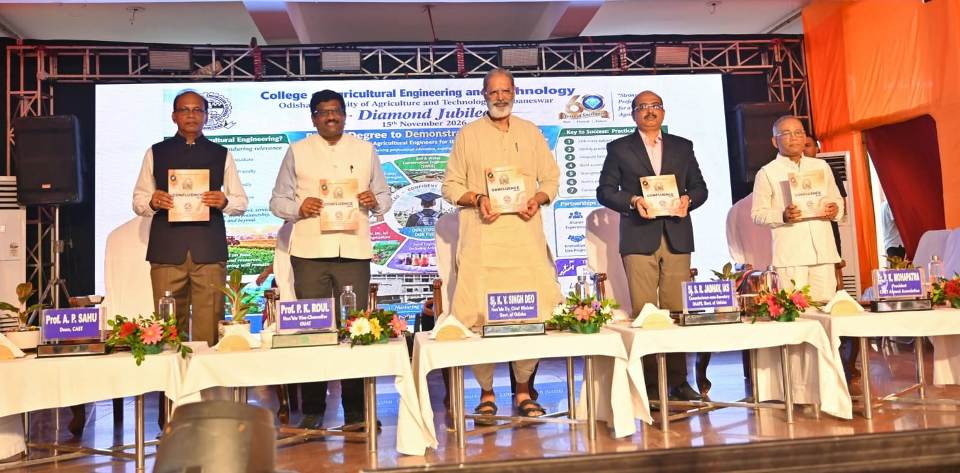
The dignitaries inaugurated a diamond jubilee memorial constructed on the
college campus and a technology exhibition showcasing innovations, equipment
and modern technologies in agricultural engineering.
The exhibition featured various aspects of agricultural mechanisation,
post-harvest processing, soil and water conservation, drone technology and
other advanced agricultural applications.
A special commemorative publication titled 'Confluence', brought out to
mark the diamond jubilee, was also released on the occasion. It highlights the
institution's heritage, achievements, research activities, technological
contributions and memories shared by its alumni.
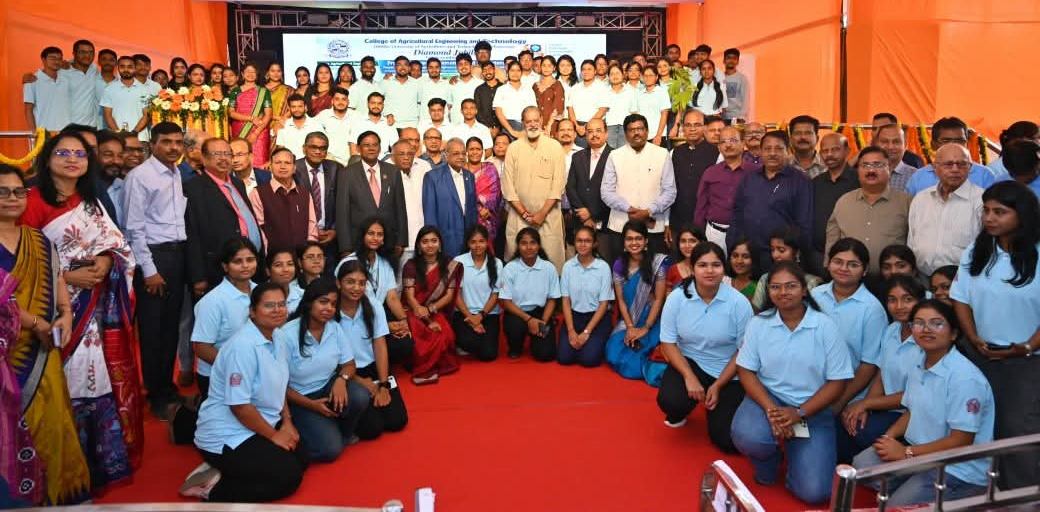
More than 1,000 participants, including alumni, present students, faculty
members, scientists, academicians, researchers and agricultural machinery
manufacturers, attended the celebrations and recalled the institution's
six-decade-long journey.
The day-long programme included a diamond jubilee seminar, an interaction
between students and alumni, and cultural performances by students in the
evening. The events provided a platform for interaction between former and
present generations, facilitating the exchange of knowledge, experiences and
professional insights.
 During the inaugural session, president of the Alumni Association,
engineer P K Mahapatra, placed several demands before the Deputy Chief Minister
and the Agriculture Department Commissioner-cum-Secretary to strengthen
agricultural engineering and enhance professional recognition of the
discipline.
The key demands included restructuring the agricultural engineering cadre
and ensuring the appointment and posting of agricultural engineers at every
block level in the departments of Agriculture, Horticulture, Soil Conservation
and Watershed Development.
Mahapatra said these measures would facilitate effective implementation
of agricultural mechanisation schemes, wider dissemination of modern farm
machinery, improved management of soil and water resources and better technical
assistance to farmers at the grassroots level.
During the inaugural ceremony, Singh Deo and Jadhav assured that the
government would accord priority to agricultural mechanisation and extend
necessary support for the development of the profession and the technical
discipline.
Particular emphasis was laid on developing and promoting low-cost,
affordable and appropriate agricultural machinery to meet the requirements of
small and marginal farmers.
The need to encourage the design and availability of women-friendly farm
equipment was also highlighted, with a view to reducing the physical drudgery
involved in agricultural operations performed by women farmers.
The speakers also underscored the importance of expanding the use of
drone technology, sensor-based farming, artificial intelligence (AI), the
Internet of Things (IoT) and advanced agricultural machinery.
These technologies can play a decisive role in increasing agricultural
productivity, reducing labour and production costs, ensuring optimum
utilisation of resources and enhancing farmers' income, they said.
The diamond jubilee celebrations were described as not merely an occasion
to commemorate past achievements but also an important platform to identify
future challenges and opportunities in agricultural engineering.
The institution called for stronger coordination among educational
institutions, research organisations, industries and the farming community to
accelerate the development of new technologies and ensure their wider adoption
at the field level.
Looking ahead, CAET aims to intensify research and innovation in
agricultural mechanisation, soil and water conservation, irrigation and
drainage engineering, renewable energy, post-harvest processing, smart
agriculture and digital farming.
Developing practical technological solutions, particularly for small and
marginal farmers, women farmers and rural youth, will remain among the
institution's major priorities.
The college is expected to play a leading role in strengthening agricultural mechanisation, developing rural infrastructure, ensuring efficient management of water and natural resources, and making agriculture more profitable and climate-resilient in Odisha as well as the country.
With a distinguished legacy of six decades, a present enriched by innovation and a commitment to shaping a brighter future for agriculture, CAET is moving forward with renewed determination, the institution said.