THEBUSINESSBYTES BUREAU
BHUBANESWAR, NOVEMBER 18, 2026
Tata Power on Wednesday showcased a range of next-generation energy and
renewable power solutions for industries at the Odisha Industrial Conclave
2026, seeking to strengthen the state's industrial ecosystem through reliable,
cost-effective and sustainable energy infrastructure.
Organised in coordination with the Industrial Promotion & Investment
Corporation of Odisha Limited (IPICOL), the conclave brought together over 40
industries, investors and key stakeholders from sectors including renewable
energy, green hydrogen, mining, cement and hospitality to explore emerging
energy requirements and investment opportunities.
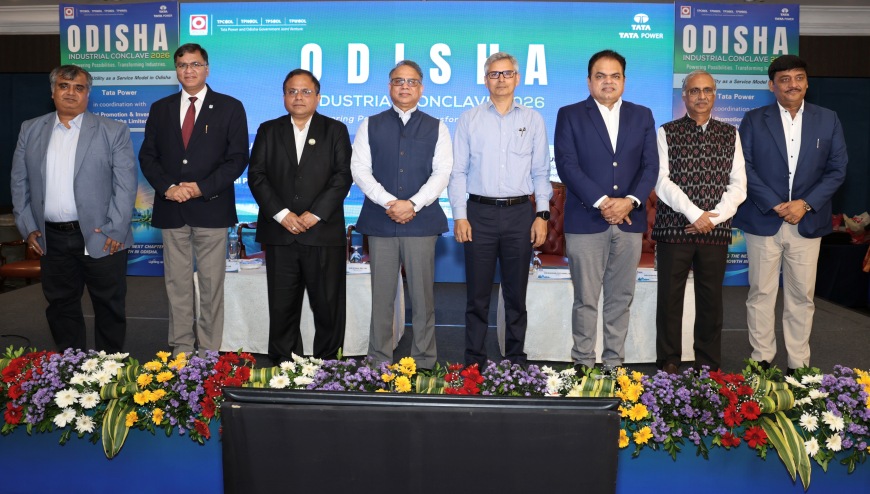
Held under the theme 'Powering Possibilities. Transforming Industries.',
the event was attended by Vishal Dev, Additional Chief Secretary, Energy
Department, Government of Odisha, Bhaskar Jyoti Sarma, Chairman and Managing
Director of OPTCL: and Kalyan Mohanty, ED, IPICOL.
Tata Power executives, including Tarun Katiyar, CEO and MD of Tata Power
Trading Company Ltd (TPTCL), and Gajanan Kale, Chief of Odisha Distribution
Business and CEO of TPCODL, were also present.
The company presented four major service-led offerings, including
Utility-as-a-Service (UaaS), Energy-as-a-Service (EaaS), Cooling-as-a-Service
(CaaS), and captive, group captive and distributed renewable energy solutions,
aimed at helping industrial and commercial establishments optimise energy costs,
reduce capital expenditure and accelerate their clean energy transition.
Under the Utility-as-a-Service model, Tata Power provides electrical
infrastructure through a Build-Own-Operate-Transfer (BOOT) arrangement, taking
responsibility for its design, development, ownership, operation and
maintenance during the contract period. Customers pay a predictable annuity,
with the assets transferred to them at the end of the agreement.
The company said the model is being implemented at major infrastructure
developments, including Noida International Airport, where it is providing an
integrated grid-to-gate electrical solution.
Its Energy-as-a-Service offering, delivered through the EnerUni platform,
combines energy efficiency, demand-side management, power portfolio management
and digital energy management to help businesses optimise consumption, improve
operational reliability and increase renewable energy adoption.
The Cooling-as-a-Service model, meanwhile, enables customers to access
cooling infrastructure without conventional ownership-related capital
investment, with Tata Power undertaking its design, financing, operation and
maintenance. Customers pay based on cooling consumption. The solution is
particularly relevant for energy-intensive establishments such as hospitals,
data centres, airports, commercial buildings and industrial facilities.
Through its subsidiary Tata Power Renewable Energy Ltd (TPREL), the company
also offers captive and group captive renewable energy solutions across solar,
wind, hybrid and energy storage projects, besides rooftop solar installations
for industrial and commercial consumers.
These integrated offerings are designed to help businesses reduce
dependence on conventional power sources, improve energy efficiency and meet
their sustainability and environmental, social and governance (ESG)
commitments, the company said.
Speaking at the event, Vishal Dev said reliable and sustainable energy was
the foundation of Odisha's economic growth, adding that future utilities would
need to go beyond electricity supply and deliver comprehensive energy solutions
and services.
"Service-led models that combine dependable infrastructure with
clean energy will help industries in the state grow competitively, while
staying anchored in affordability, reliability and accessibility," he
said.
Katiyar said Odisha's industrial growth ambitions and the Make in Odisha
vision offered significant opportunities, with dependable and sustainable power
infrastructure playing a critical role in attracting investments.
Through its integrated offerings, Tata Power aims to enable industries to
focus on their core businesses while providing efficient, reliable and
sustainable energy infrastructure, he said.
Kale said Tata Power-led distribution companies in Odisha had been
working with the state government to strengthen the distribution network and
improve customer-focused services.
As the state's industrial base expands and new investments take shape,
the company's priority would be to ensure quality power supply and responsive
services for businesses, he added.
Tata Power operates four electricity distribution companies in Odisha in
partnership with the state government, collectively serving nearly 10 million
consumers.
Odisha is positioning itself as a major industrial and investment
destination through infrastructure development, investor-friendly policies and
initiatives such as Make in Odisha and Samruddha Odisha 2036.
The state's fifth position nationally in NITI Aayog's Investment
Friendliness Index 2026, placing it among the top five performer states,
reflects its growing investment potential.
While traditional sectors such as metals and mining continue to drive industrial activity, Odisha is also expanding its focus to manufacturing, chemicals, petrochemicals, textiles, food processing, electronics, green energy and emerging technologies.
Tata Power said the conclave provided an opportunity to engage with industries and prospective investors on their evolving energy requirements, reaffirming its commitment to supporting Odisha's industrial expansion through innovative energy models, renewable power and improved infrastructure.