THEBUSINESSBYTES
BUREAU
NEW
DELHI, JANUARY 12, 2026
Calling upon
India’s youth to uphold intellectual integrity and contribute meaningfully to
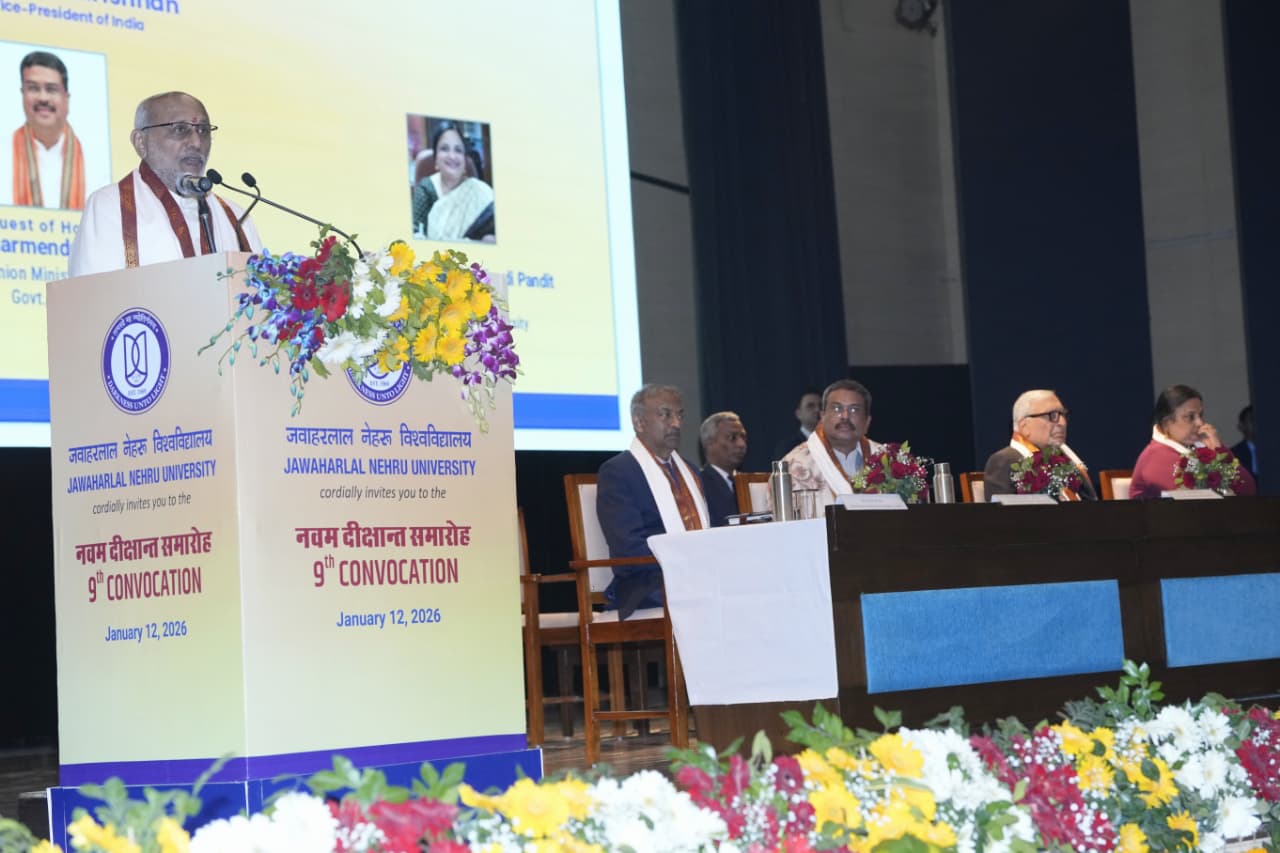
nation-building, Vice-President C. P. Radhakrishnan on Monday said education
must transcend degrees and credentials to shape character, strengthen intellect
and empower individuals to stand on their own feet.
Addressing
students while recalling the teachings of Swami Vivekananda on his birth
anniversary, the Vice-President emphasised that only education combined with
proper training can enable young Indians to realise Prime Minister Narendra
Modi’s vision of Viksit Bharat @2047.
Highlighting
India’s rich civilisational legacy of learning, the Vice-President referred to
ancient centres such as Nalanda and Takshashila, noting that Indian scriptures
and classical texts — from the Upanishads and the Bhagavad Gita to Kautilya’s
Arthashastra and Thiruvalluvar’s Thirukkural — have consistently placed
knowledge and ethics at the core of societal life. True education, he said, is
reflected in conduct and character, not merely in the accumulation of degrees.
Stressing the
need for harmony between modern science and traditional values, the
Vice-President underscored the importance of democratic engagement in academic
spaces. Referring to the ethos of Jawaharlal Nehru University, he observed that
debate, discussion, dissent and even confrontation are integral to a vibrant
democracy. However, he added that such processes must ultimately lead to
decisions, and once taken, there should be collective cooperation in their
implementation to ensure effective governance and administration.
The
Vice-President appreciated the inclusive academic environment fostered by JNU
and its sustained efforts to promote equity and social inclusion in student
admissions as well as faculty recruitment. He also commended the University leadership
for expanding academic engagement into emerging and civilisational domains,
including the establishment of new Centres for Hindu, Jain and Buddhist Studies
at the School of Sanskrit and Indic Studies.
 Lauding JNU’s
initiatives to promote Indian languages, he highlighted the role of the Special
Centre for Tamil Studies and various chairs and programmes in Assamese, Odia,
Marathi and Kannada. He observed that knowledge creation must flourish in
mother tongues, in keeping with the spirit of the National Education Policy.
Lauding JNU’s
initiatives to promote Indian languages, he highlighted the role of the Special
Centre for Tamil Studies and various chairs and programmes in Assamese, Odia,
Marathi and Kannada. He observed that knowledge creation must flourish in
mother tongues, in keeping with the spirit of the National Education Policy.
In his
concluding remarks, the Vice-President urged graduating students to uphold
three core responsibilities: intellectual honesty in the pursuit of truth,
commitment to social inclusion to reduce inequalities, and active participation
in national development. Calling upon them to remain guided by constitutional
values and India’s civilisational ethos, he also stressed the importance of
respecting parents and teachers. Wishing the students success in their future
endeavours, he reaffirmed India’s unity and collective resolve to progress
together.
Union Minister
for Education Dharmendra Pradhan, Chancellor of Jawaharlal Nehru University
Kanwal Sibal, Vice-Chancellor Prof. Santishree Dhulipudi Pandit, senior
officials, faculty members, graduating students and their families were present
at the event.