The
MMDR Amendment seeks to replace a fragmented fiscal structure with greater
predictability. For mineral-rich States, the larger opportunity may lie in
higher production, competitive pricing and stronger auction revenues, says Priyabrat Biswal
For a State whose economy is
closely intertwined with its mineral wealth, any change in the rules governing
mining is bound to invite scrutiny. In Odisha, where mining has emerged as a
major source of public revenue, concerns over whether the Mines and Minerals
(Development and Regulation) Amendment Act, 2026 could dilute the State’s
fiscal gains are understandable.
Yet the central proposition of
the new law is not to take revenue away from mineral-rich States. It is to make
mineral production more predictable and competitive, and, in the process, expand the value that States can realise from
their resources.
That distinction is important.
India’s mining industry has
acquired a complicated fiscal architecture, with as many as 14 taxes, charges,
fees and levies imposed across States. Royalty, auction premium, dead rent,
District Mineral Foundation (DMF) payments, GST and transit fees form part of
this structure. Taxes on mineral-bearing land in some cases add considerably to
the cost of extraction.
The argument behind the 2026
amendment is that such fragmentation can make Indian minerals uncompetitive,
discourage investment and ultimately reduce production. A rational and stable
fiscal framework, the Centre argues, can help correct this without disturbing
the principal revenue streams of States.
For Odisha, the experience of the
past decade offers an instructive starting point.
The State was among the early and
most successful adopters of the competitive auction regime introduced after the
2015 amendments to the MMDR Act. Odisha put 79 mineral blocks up for auction. Of these, 34 are operational,
the highest number for any State, while another 45 are yet to begin production.
The numbers tell a significant
story. The 34 operational blocks have generated about Rs 87,000
crore in auction premium between 2020-21 and 2025-26.
This is a reminder that Odisha's
principal mining windfall does not rest on the proliferation of levies. It
rests substantially on transparent
auctions, production and the ability to bring mines into operation.
The remaining 45 blocks could
therefore, represent a substantial future revenue opportunity. If predictable
fiscal conditions encourage more competition at the bidding stage and make
projects more viable, the State could benefit through higher auction premiums
as well as through production-linked revenues.
There is, in fact, a paradox at
the heart of the apprehension over taxation. Odisha, with one of the largest
operational mining bases in the country, has more to lose from unpredictable
costs than States with smaller mining sectors. If a levy makes a mine
economically unviable or its output uncompetitive, the State does not merely
lose a potential tax or fee. It can lose royalty, auction premium, DMF receipts and the wider economic activity
associated with production.
The strongest case for a more
competitive domestic mining regime may lie outside the mining sector itself.
Odisha produces more iron ore
than any other State. Yet India imported iron ore worth Rs 11,115 crore in FY 2025-26. Imports of manganese were valued at
Rs 10,872 crore, bauxite at Rs 4,822 crore and chromite at Rs 753 crore.
These figures pose a larger
question: why should India import minerals that are available domestically?
The answer is partly one of price
competitiveness. If the cumulative cost of extracting and transporting an
Indian mineral makes it more expensive than an imported alternative,
manufacturers have an economic incentive to look overseas. A tax imposed at the
mine becomes part of that calculation.
For Odisha, this matters
directly. A reduction in the price disadvantage of domestic ore can bring
orders back to Indian mines. Greater production would then generate the very
State revenues that critics fear could be lost — through royalty, auction
premiums and DMF contributions.
In this sense, every tonne of mineral imported because
domestic production is uncompetitive is a missed opportunity for a mineral-rich
State.
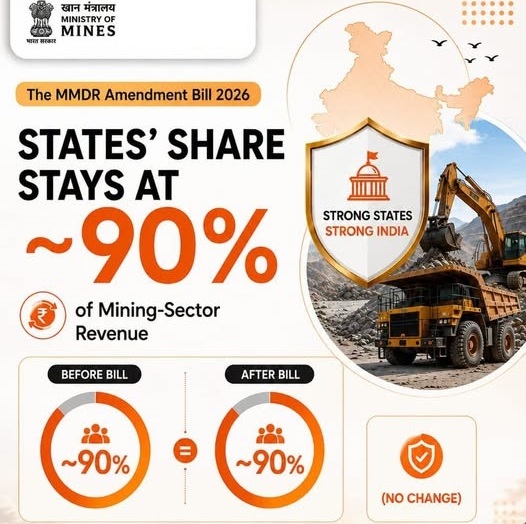
The Centre has explicitly
maintained that the amendment will not reduce the revenue accruing to
mineral-rich States. States, it says, will continue to receive royalty, auction
premium, DMF collections and their share of GST, and currently account for
around 90 per cent of revenue generated
from mineral production.
Since the auction regime began in
2015, States have received more than Rs
7 lakh crore from mining, including coal, according to the government.
State mineral revenue has risen by about 354 per cent over the past decade, reaching approximately Rs 82,366 crore in 2025-26.
The amendment also does not
amount to a transfer of money from State treasuries to mining companies, nor
does it waive outstanding dues. Its stated purpose is to create a clearer legal
framework for levies, reduce litigation and provide the fiscal certainty needed
for investments with long gestation periods.
That certainty is particularly
relevant to Odisha because mining companies make bids based on their assessment
of the costs and returns of a block over its lifetime. The more predictable the
fiscal environment, the greater the scope for competitive bidding.
The amendment is also part of a
broader transformation of India's mineral economy since 2015. Competitive
e-auctions have replaced discretionary allocation, with 723 major mineral blocks auctioned across 17 States. In FY 2025-26
alone, 212 blocks were auctioned and 36 operationalised.
Production has risen alongside
the reforms. The value of major mineral production increased by 26.8 per cent
in FY 2025-26, while iron ore production touched a record 313 million tonnes.
Non-coal mineral production has nearly tripled since 2014.
The next frontier is critical
minerals. The National Critical Mineral Mission, with an outlay of Rs 16,300 crore, seeks to strengthen
domestic exploration and supply chains. Odisha is also among the States where
Critical Mineral Processing Parks are being supported.
This creates an opportunity for
Odisha to move beyond its traditional role as a supplier of raw minerals and
deepen its presence in processing and value addition.
There is another point that
should not be overlooked. The amendment does not cover minor minerals
exclusively regulated by the States. Nearly 50 minerals, including sand,
gravel, clay, silica, granite, marble, gypsum and laterite, remain outside its
ambit, with existing State regulatory and fiscal powers unchanged.
At the community level, the
post-2015 mining framework has also created District Mineral Foundations. The
government says 656 DMFs have been established, including 106 in aspirational
districts, with funds being used for roads, hospitals, schools, drinking water
and other local needs.
For Odisha, therefore, the debate
need not be framed as revenue versus
reform.
The State's experience shows that
transparent auctions can generate substantial premiums. Its mineral reserves
give it a natural advantage. What the new regime seeks to add is a more
predictable fiscal environment in which those resources can be extracted, sold
and processed competitively.
The real test will, of course,
lie in implementation. But the underlying proposition is clear: a mineral-rich State does not maximise its
revenue simply by imposing more charges on every tonne extracted. It maximises
revenue when more mines operate, more minerals are sold, investments flow in
and domestic resources remain competitive against imports.
For Odisha, the 45 auctioned
blocks waiting to come into production may offer the clearest indication of
what is at stake.
The question, then, is not
whether Odisha should protect its mineral revenue. It should. The more consequential
question is how best to enlarge it.
The MMDR Amendment's answer is: through greater certainty, production and competitiveness.
For a State that has already
demonstrated what competitive auctions can deliver, that may be an opportunity
rather than a threat.
The
author may be reached at [email protected]