
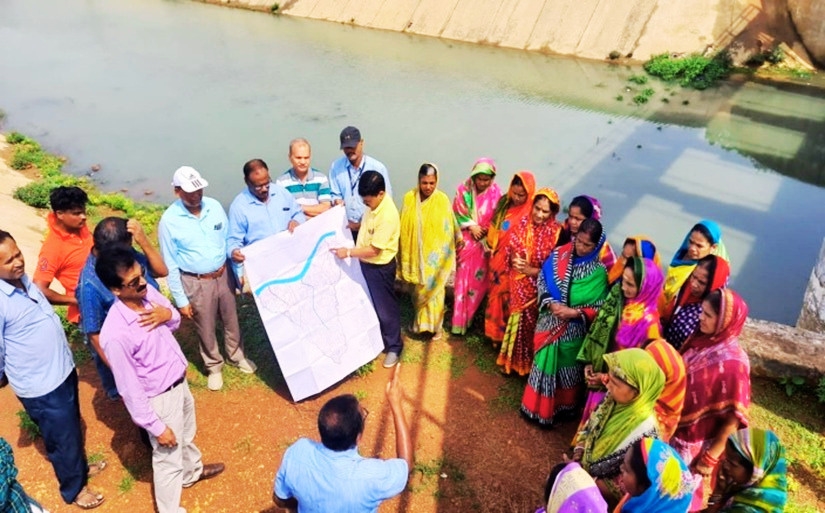
118 Women Interest Groups linked to 45 Pani
Panchayats in Rengali command area; women take active role in water
distribution, canal management
THEBUSINESSBYTES BUREAU
BHUBANESWAR, NOVEMBER 23, 2026
As many as 118 Women Interest Groups (WIGs) have been formed and linked
to 45 Pani Panchayats in Odisha’s Rengali command area, empowering women
farmers to take a leading role in participatory irrigation management, water
distribution and agricultural decision-making.
Under the Japan International Cooperation Agency (JICA)-assisted Rengali
Irrigation Project, Phase-II, women farmers are increasingly emerging as key
stakeholders in water governance by leading village-level interest groups,
serving on Chak Committees and occupying elected positions in Pani Panchayats.
Implemented by the state’s Department of Water Resources, the project has
a targeted command area of 39,416 hectares spread across Dhenkanal, Jajpur and
Kendujhar districts. In Bhubhan and Sukinda blocks, the formation of 118 WIGs
has provided women farmers with an institutional platform to raise
irrigation-related concerns, participate in water management and contribute to
resolving local disputes.
To strengthen their leadership and technical expertise, the Water and
Land Management Institute (WALMI), in collaboration with the project's
Agriculture Project Management Unit (Agri-PMU), has been conducting specialised
training programmes on participatory irrigation management, improved
agricultural practices and livelihood development.
The training programmes cover the functions of Pani Panchayats, canal
operation and maintenance, record-keeping, equitable water distribution and
dispute resolution in accordance with the Pani Panchayat Act, 2002, and Pani
Panchayat Rules, 2003.
Practical sessions, including command area mapping, canal monitoring
walks, field demonstrations and exposure visits, are also organised to
familiarise women farmers with irrigation systems and help them identify
problems affecting water delivery.
Since 2026, WALMI has conducted more than 43 training programmes under
the project, benefiting around 1,000 women farmers and 1,300 other farmers,
officials said.
Besides strengthening women's participation in irrigation governance, the
initiative is promoting agricultural diversification and climate-resilient
farming practices. Farmers are being trained in improved paddy cultivation,
seed treatment, organic farming, paddy straw mushroom cultivation and the
cultivation of pulses, oilseeds and other non-paddy crops.
Experts from the Agriculture and Horticulture Departments and other
institutions are providing technical guidance on crop selection, improved
cultivation methods, government schemes, post-harvest management and marketing
opportunities. Specialised capacity-building programmes are also being conducted
for newly recruited Assistant Executive Engineers and Junior Engineers.
The initiative seeks to bridge the gap between women's traditional contribution to agriculture and their representation in institutional decision-making, while enhancing their technical knowledge and leadership capabilities.
By placing women farmers at the forefront of irrigation management, the JICA-assisted project is expected to strengthen community institutions, promote inclusive and sustainable water governance and create better livelihood opportunities in the Rengali command area.