
THEBUSINESSBYTES
BUREAU
NEW DELHI,
JANUARY 25, 2026
Union Minister for New and Renewable
Energy Pralhad Joshi on Saturday said that India’s engagements at the World
Economic Forum (WEF) Annual Meeting 2026 in Davos have significantly
strengthened global partnerships and reinforced international confidence in the
country’s renewable energy transition. Returning from Davos after a series of
high-level interactions, the Minister described the visit as a decisive step in
positioning India as one of the world’s most attractive destinations for
long-term clean energy investments.
The Union Minister noted that the
discussions at WEF 2026 yielded valuable insights, deepened strategic
partnerships and renewed global trust in India’s clean energy journey. He
underlined that India’s commitment to stable policies, predictable regulations
and sustained global collaboration is accelerating the nation’s transition to a
low-carbon future while ensuring inclusive socio-economic growth. According to
him, the interactions at Davos further strengthened India’s resolve to emerge
as a key driver of the global energy transition.
At the World Economic Forum, Minister
Joshi showcased India’s long-term investment story anchored in policy
stability, transparent governance and coordinated action at both the Central
and State levels. Global leaders and investors reaffirmed their confidence in
India’s ability to rapidly scale renewable energy capacity, supported by strong
institutional frameworks and people-centric programmes that balance growth with
inclusivity.
Highlighting India’s clean energy
progress during multiple sessions and media interactions, the Minister pointed
to the success of flagship initiatives such as PM-Surya Ghar and PM-KUSUM,
which have demonstrated India’s capacity to implement large-scale renewable
programmes efficiently and at speed. International stakeholders expressed
strong interest in India’s robust and investible project pipeline,
acknowledging the country’s execution capabilities and the clarity of its
policy direction.
India’s efforts to strengthen domestic
manufacturing across the solar photovoltaic value chain received widespread
appreciation from global corporate leaders, reinforcing the country’s emergence
as a resilient and competitive clean energy manufacturing hub. The Minister
also highlighted the export potential of green hydrogen derivatives,
positioning India as a reliable partner capable of supporting the energy
transition of other countries through technology, supply chains and clean fuel
solutions.
Outlining India’s broader vision for
the global energy transition, Minister Joshi emphasised the transformative role
of artificial intelligence in the energy sector. He noted that AI-driven
solutions can improve forecasting, reduce losses, lower costs and enhance grid
reliability. He explained India’s strategic shift from pilot-based initiatives
to platform-based deployment through Digital Public Infrastructure for Energy,
enabling scalable and impactful adoption of advanced technologies.
India’s milestone achievements were
also showcased at Davos, including the installation of 267 GW of non-fossil
fuel-based electricity capacity and the attainment of 50 per cent non-fossil
capacity five years ahead of its 2030 target under the Paris Agreement. The
Minister underlined that achieving 500 GW of non-fossil capacity by 2030 would
require investments of about USD 300–350 billion, or nearly ₹30 lakh crore, and invited global investors to
partner in this transformative journey.
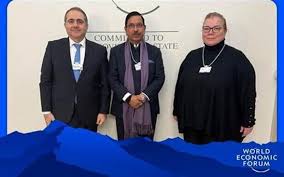
On the sidelines of WEF 2026, the
Union Minister held a series of high-level bilateral and institutional meetings
aimed at deepening cooperation and mobilising long-term capital. Discussions
with leaders from Oman, Belgium, Kuwait and Paraguay explored collaboration in
solar, wind, green hydrogen, storage technologies, research and development,
and capacity-building, while leveraging multilateral platforms such as the
International Solar Alliance and initiatives like One Sun One World One Grid.
Engagements with leaders from Zimbabwe
and Jordan focused on replicable renewable energy models for the Global South,
with India committing to share its experience in developing solar parks, hydrogen
hubs and storage solutions to support inclusive and sustainable energy
transitions. Meetings with the International Energy Agency and the
International Atomic Energy Agency further reinforced cooperation with
multilateral institutions to accelerate the deployment of clean energy
technologies.
Industry engagements formed a key
pillar of India’s Davos outreach, with discussions held with leading global
companies including Mercuria, TotalEnergies, La Caisse, Ingka Group, ENGIE, EDF
and Acciona. These interactions focused on expanding investments in solar,
wind, storage, green hydrogen, climate finance and energy innovation, with
global majors expressing strong interest in India’s stable and
investor-friendly ecosystem.
The Minister also held targeted discussions
on advancing the National Green Hydrogen Mission, including next-generation
electrolyser technologies, fuel cell solutions for industrial clusters and data
centres, and the development of robust frameworks for ESG standards, credit
assessment and price discovery in renewables.
The engagements at Davos 2026
reaffirmed India’s position as a central focus for global clean energy
investments, driven by scale, policy certainty and strong execution. With
global companies increasingly looking to partner with Indian firms through greenfield
and brownfield projects, India’s renewable energy transition is set to gain
fresh momentum through strengthened international collaboration and long-term
capital inflows.