
THEBUSINESSBYTES
BUREAU
NEW DELHI,
FEBRUARY 1, 2026
Union Minister for Finance and
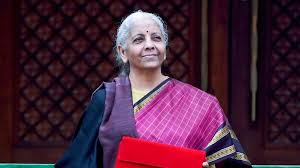
Corporate Affairs, Nirmala Sitharaman, on Sunday presented the Union Budget
2026-27 in Parliament, laying out a comprehensive, reform-oriented and
youth-driven economic roadmap that places the poor, underprivileged and
disadvantaged at the centre of India’s development journey, while sustaining
high growth and strengthening global competitiveness.
Presenting the first Budget from
Kartavya Bhawan on the auspicious occasion of Magha Purnima and the birth
anniversary of Guru Ravidas, the Finance Minister said the Budget is guided by
three core ‘kartavya’. The first is to accelerate and sustain economic growth
by enhancing productivity, competitiveness and resilience in an increasingly
volatile global environment. The second ‘kartavya’ focuses on fulfilling the
aspirations of people and building their capacity so that citizens become
strong partners in India’s prosperity. The third ‘kartavya’, aligned with the
vision of Sabka Saath, Sabka Vikas,
aims to ensure that every family, community, region and sector has equitable
access to resources, amenities and opportunities for meaningful participation
in national development.
Describing the Budget as a Yuva
Shakti-driven exercise rooted in the Government’s ‘Sankalp’, Sitharaman said
India will continue to take confident steps towards becoming a Viksit Bharat by
balancing ambition with inclusion. She underlined that as a fast-growing
economy with expanding trade and capital needs, India must remain deeply
integrated with global markets, export more and attract stable long-term
investments even as the global environment faces challenges such as disrupted
supply chains, weakened multilateralism and rising demands on water, energy and
critical minerals due to new technologies.
The Finance Minister informed the
House that following the Prime Minister’s announcement on Independence Day
2025, more than 350 reforms have been rolled out. These include GST
simplification, notification of Labour Codes and rationalisation of mandatory
Quality Control Orders. High-Level Committees have been constituted and, in
parallel, the Central Government is working closely with State Governments on
deregulation and reducing compliance requirements.
Under the first ‘kartavya’ of
accelerating and sustaining economic growth, the Budget proposed targeted
interventions across six priority areas — scaling up manufacturing in seven
strategic and frontier sectors, rejuvenating legacy industrial sectors,
creating “Champion MSMEs”, delivering a strong push to infrastructure, ensuring
long-term energy security and stability, and developing City Economic Regions.
 A major announcement was the launch of
Biopharma SHAKTI, with an outlay of ₹10,000
crore over five years, to develop India into a global biopharma manufacturing
hub. The initiative will support domestic production of biologics and
biosimilars through a robust ecosystem that includes a biopharma-focused
network with three new National Institutes of Pharmaceutical Education and
Research (NIPERs) and the upgradation of seven existing NIPERs. It also
envisages the creation of a nationwide network of over 1,000 accredited
clinical trial sites**. The Central Drugs Standard Control Organisation will be
strengthened through a dedicated scientific review cadre and specialists to
meet global regulatory standards and faster approval timelines.
A major announcement was the launch of
Biopharma SHAKTI, with an outlay of ₹10,000
crore over five years, to develop India into a global biopharma manufacturing
hub. The initiative will support domestic production of biologics and
biosimilars through a robust ecosystem that includes a biopharma-focused
network with three new National Institutes of Pharmaceutical Education and
Research (NIPERs) and the upgradation of seven existing NIPERs. It also
envisages the creation of a nationwide network of over 1,000 accredited
clinical trial sites**. The Central Drugs Standard Control Organisation will be
strengthened through a dedicated scientific review cadre and specialists to
meet global regulatory standards and faster approval timelines.
For the labour-intensive textile
sector, an integrated programme with five sub-parts was announced. This includes
the National Fibre Scheme for self-reliance in natural fibres such as silk,
wool and jute, man-made fibres and new-age fibres; a Textile Expansion and
Employment Scheme to modernise traditional clusters with capital support for
machinery, technology upgradation and common testing and certification centres;
a National Handloom and Handicraft Programme to integrate existing schemes and
ensure targeted support to weavers and artisans; the Tex-Eco Initiative to
promote globally competitive and sustainable textiles and apparel; and Samarth
2.0 to modernise the textile skilling ecosystem through collaboration with
industry and academic institutions.
Recognising MSMEs as a vital engine of
growth, the Finance Minister proposed a dedicated ₹10,000 crore SME Growth Fund to create future champions
by incentivising enterprises based on clearly defined performance criteria.
On infrastructure, Sitharaman
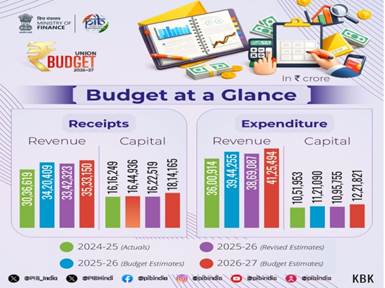
highlighted that public capital expenditure has increased manifold from ₹2 lakh crore in FY 2014-15 to ₹11.2 lakh crore in BE
2025-26. For FY 2026-27, she proposed to raise public capex further to ₹12.2
lakh crore to sustain infrastructure-led growth momentum.
To promote environmentally sustainable
cargo movement, the Budget proposed new Dedicated Freight Corridors connecting Dankuni
in the East to Surat in the West, and the operationalisation of 20 new National
Waterways over the next five years, beginning with National Waterway-5 in
Odisha, linking mineral-rich Talcher and Angul and industrial centres like
Kalinga Nagar with the ports of Paradeep and Dhamra. Regional Centres of
Excellence will be set up as training institutes to develop the required
manpower.
To unlock the economic potential of
cities, the Budget proposed mapping City Economic Regions (CERs) based on
specific growth drivers, with an allocation of ₹5,000
crore per CER over five years, to be implemented through a challenge mode with
a reform-cum-results-based financing mechanism.
For sustainable passenger mobility,
seven High-Speed Rail corridors were proposed as growth connectors — Mumbai–Pune,
Pune–Hyderabad, Hyderabad–Bengaluru, Hyderabad–Chennai, Chennai–Bengaluru,
Delhi–Varanasi and Varanasi–Siliguri.
Under the second ‘kartavya’ of
fulfilling aspirations and building capacity, the Finance Minister noted that
nearly 25 crore individuals have come out of multidimensional poverty over the
past decade due to sustained reforms and targeted welfare initiatives.
To position India as a global hub for
medical tourism, a scheme was proposed to support States in establishing five
Regional Medical Hubs in partnership with the private sector. These integrated
healthcare complexes will combine medical, educational and research facilities,
AYUSH centres, Medical Value Tourism Facilitation Centres and infrastructure
for diagnostics, post-care and rehabilitation, generating large-scale employment
for doctors and allied health professionals.
To address the shortage of veterinary
professionals, a loan-linked capital subsidy scheme was proposed to support the
establishment of veterinary and para-vet colleges, hospitals, diagnostic
laboratories and breeding facilities in the private sector, aiming to scale up
the availability of professionals by over 20,000.
Acknowledging the rapid growth of the Animation,
Visual Effects, Gaming and Comics (AVGC) sector, projected to require 2 million
professionals by 2030, the Budget proposed support to the Indian Institute of
Creative Technologies, Mumbai, to set up AVGC Content Creator Labs in 15,000
secondary schools and 500 colleges.
To address challenges faced by girl
students in higher education STEM institutions, the Budget proposed, through
viability gap funding or capital support, the establishment of one girls’
hostel in every district.
The Finance Minister also announced
the upgradation of the National Council for Hotel Management and Catering
Technology into a National Institute of Hospitality, and a pilot scheme to
upskill 10,000 tourist guides across 20 tourist sites through a standardised
12-week hybrid training programme in collaboration with an Indian Institute of
Management.
Building on the Khelo India
initiative, a Khelo India Mission was proposed to transform the sports sector
over the next decade through integrated talent pathways, systematic development
of coaches and support staff, adoption of sports science and technology,
promotion of leagues and competitions, and development of sports
infrastructure.
The third ‘kartavya’, aligned with Sabka Saath, Sabka Vikas, focuses on
inclusive and region-specific development. Key proposals included Bharat-VISTAAR,
a multilingual AI-based tool integrating AgriStack portals and ICAR packages to
provide customised advisory support to farmers; establishment of Self-Help
Entrepreneur (SHE) Marts as community-owned retail outlets; expansion of mental
health infrastructure through the setting up of NIMHANS-2 and upgradation of
National Mental Health Institutes in Ranchi and Tezpur; development of an integrated
East Coast Industrial Corridor with a node at Durgapur; creation of five
tourism destinations in the five Purvodaya States; deployment of 4,000 e-buses;
and a dedicated Buddhist Circuit Development Scheme across Arunachal Pradesh,
Sikkim, Assam, Manipur, Mizoram and Tripura.
On fiscal consolidation, the Finance
Minister said the debt-to-GDP ratio is estimated at 55.6 per cent in BE
2026-27, down from 56.1 per cent in RE 2025-26. The fiscal deficit is estimated
at 4.3 per cent of GDP in BE 2026-27, compared to 4.4 per cent in RE 2025-26.
For RE 2025-26, non-debt receipts are
estimated at ₹34 lakh crore, with net tax receipts
of ₹26.7 lakh crore, and total expenditure at ₹49.6 lakh crore, including
capital expenditure of about ₹11 lakh crore. For BE 2026-27, non-debt receipts
are estimated at
₹36.5 lakh crore, total expenditure
at ₹53.5 lakh crore, and net tax receipts at ₹28.7 lakh crore. Net market
borrowings are estimated at ₹11.7 lakh crore, with gross market borrowings of ₹17.2
lakh crore.
Part-B of the Budget proposed sweeping
reforms in direct and indirect taxes, including the rollout of the New Income
Tax Act, 2025 from April 2026, reduction in TCS rates, simplified compliance
for small taxpayers, rationalisation of penalties and prosecutions, major
incentives for cooperatives, IT services, global investors and exporters, and
extensive customs duty rationalisation to support manufacturing, exports and
ease of living.
Overall, the Union Budget 2026-27
presents an extensive, data-backed and reform-driven blueprint that seeks to
harness youth power, strengthen economic resilience, ensure fiscal prudence and
deliver inclusive growth across regions and communities, firmly anchoring
India’s march towards a Viksit Bharat.