
THEBUSINESSBYTES
BUREAU
NEW DELHI, JANUARY 22, 2026
As the number of affluent
Indians grows, demand for spacious and amenity-rich 3BHK homes has surged
across major cities, driven by changing family structures, the need for
multifunctional living spaces, increased work-from-home adoption, and a
preference for future-ready housing. However, the rapid escalation of
residential prices, rising land and construction costs, and a supply skewed
heavily towards premium segments are pushing 3BHK homes beyond the reach of the
average buyer, according to the latest report by proptech firm Square Yards.
The
report, From
Aspiration to Reality: The Cost of Owning a 3BHK in India, reveals
that the average price of a new 3BHK across India’s top five metropolitan
cities has climbed to ₹2.7
crore. At an annual income of around ₹23
lakh, a buyer would need nearly 12 years of income to afford such a home.
Strikingly, this income level is close to the estimated threshold for entry
into India’s top 1% earners, underlining the severity of affordability stress
in large-home ownership.
While
affordability pressures dominate, the study identifies emerging growth
corridors within cities as relatively income-aligned pockets offering better
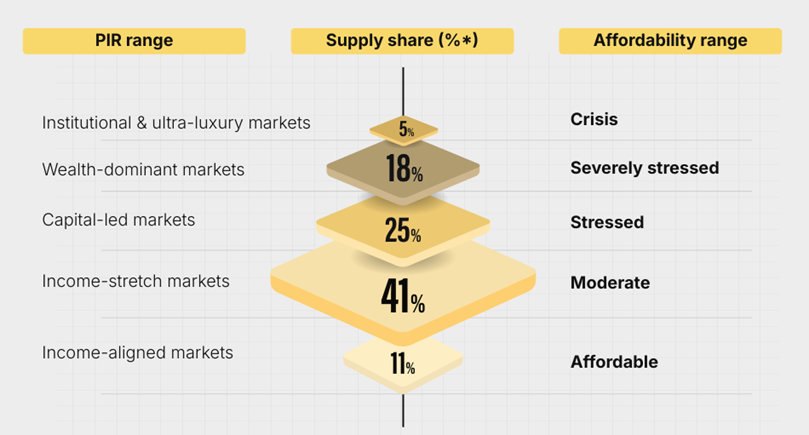
value for 3BHK buyers. It points out that only 11% of new housing supply
currently falls within the affordable segment, while the remaining 89% is concentrated
in markets marked by elevated EMI burdens. Of this, 41% lies in
‘income-stretched’ zones, where financial stress on households begins to
intensify sharply.
City-wise
analysis shows Bengaluru as the most balanced market, with incomes broadly keeping
pace with property prices across corridors. In contrast, NCR and the Mumbai
Metropolitan Region exhibit sharp corridor-level disparities, making location
choice a decisive factor for buyers. Hyderabad, despite being a high-growth
market, has witnessed prices outstripping income growth, pushing most
residential hubs into high-stress categories. Pune, a preferred destination for
young professionals, remains wealth-dominated in its core areas, compelling
buyers to look towards peripheral locations for 3BHK affordability. The report
notes that selecting the right micro-market can translate into savings of ₹30–60 lakh, as central and
premium zones increasingly serve as wealth-preservation or capital-parking
destinations.
The
findings are based on an analysis of 10,500 RERA-registered 3BHK units launched
between 2024 and 2025 across 44 micro-markets in Bengaluru, Hyderabad, Mumbai
Metropolitan Region, NCR — including Noida, Gurugram and Greater Noida — and
Pune. The report offers a structured buyer playbook segmented by income
cohorts, with tailored guidance for first-time buyers, mid-income upgraders,
and high-net-worth individuals and investors.
Affordability
has been assessed using the price-to-income ratio (PIR), an OECD-referenced
metric that measures the number of years of household income required to
purchase a 3BHK. Based on this framework, markets are categorised as
income-aligned, income-stretched, capital-led, wealth-dominant, and
institutional or ultra-luxury.
The data indicate that 48% of
3BHK supply launched in the past year falls within stressed, severely stressed,
and crisis categories, where higher-priced segments tend to deliver stronger
returns. Developer profit margins in these markets range between 45–50%,
compared with 15–18% in income-aligned segments. “This concentration of premium
supply has coincided with a post-pandemic shift in buyer preferences towards
larger, amenity-rich homes by reputed developers. At the same time, a surge in
high-net-worth individuals in a favourable economic environment has placed 3BHK
affordability under significant pressure,” said Tanuj Shori, Founder and CEO,
Square Yards.