THEBUSINESSBYTES
BUREAU
NEW
DELHI, OCTOBER 6, 2026
Developing
affordable, accessible and cost-effective healthcare solutions presents both a
challenge and an opportunity for premier institutions like the All India
Institute of Medical Sciences (AIIMS), President Droupadi Murmu said on
Tuesday, stressing that providing quality healthcare at an affordable cost was
a collective responsibility.
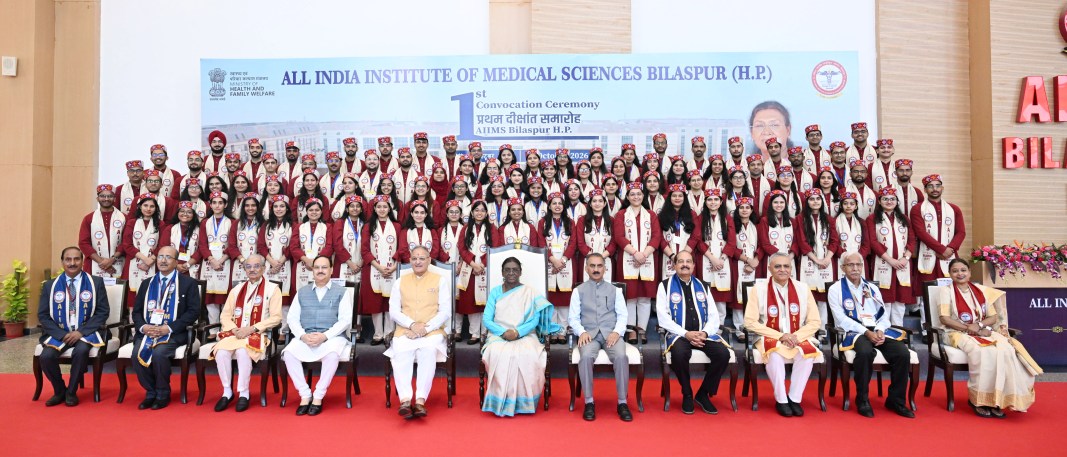
Addressing the first
convocation of AIIMS Bilaspur in Bilaspur, Himachal Pradesh, the President said
institutions such as AIIMS had a crucial role to play in ensuring that citizens
remained healthy and were able to contribute to the nation’s progress to their
full potential.
“The primary objective of the medical
profession should be to serve humanity,” Murmu said, underlining the importance
of empathy and compassion in medical practice. A person approaching a doctor,
she said, carried not only the fear and uncertainty associated with illness but
also hope.
While medical
knowledge and professional skills were essential to treating a patient, the
empathetic and compassionate behaviour of doctors could give patients the
courage to confront their illness, she said. She urged medical professionals to
combine sensitivity and compassion with the pursuit of excellence in their
profession.
The President
described quality medical care at minimal cost as the hallmark of AIIMS, saying
the institution represented, for people across the country, access to medical
treatment by some of the nation’s most competent doctors.
She noted that
several AIIMS had been established across different parts of the country with
the twin objectives of enabling a larger number of people to benefit from the
public trust associated with the institution and providing more meritorious
students access to top-tier medical education so that they could serve the
nation.
AIIMS Bilaspur, Murmu
said, had a special responsibility because of its geographical location.
Ensuring timely and quality healthcare to people living in remote and
difficult-to-reach areas of Himachal Pradesh posed a multi-faceted challenge,
she said.
The institution, she
stressed, must emerge as a premier centre for advanced tertiary healthcare and
contribute to strengthening healthcare delivery in the State’s hilly regions.
The President called
for greater use of telemedicine and specialist consultations for remote
populations, along with systematic training of medical personnel and deployment
of the latest technologies. Such measures, she said, could help bridge
geographical barriers and improve access to specialised healthcare in
mountainous areas.
Murmu also drew
attention to the financial burden that serious illnesses could impose on
ordinary families. For vulnerable sections of society, the cost of medical
treatment could become a major source of hardship, she said.
She pointed to the
Government of India’s Ayushman Bharat–Pradhan Mantri Jan Arogya Yojana, under
which eligible families receive health insurance cover of up to ₹5 lakh per family per year, as an
important measure to ease this burden.
At the same time, the
rising cost of medical equipment and medicines remained a serious challenge for
patients and their families, she said.
Against this backdrop, she urged premier medical institutions to look beyond conventional healthcare delivery and contribute to the development of solutions that were affordable, accessible and cost-effective.
The President said that innovation in healthcare, combined with compassion and professional excellence, could help ensure that the benefits of medical advancement reached a wider section of society. Such efforts would not only improve public health but also enable citizens to participate more fully in the country’s development, she said.