
THEBUSINESSBYTES BUREAU
MUMBAI, NOVEMBER 23, 2026
Employees in India are increasingly embracing artificial intelligence
(AI) and seeking opportunities for skill development, even as their loyalty to
employers becomes more conditional on job satisfaction, career growth and
meaningful work, according to a global study by employee benefits and
engagement company Pluxee.
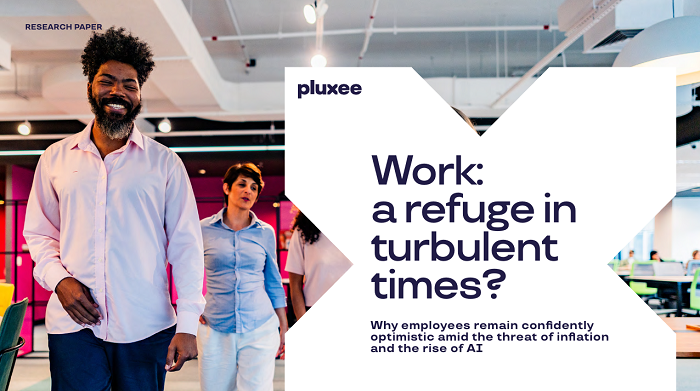
The study, titled Work: A Refuge
in Turbulent Times?, released globally in September 2026, surveyed
11,000 employees across 14 countries, including more than 1,000 respondents in
India. It highlights changing workplace priorities, growing employee
expectations and the evolving relationship between organisations and their
workforce.
A key finding is that 83 per cent of Indian employees have a positive
attitude towards the use of AI at work, significantly higher than the global
average of 65 per cent. Further, 67 per cent of Indian respondents said they
love AI, compared with 40 per cent globally.
The findings also indicate that 51 per cent of Indian employees believe
AI will positively transform the nature of their jobs, making work more
interesting and less routine, against 42 per cent globally.
"Indian employees are among the most optimistic about AI and the
most connected to their skills training, especially in AI. For Indian
organisations, the message is clear. Engagement is a two-way street, and
employees expect their employers to invest in them in return," Abhijit
Dey, Country Managing Director, Pluxee India, said.
The report identifies three emerging paradoxes in employee engagement.
While work is becoming less central to employees' lives, their emotional
connection with their organisations is strengthening. Despite financial
pressures, employees are increasingly willing to leave jobs that no longer
interest them. Meanwhile, AI, despite its potential to disrupt employment, is
generating more enthusiasm than apprehension.
Globally, 87 per cent of employees said they love or like their
companies, an increase of four percentage points from 2025. In India, the
proportion is considerably higher at 95 per cent.
However, this growing organisational connection does not necessarily
translate into unconditional loyalty. The proportion of employees globally
intending to remain with their organisations as long as their jobs remain
interesting has increased by six percentage points to 33 per cent. In India,
the figure stands at 42 per cent, up 12 percentage points from the previous
year.
The study also highlights the growing trend of measured engagement,
wherein employees engage with work more deliberately while protecting personal
boundaries, individual values and work-life balance. Globally, 38 per cent of
employees follow this approach, up five percentage points from 2025. In India,
the figure is 21 per cent, registering a six-percentage-point increase.
Financial uncertainty continues to weigh heavily on employees, with
inflation and purchasing power emerging as the biggest concerns. Around 70 per
cent of respondents globally cited rising prices and cost-of-living pressures
as their primary worry, compared with 68 per cent in India. Nearly 29 per cent
of Indian employees said they could not stop thinking about these financial
concerns.
Interestingly, job satisfaction remains higher than overall life
satisfaction globally, with scores of 7.6 and 7.3, respectively, on a 10-point
scale. In India, both job and life satisfaction registered a score of 8.1.
The report also points to differences in employee expectations across
markets. While global employees prioritise well-being and working conditions
(35 per cent), recognition (33 per cent) and employee benefits complementing
salaries (29 per cent), Indian employees place greater emphasis on professional
development.
Developing skills through training, particularly in AI, emerged as the
top HR priority for Indian employees, cited by 35 per cent of respondents.
Career development, flexibility and better management followed at 29 per cent
each. Well-being and working conditions, recognition and employee benefits were
also important priorities.
The study further found that 40 per cent of employees globally are
confident that AI will not make their jobs disappear, while 42 per cent expect
the technology to transform their roles positively. Among Indian respondents,
30 per cent expressed confidence about job continuity, while 51 per cent
anticipated a positive transformation of their work.
The findings suggest that employees are increasingly taking
responsibility for acquiring AI skills, with 39 per cent of regular AI users
globally saying they learn to use the technology independently, while only nine
per cent rely on managers and an equal proportion on colleagues.
Conducted by Ipsos in May 2026, the study covers Belgium, Brazil, Chile, Colombia, France, Germany, India, Italy, Mexico, Romania, Spain, Turkey, the UK and the US. Its findings were analysed by public policy expert Jean-Baptiste Barféty and Antoine Solom, Senior Consultant at FOCUS.
The report concludes that organisations must convert employees' enthusiasm for AI into tangible improvements in efficiency, workplace well-being and job satisfaction, while investing in skills, recognition and career opportunities to sustain engagement and retain talent.