
THEBUSINESSBYTES BUREAU
VELLORE, NOVEMBER 23, 2026
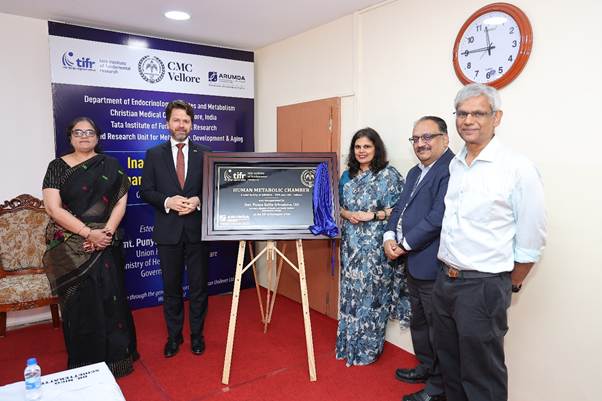
India’s first dedicated Human Metabolic Chamber Facility was inaugurated
at Christian Medical College (CMC), Vellore, on Monday, marking a significant
step towards strengthening indigenous research into nutrition, diabetes,
obesity and other metabolic disorders.
Union Health Secretary Punya Salila Srivastava, who inaugurated the
facility, called for robust, India-specific scientific research to better
understand the country's unique metabolic risk factors and generate evidence to
strengthen preventive healthcare.
Established through a collaboration between the Tata Institute of
Fundamental Research (TIFR) and CMC Vellore, the state-of-the-art facility is
expected to advance research into human metabolism by enabling scientists to
study how the body utilises energy, fats and carbohydrates under different
conditions, including meals, physical activity and sleep.
Addressing the gathering, Srivastava congratulated TIFR, its Advanced
Research Unit on Metabolism, Development and Aging (ARUMDA), and CMC Vellore
for the initiative, while acknowledging the Department of Atomic Energy for
supporting the collaboration.
She emphasised that India's diverse population has distinct nutritional
and metabolic risk profiles, making it essential to generate scientific
evidence rooted in the country's own health conditions rather than relying
solely on research findings from other countries.
The Human Metabolic Chamber is a room-sized calorimeter that measures
oxygen consumption and carbon dioxide production while a volunteer lives, eats
and sleeps inside the facility for 24 hours or longer. These measurements help
determine total energy expenditure and assess how the human body uses fat and
carbohydrates during different activities and physiological states.
The facility will complement ARUMDA's National Analytical Facility for
Nutrition and Metabolism Research, established last year, allowing researchers
to integrate molecular and biochemical measurements with data on the body's
energy utilisation.
The collaboration also builds on CMC Vellore's clinical expertise in
diabetes and other endocrine and metabolic disorders, including earlier studies
on insulin sensitivity and energy expenditure among individuals with a history
of undernutrition and low birth weight.
The facility has been established with funding from the Department of
Atomic Energy and corporate social responsibility support from Hindustan
Unilever Limited, with technical guidance from NUTRIM at Maastricht University
and network support from the Embassy of the Kingdom of the Netherlands in
India.
Highlighting the government's commitment to preventive healthcare,
Srivastava said 1.87 lakh Ayushman Arogya Mandirs are providing comprehensive
primary healthcare services, including population-based screening for
non-communicable diseases and three types of cancers.
She said community-based assessment of all individuals above 30 years of
age is being undertaken to facilitate early detection and timely intervention.
The country has also strengthened its network of specialised healthcare
services, with more than 781 district NCD clinics and 6,489 NCD clinics at
Community Health Centres providing follow-up services and ensuring continuity
of care, she added.
Srivastava further highlighted the role of Rashtriya Bal Swasthya
Karyakram (RBSK) 2.0 in identifying children at risk of health complications at
an early stage. Five additional diseases, including chronic obstructive
pulmonary disease (COPD), stroke and chronic kidney disease (CKD), will also be
brought under the National Programme for Non-Communicable Diseases.
Referring to Prime Minister Narendra Modi's call for a 10 per cent
reduction in oil consumption, the Health Secretary said the government has launched
several initiatives, including Sugar and Oil Boards, awareness programmes in
schools and the 'Aaj Se Thoda Kam' campaign to encourage healthier dietary
habits.
She said awareness activities are being expanded through social media,
radio and video-based communication, while yoga and wellness programmes have
been integrated into the services offered at Ayushman Arogya Mandirs.
More than 7.8 crore cumulative yoga sessions have been conducted at these
health facilities so far, reflecting the growing emphasis on lifestyle
modification and preventive healthcare, she added.
Srivastava also pointed to the role of technology in promoting informed
food choices, noting that institutions such as ICMR-National Institute of
Nutrition (ICMR-NIN) are developing innovative solutions, including an
artificial intelligence-powered tool to help consumers understand the
nutritional value of packaged food products.
Calling for stronger institutional partnerships, she urged TIFR, ARUMDA
and CMC Vellore to work closely with the Ministry of Health and Family Welfare
and other national institutions to develop a focused research agenda addressing
India's pressing health priorities.
She also highlighted the potential of the Pan-AIIMS Research Consortium
to collaborate with specialised research facilities such as the Human Metabolic
Chamber to strengthen the country's research ecosystem and build reliable,
evidence-based national datasets.
The programme was attended by CMC Vellore Director Prof Biju George, TIFR Director Prof Jayaram Chengalur, BRIC-Centre for DNA Fingerprinting and Diagnostics Director Prof Ullas Kolthur, ARUMDA-TIFR Director Prof Mahendra Sonavane, CMC Vellore Stem Cell Centre Head Prof Nihal Thomas, and Health Counsellor at the Embassy of the Kingdom of the Netherlands Nico Schiettekatte.
Representatives of Hindustan Unilever Limited, Prof Felix Jebasingh of the Department of Endocrinology, Diabetes and Metabolism at CMC Vellore, and several faculty members and officials were also present.