
THEBUSINESSBYTES BUREAU
NEW DELHI, FEBRUARY 17, 2026
Artificial Intelligence (AI) has moved from being a futuristic concept to
a foundational requirement across industries and governance, Union Minister Dr.
Jitendra Singh said on Tuesday while highlighting the growing economic and
strategic significance of India’s first government-owned sovereign large
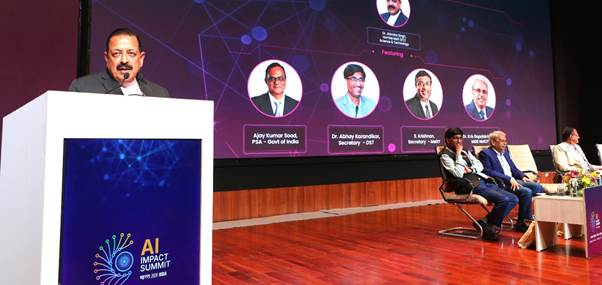
language model initiative, BharatGen. Addressing the session on “BharatGen
Models: Vision and Technical Execution 2026” at Bharat Mandapam during the
Global AI Summit, the Minister underscored that AI is now integral to
productivity, competitiveness and public service delivery across sectors.
The Minister lauded BharatGen as a landmark step in India’s technological
self-reliance, describing it as a sovereign multilingual and multimodal AI
stack designed specifically for the country’s socio-cultural and linguistic
landscape. Unlike global large language models, BharatGen reflects a
government-supported approach aimed at ensuring data sovereignty, secure
deployment and inclusive access for diverse user groups. He noted that the
initiative signals an early and proactive policy response to the global AI
race, positioning India as both a technology creator and a responsible digital
economy.
 BharatGen is being implemented through a consortium led by the TIH
Foundation for IoT and IoE at IIT Bombay, with participation from IIIT
Hyderabad, IIT Hyderabad, IIT Mandi, IIT Kanpur, IIM Indore and IIT Madras. The
project is funded by the Department of Science and Technology under the
National Mission on Interdisciplinary Cyber-Physical Systems with ₹235 crore,
alongside support from the India AI Mission of MeitY with an outlay of ₹1058 crore. The Minister
described the initiative as a “whole-of-science, whole-of-government and
whole-of-nation” model that integrates academia, industry and public
institutions.
BharatGen is being implemented through a consortium led by the TIH
Foundation for IoT and IoE at IIT Bombay, with participation from IIIT
Hyderabad, IIT Hyderabad, IIT Mandi, IIT Kanpur, IIM Indore and IIT Madras. The
project is funded by the Department of Science and Technology under the
National Mission on Interdisciplinary Cyber-Physical Systems with ₹235 crore,
alongside support from the India AI Mission of MeitY with an outlay of ₹1058 crore. The Minister
described the initiative as a “whole-of-science, whole-of-government and
whole-of-nation” model that integrates academia, industry and public
institutions.
From a business and economic standpoint, BharatGen’s multimodal
capabilities are expected to unlock new opportunities across governance,
healthcare, education, agriculture and legal services. The platform includes
text-based large language models, speech technologies such as automatic speech
recognition and text-to-speech, and document vision-language systems. These
capabilities are being tailored for India-centric use cases, particularly in
linguistically diverse and underserved markets, enabling scalable digital
solutions for both public and private sectors.
Dr. Singh highlighted the release of domain-specific fine-tuned models
including Ayur Param for Ayurveda, Agri Param for agriculture and Legal Param
for the Indian legal ecosystem. He also referred to the launch of the Param-2
text foundation model in 22 scheduled Indian languages with 17 billion
parameters, Shrutam speech-to-text models in 12 languages, Sooktam
text-to-speech models and Patram document models under the DocBodh framework.
These developments, he said, create a strong foundation for AI-led innovation,
enterprise applications and startup ecosystems focused on vernacular
technologies.
Emphasising market relevance, the Minister noted that India’s linguistic
diversity extends far beyond the 22 scheduled languages, creating a vast
opportunity for AI-driven digital services in regional languages. Expanding
datasets to include dialects and widely spoken local languages will be critical
for sectors such as digital health, financial inclusion, agri-tech and citizen
services, thereby widening the addressable market for AI-enabled businesses.
He further pointed out that BharatGen has transitioned into a Section-8
company, the BharatGen Technology Foundation, enabling national-scale
operations with a structured governance model while ensuring data and model
sovereignty through initiatives such as Bharat Data Sagar. This institutional
framework is expected to facilitate industry partnerships, commercial
deployments and innovation-led investments in the AI value chain.
Calling for a shift in organisational mindset, Dr. Singh urged both
public and private sectors to adopt collaborative approaches to emerging
technologies rather than operating in silos. He reiterated that the government
will continue to support innovation through policy facilitation, early-stage
funding and openness to private participation, ensuring that India remains
globally competitive in AI development and deployment.
The session featured detailed technical and ecosystem presentations by BharatGen leadership and participating institutions, along with addresses from senior officials of MeitY, DST and the National Mission on Interdisciplinary Cyber-Physical Systems. An MoU between BharatGen and the IIT Bombay Heritage Foundation was also exchanged in the Minister’s presence.
Concluding, Dr. Jitendra Singh said BharatGen marks a new phase in India’s AI journey by combining sovereign capability, collaborative execution and inclusive design, and will play a decisive role in building a robust national AI infrastructure aligned with the vision of Viksit Bharat while opening significant avenues for business growth and digital economy expansion.