THEBUSINESSBYTES BUREAU
NEW DELHI, FEBRUARY 20, 2026
"Artificial Intelligence (AI) can substitute everything on this
planet, but it cannot substitute integrity. Artificial Intelligence can
transform systems, improve efficiency and expand access, but it cannot replace
human integrity".
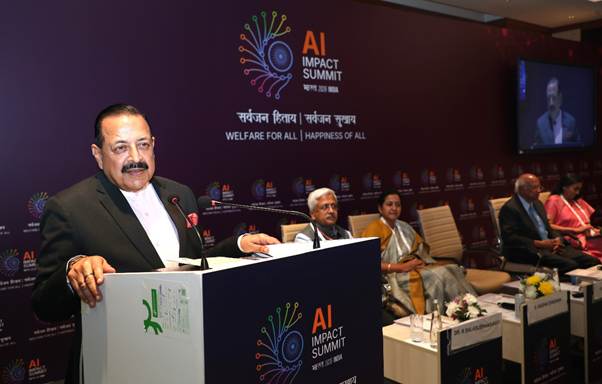
With this powerful assertion, Union Minister of State (Independent
Charge) for Science & Technology; Earth Sciences; and Minister of State in
PMO, Personnel, Public Grievances, Pensions, Atomic Energy and Space, Dr. Jitendra
Singh delivered the keynote address at the “AI Impact Summit 2026 India” at
Bharat Mandapam here on Friday. The session, titled “AI for Viksit Bharat: The
Capacity Building Imperative,” brought together policymakers, administrators
and domain experts to deliberate on the convergence of governance, capacity
building and Artificial Intelligence.
 Addressing the gathering, Dr. Jitendra Singh invoked the Mantra
"MANAV" cited by Prime Minister Narendra Modi in his address
yesterday, underscoring the importance of a human-centric approach in the
deployment of AI. He described governance and capacity building as dynamic and
continuous processes that must evolve in tandem with the rapid pace of
technological change. In an era marked by swift transitions, he observed,
institutions must constantly upgrade themselves to remain future-ready and
responsive.
Addressing the gathering, Dr. Jitendra Singh invoked the Mantra
"MANAV" cited by Prime Minister Narendra Modi in his address
yesterday, underscoring the importance of a human-centric approach in the
deployment of AI. He described governance and capacity building as dynamic and
continuous processes that must evolve in tandem with the rapid pace of
technological change. In an era marked by swift transitions, he observed,
institutions must constantly upgrade themselves to remain future-ready and
responsive.
Artificial Intelligence, he said, has emerged as an inescapable reality
across sectors and must be integrated meaningfully into public systems to
enhance outcomes. At the same time, he stressed that technology should remain
an enabler rather than an end in itself.
The Minister said the most encouraging feature of India’s transformation
journey is the presence of political leadership willing to embrace futuristic
as well as future-ready ideas. Recalling that concepts such as AI-driven
governance would have been inconceivable in official discourse a decade and a
half ago, he credited Prime Minister Narendra Modi’s reform-oriented approach
for creating an enabling ecosystem where innovation and governance reforms move
in parallel.
Highlighting administrative reforms undertaken over the last decade, Dr.
Jitendra Singh spoke about the removal of nearly 2,000 outdated rules that had
outlived their relevance. Many of these regulations, he noted, were framed for
a different era and could not have anticipated the scale of today’s
technological advancements. The simplification of procedures, including the
elimination of unnecessary attestations and redundant practices, reflects a
decisive shift towards trust-based governance.
He explained that the Capacity Building Commission was conceptualised to
institutionalise continuous learning within the civil services. In a rapidly
evolving ecosystem, he said, public servants must not only acquire new skills
but also develop the ability to keep learning and adapting. The blending of
best practices from both public and private sectors, he added, has strengthened
governance reforms and contributed to building more agile and responsive systems.
Referring to the concept of Digital Public Goods (DPG), Dr. Jitendra
Singh said that while the terminology may be new, the underlying philosophy
remains rooted in public good and citizen-centric governance. From the outset,
the government has pursued the vision of “maximum governance, minimum
government,” with a focus on transparency, accountability and ease of living.
Technology, he reiterated, serves as a facilitator of these goals.
Sharing practical experiences, the Minister spoke about the evolution of
the CPGRAMS grievance redressal system. While digital processing and AI tools
helped achieve high disposal rates, citizen satisfaction did not always
correspond to the numbers. This prompted the introduction of a human interface
alongside AI-driven mechanisms, demonstrating that the most effective approach
is a hybrid model that combines Artificial Intelligence with Human
Intelligence.
Dr. Jitendra Singh cited another example from the health sector, where
AI-assisted telemedicine services function in conjunction with physical
consultations. While AI improves efficiency and expands reach, the presence of
a human doctor reassures patients and fosters trust. Such hybrid models, he
said, are particularly suited to India’s diverse social and linguistic
landscape, where technology must adapt to local realities.
Referring to India’s growing global recognition in the field of AI,
including appreciation from international institutions, he said that while
global benchmarks are important, solutions must be tailored to Indian
conditions. Inclusive scaling and wider adoption remain central to the success
of digital capacity-building initiatives.
The Minister also elaborated on the governance “MODEL” framework articulated by Prime Minister Narendra Modi — Moral and Ethical Systems; Accountable Governance; National Solvency; Accessible and Inclusive Systems; and Legitimacy and Validity. He observed that true capacity building lies not in memorising acronyms but in internalising their essence and translating them into actionable outcomes.
Concluding his address, Dr. Jitendra Singh said that the real test of technological advancement lies in its ethical application. Artificial Intelligence, he remarked, can transform systems, improve efficiency and expand access, but it cannot replace human integrity. The responsibility to use technology wisely ultimately rests with individuals as well as institutions.