
THEBUSINESSBYTES
BUREAU
NEW
DELHI, APRIL 15, 2026
Declaring
that Artificial Intelligence is not merely a technological advancement but a
transformative human revolution, Vice President C. P. Radhakrishnan on
Wednesday underscored the profound impact of AI on governance, society, and
human progress.
Addressing
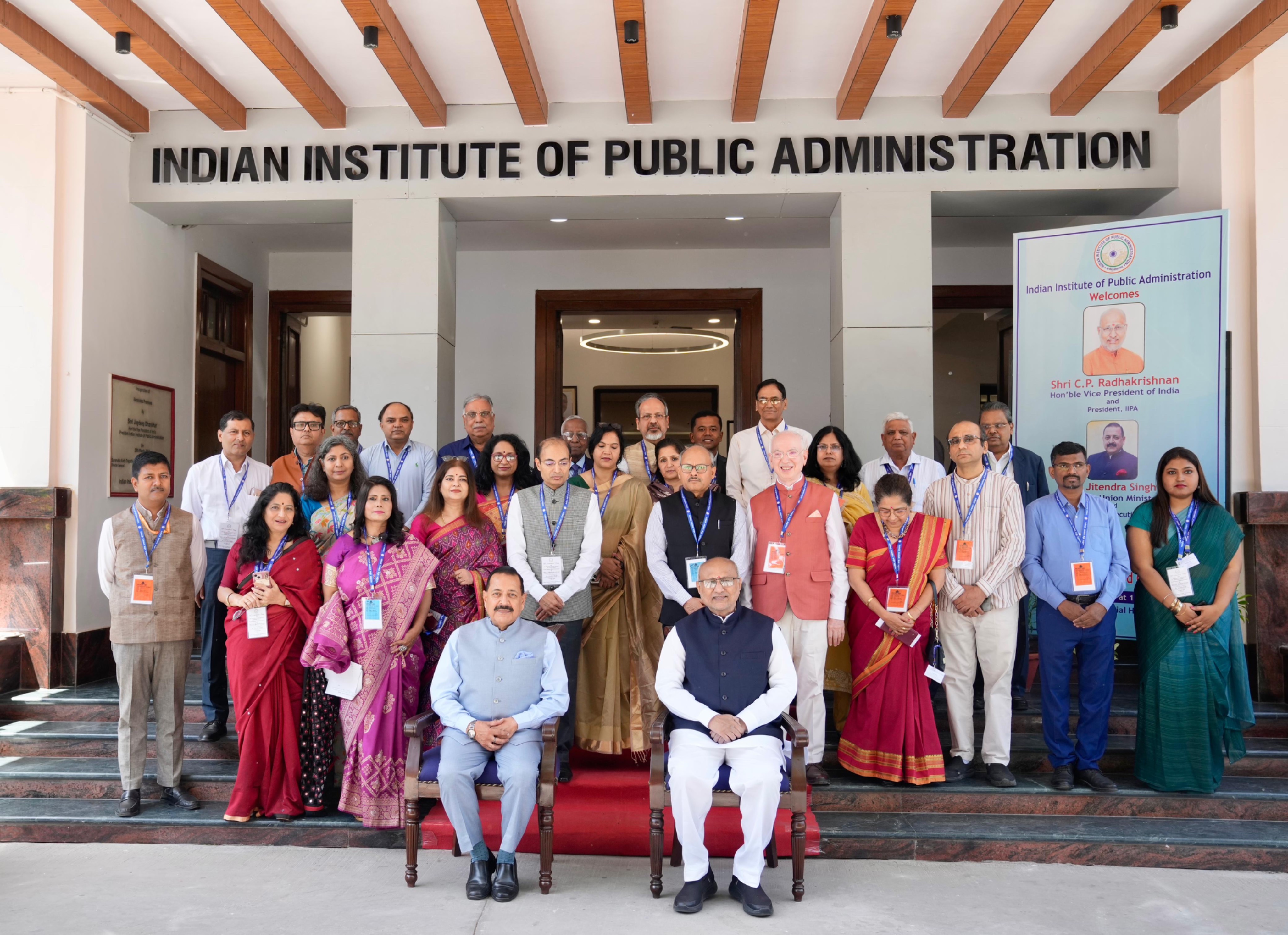
the 72nd Founders’ Day celebrations of the Indian Institute of Public
Administration in New Delhi, the Vice President delivered the 5th Dr. Rajendra
Prasad Annual Memorial Lecture on the theme “AI for Good Governance.” He
described the ongoing era as one of the most exciting phases in human history,
marked by the rise of intelligent systems capable of learning and decision-making,
fundamentally reshaping governance.
Paying
rich tributes to Rajendra Prasad, he highlighted the former President’s
unwavering commitment to moral values, simplicity, and public service.
Recalling Dr. Prasad’s principled leadership, including his visit to the
Somnath Temple despite opposition, the Vice President said his life remains a
timeless example that governance is about service, not power.
 Emphasizing
the transformative potential of AI, Radhakrishnan noted that it is redefining
governance by equipping governments with unprecedented capabilities to
understand and serve citizens more effectively. He stressed that governance
must go beyond systems and regulations to truly empower people, ensuring
inclusivity and leaving no one behind.
Emphasizing
the transformative potential of AI, Radhakrishnan noted that it is redefining
governance by equipping governments with unprecedented capabilities to
understand and serve citizens more effectively. He stressed that governance
must go beyond systems and regulations to truly empower people, ensuring
inclusivity and leaving no one behind.
Highlighting
AI’s role in India’s journey towards a developed nation by 2047, he said the
technology is making governance faster, smarter, and more transparent. It is
enabling targeted delivery of welfare schemes, reducing leakages, and
strengthening the vision of inclusive development. He added that AI is bridging
the gap between policy and people by enabling data-driven decision-making and
enhancing public trust.
 The
Vice President lauded India’s strides in AI under the leadership of Prime
Minister Narendra Modi, noting that the country is emerging as a global leader
in leveraging AI for inclusive governance. He highlighted how AI-powered
platforms are breaking language barriers in a diverse nation and pointed to
initiatives like BHASHINI, which are making governance more accessible through
multilingual interfaces.
The
Vice President lauded India’s strides in AI under the leadership of Prime
Minister Narendra Modi, noting that the country is emerging as a global leader
in leveraging AI for inclusive governance. He highlighted how AI-powered
platforms are breaking language barriers in a diverse nation and pointed to
initiatives like BHASHINI, which are making governance more accessible through
multilingual interfaces.
Elaborating
on sectoral applications, he said AI is revolutionizing healthcare through
AI-assisted TB screening, portable diagnostic tools, and telemedicine platforms
such as eSanjeevani, ensuring healthcare reaches even remote areas. Similar
transformative impacts are being witnessed in agriculture, MSMEs,
cybersecurity, judiciary, and administrative systems.
The
Vice President also highlighted India’s strong global standing in AI, citing
its high ranking in global AI vibrancy indices. He referred to key initiatives
such as the India AI Mission and the Anusandhan National Research Foundation,
aimed at strengthening the country’s innovation ecosystem. He also mentioned
the recent AI Impact Summit in Delhi, where global leaders acknowledged India’s
growing leadership in the domain.
Encouraging
youth and professionals to embrace emerging technologies, he drew parallels
with early apprehensions about computers, noting that technological
advancements ultimately create new opportunities. He emphasized the importance
of building an AI-ready workforce through initiatives like the Skill India
Digital Hub, the National Education Policy, and Yuva AI.
Addressing
ethical concerns, Radhakrishnan cautioned that technological power must be
guided by responsibility. He stressed that AI must adhere to principles of
fairness, accountability, and ethics to ensure it serves humanity positively.
In his concluding remarks, the Vice President reiterated that Artificial Intelligence is a human revolution that must be harnessed for the greater good. He called upon all stakeholders to use AI as a tool for building a just, inclusive, and compassionate society, driven by wisdom, responsibility, and a shared vision for a better future.
Union Minister and Chairman of the IIPA Executive Council Jitendra Singh, Director General of IIPA Surendra Kumar Bagde, along with distinguished guests, faculty members, and participants, were present on the occasion.