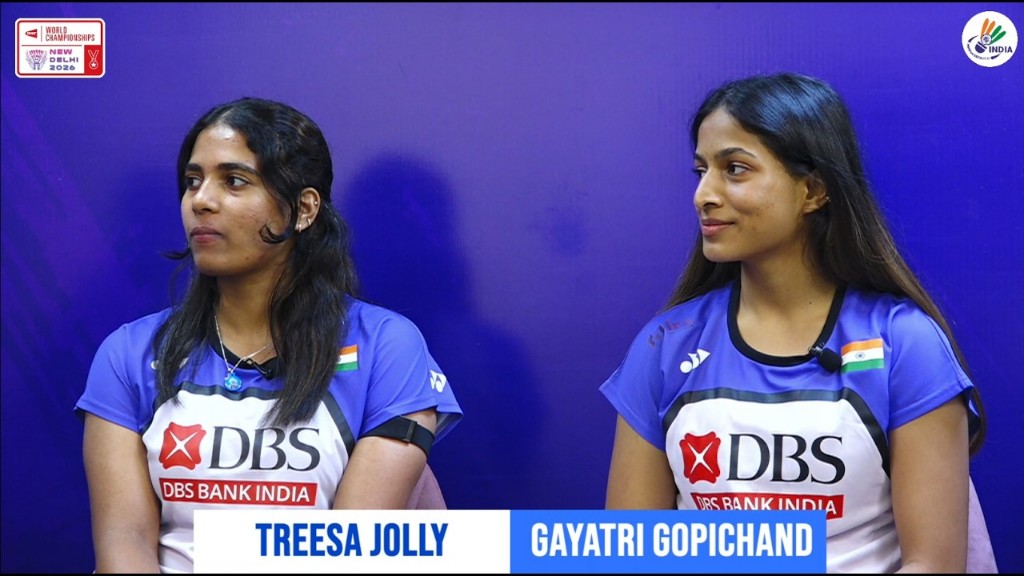
Treesa Jolly and Gayatri Gopichand
reflect on their emotional World Championships bronze, the injuries and
training tweaks that shaped their campaign, the role of their fathers and the
electric atmosphere in Delhi.
THEBUSINESSBYTES BUREAU
NEW DELHI, AUGUST 23, 2026
For
Treesa Jolly and Gayatri Gopichand, a bronze medal at the BWF World
Championships was more than a landmark achievement. It was the culmination of
an up-and-down journey marked by injuries, patient rehabilitation, tactical
adjustments and an unwavering belief in each other.
The
women's doubles pair secured the bronze at the Indira Gandhi Stadium in New
Delhi after a remarkable run in which they defeated three seeded pairs on their
way to the semifinals. The medal was especially meaningful because it came in
front of a packed home crowd—and after a long period in which injury had
threatened their rhythm and momentum.
In
an interaction with the Badminton Association of India's YouTube channel,
Treesa and Gayatri spoke about the emotions of winning a World Championships
medal, the pressure of carrying expectations, the influence of their fathers,
and the changes in their game that helped them make a deep run in Delhi.
On the moment they knew they had secured a World Championships medal
Gayatri
Gopichand:
Going into the quarterfinal, personally, I didn't have any expectations. I just
wanted to go there and give my 100 percent. We had just come back from a long
break and there had been a few ups and downs, so I didn't really know what was
going to happen.
After
the first set, it was tricky. In the second, we were down 7-10. We converted a
few points, took charge and changed our game plan. It worked in our favour.
Once we won that second set, we became super confident. We looked at each other
and thought, "I think we can do it." We were just one game away from
winning a medal.
We
trusted each other and played some really good badminton. At the end, I was
just so emotional. It was a pinch-me moment—"Is this really
happening?" I just started crying. The emotions were there throughout the
match and afterwards. Till the last point, it's not over. Once it was done, we
were like, "We made it."
Treesa
Jolly:
Getting a World Championships medal is almost a dream for us as partners. And
the fact that it happened at home makes it even more special. It was a
goosebumps moment.
We've
played so many tournaments and always given our 100 percent, but this one felt
different. There was such a mix of emotions. Gopi sir was sitting behind us and
guiding us throughout the match, telling us to stay calm.
Even
when we had match point and the lead, we were just waiting for the right moment
to express our happiness. We wanted to stay calm until the very end.
On the packed Delhi crowd and the feeling of playing a World
Championships semifinal at home
Gayatri: When we were
walking in for our semifinal, it was amazing. I've never felt anything like
that before. There were so many people. It was packed — it almost felt like a
cricket stadium.
It
felt amazing to play in front of that crowd. We've played some incredible
matches here and there is so much to learn from this week.
On the pressure of carrying the Gopichand name
Gayatri: Honestly, sometimes
on court, I do feel that pressure. I wouldn't say I don't. But there is also a
lot of guidance, and that's the better part of it.
When
I'm on court, there isn't much time to think about my father. There is already
so much happening inside the match. When I go off court, though, there are
people who tell me, "You are Gopi sir's daughter. You need to prove
yourself."
But
I think I'm much better at handling it now. There is pressure, but I've learnt
how to deal with it. When I'm on court, we're just enjoying ourselves. That's
what he tells me — just enjoy.
I
think the pressure is more for people outside. I don't feel it as much. We have
this chat where he asks me, "Do you feel pressurised because of
this?" And I'm like, "No, it's not that hard. I can deal with
it."
There
is always going to be some pressure, but over the years I've learnt how to
handle it.
On the role of Treesa's father, Jolly Mathew, in her journey from
Kannur
Treesa: My father was a
volleyball coach, and we had a volleyball court in our backyard. At that time,
a lot of players were taking up badminton, so he changed it into a badminton court
for me and my elder sister.
The
initial days were difficult. Badminton was an expensive sport and we had to
face a lot of financial struggles. But somehow, my father never made me feel
those pressures.
That
confidence gives you something else when your parents tell you that you have
the talent to play at that level. That support was always there from my
parents. They are so amazing in that regard. I am here because of my parents.
And
I think my father is the star. When I started playing, there was nothing in my
village. After the Commonwealth Games medal, I can now see so many courts.
Students come up to me and people are excited to play. Everyone plays in my
village now.
Before,
there was just a clay court. During the rainy season, we couldn't play. So my
father changed the clay court into a tarpaulin court. If I am here, it's only
because of him.
Even
my jump smash is possibly because of the volleyball drills my father made me do
when I started. In Class I, I used to do the volleyball jump serve, so I had
that strength.
My
sister also supported me a lot. And then there is my friend Varshini at the
academy, who took care of me like a parent for seven weeks when I was injured
and couldn't even go home.
On how their front-and-back court rotations have evolved
Gayatri: When Treesa was
injured, I just wanted to be fit. I wanted to be able to cover the backcourt
when she came back because I knew it wouldn't be easy for her to cover that
much area immediately after an injury.
So
I started doing a lot more backcourt work. I wanted to be fit enough to cover
for her. But it wasn't really needed because she came back stronger than ever.
And
in this tournament, I feel Treesa's net game was incredible. I had never seen
her net game at this level before.
Treesa: That's what we were
working on a lot during training. Even this morning, I was telling her,
"Bro, I always get that fear of going to the net."
I'm
not naturally as confident at the net because I tend to hit harder and be
aggressive. At the net, you have to be a little calmer.
Gopi
sir kept telling us during our sessions: just block, go to the net, but be
calm. The training system was designed that way. So when we came here and
played, I could actually see the difference.
It
made me believe that what we were doing in training was working. Against the
Japanese pair, when I took charge at the net and Gaya started hitting from the
backcourt, the rotation was really good. It helped us a lot.
We
could see that our opponents had no clue what was happening—who was going to
the front and who was going to the back. Earlier, our game had become a little
predictable.
On the training changes that prepared them for the World
Championships
Gayatri: Definitely. Once we
started playing together again after Treesa's injury recovery, there were only
a few very basic things we worked on: block, net, drive and smash.
Simple,
but very effective. We did those drills repeatedly—morning, evening, morning,
evening. I think we followed the same programme every day for two months.
After
every session, Gopi sir would ask us, "Does this make sense? Do you
understand what's happening?"
Treesa: I think that's one
of his good qualities. He comes and asks us how the session was going. As a
coach, Gopi sir has achieved almost everything, but he still has this attitude
of having a conversation with the players.
If
we have any doubts or questions, we can just go to him and clear them.
On dealing with injury and rehabilitation as a doubles pair
Gayatri: When Treesa was
injured, I just thought I had to practise and practise. Injuries disrupt your
rhythm and momentum, so I wanted to be fit and ready for when she came back.
I
knew Treesa was hurting. I think it was the first time she had suffered such a
serious injury. We just had to be patient with each other and trust each other —
on court, off court, anywhere.
Even
while she was injured, we kept talking. Once we got back together, we knew we
had to work harder.
She
has always been there for me whenever I've been injured. She has called me so
many times and said, "Kuch nahi hoga bhai, tum vapas aa, hum
khelenge." I think she's been a really good support.
Having
someone by your side at that time really helps you stay positive.
On the confidence gained from winning the Philippines International
Challenge before the World Championships
Gayatri: Even at the
Challenge level, the quality was pretty high. All the pairs were good. From the
quarterfinals onwards, I think we played three games in each match.
That
definitely brought some confidence because winning a third set after a break is
important. After the final, once we won, it gave us momentum as well.
On
taking confidence from their performances against the top Chinese pairs
Treesa: Yesterday's
performance showed that we were close to beating them. I feel it's just a
matter of time. We want to take this confidence and continue.
Being
here on the global stage and playing at this level is important for us. The
matches we played this week were so intense and of such high quality.
Getting
opportunities to play those kinds of matches — and winning and pulling off
those results — is a big confidence boost for us.
On what they will take away from an unforgettable week
Gayatri: It has been so
eventful — with the Arjuna Award, the bronze medal and the World Championships
happening in Delhi.
When
we were walking in for our semifinal, the feeling was amazing. I've never felt
it before. There were so many people and it was packed, almost like a cricket
stadium.
We've
played some amazing matches here and there is so much to learn from. We're
still improving and still learning.
I
also want to thank my physios, trainers and coaches. They've worked so, so hard
to get us into this form. I'm just super happy with everything that has
happened this week and so grateful for everything.
Finally, the nickname they prefer
Treesa & Gayatri: "TreGa" is nice. We
prefer that only. We're able to understand that it's about us!